


Too many elders receive care outside Nunavut, NTI says
John Amagoalik’s struggle to stay in territory brings issue into ‘sharp focus,’ says Inuit organization
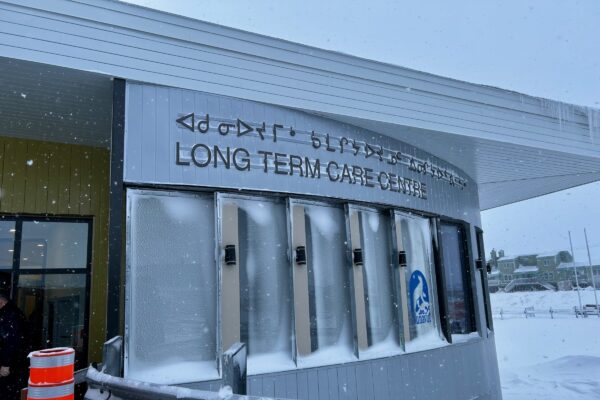
There are only a handful of long-term care homes for elders in Nunavut, with the Rankin Inlet location, opened last year, being the only one that provides care for patients with the most complex needs. (File photo by Arty Sarkisian)
This story was updated on Wednesday, Sept. 9, at 3 p.m. ET.
Nunavut Tunngavik Inc. says long-term care for elders in the territory has been inadequate for years, an issue that John Amagoalik’s situation has brought “into sharp focus.”
But the association tasked with making sure promises made in the Nunavut Agreement — which Amagoalik helped negotiate — are kept isn’t saying whether it plans to help the revered leader live out his final days at home.
Before coming back to Iqaluit in June, Amagoalik had been living at the Embassy West long-term care facility Ottawa. His loved ones raised money for his flight and some health care needs but said they were depending on the GN’s Health Department to fund Amagoalik’s care and housing needs in the long term.
The GN said its policies prevent funding privately arranged in-home care and housing through its long-term elder care programming. Now, with money running out, Amagoalik might have to leave Iqaluit again.
NTI declined requests for an interview with its president Gloria Uluqsi and sent a statement instead.
“Too many Inuit elders, including unilingual Inuktut-speaking elders, continue to receive care outside the territory, separated from their families, communities, language and homes,” said Uluqsi in the statement, sent Sept. 3.

She was responding to questions about whether NTI planned to help Amagoalik, for whom the organization is currently providing a rental unit at reduced rent.
Amagoalik, revered by many as the “Father of Nunavut,” dedicated decades of his life to advancing Inuit rights.
He served as the executive director of the Nunavut Land Claims Project starting in 1974, and after 1993 he led the land-claims settlement process with NTI, following the ratification of the Nunavut Land Claims Agreement Act. From 1999 onward, he also chaired the Nunavut Implementation Commission, the 10-member organization which eventually became Nunavut’s government.
“We would love to sit with the Government of Nunavut, the Health Department and NTI to have a discussion about how we can make this work. The alternative is that he will be sent back to Ottawa or to Rankin Inlet,” said Mark Stiles, a friend of Amagoalik. “He doesn’t want to do that.”
Anne Crawford, who has also been advocating for the family and is a lawyer involved with the Pairijiit Tigummiaqtikkut Elders Society, says she believes it’s the Nunavut government’s responsibility to find a solution and that she’s not familiar with any policy that would prevent the GN from contracting a private care provider in Iqaluit the same way it does with southern providers, such as Embassy West.
“What they’re saying is, ‘We never got around to building the policy and financial structures that would let us do what you’re asking us to do,’” she said.

“They’re building a three-seater bus and then telling us they don’t have room on the bus,” she added. “You should build a bigger bus.”
Nunatsiaq News requested an interview with Nunavut’s Health Minister, Janet Pitsiulaaq Brewster, to speak about the state of elder care in the territory, but the department sent a written statement instead.
There are care homes in Iqaluit and Arviat for those requiring lower to moderate levels of support, and ones in Cambridge Bay, Gjoa Haven, Igloolik and Rankin Inlet for elders with more complex needs, department spokesperson Charmaine Deogracias wrote. Only the care facility in Rankin Inlet provides care for those with the most complex needs.
Work is ongoing to expand long-term elder care in the Qikiqtaaluk and Kitikmeot regions.
“Until that capacity is operational, out-of-territory long-term care remains necessary when assessed needs cannot be met through services available in Nunavut,” Deogracias said in the email.

Crawford said in Amagoalik’s case, the services are available. The family says monthly costs for his care and housing are about $16,000 per month.
NTI, meanwhile, told Nunatsiaq News it’s actively working with the GN so that more elders can receive around-the-clock medical care within the territory.
“NTI has advocated for expanded after-hours home care services and is seeking updates on the outcomes of the GN’s home care review,” said Uluqsi in an emailed statement.
NTI has provided $15 million toward the renovation of care homes in Arviat, Gjoa Haven and Igloolik, she also noted, and has also provided $8 million to the Pairijiit Tigummiaqtikkut Elders Society for the development of an independent living complex for elders.
In 2024, the federal government approved $14 million over 10 years for NTI’s Indigenous Health Equity Fund, aimed at improving Indigenous people’s access to culturally safe health care services.
In June, the organization published a call for consultants to help guide its 10-year plan on how to use the money.
Clarification: This story has been updated to attribute statements from NTI to its president Gloria Uluqsi.
I agree completely with the broader point that Nunavut needs more elder-care capacity at home. But Nunatsiaq News continues to repeat the family’s claimed $16,000 monthly figure without providing the basic breakdown needed to make it a meaningful comparison.
So how much of the $16,000 is actually the cost of care?
Please do some investigative reporting and break it down: professional care (and what qualifications), housing, food, utilities, transportation, equipment and other living expenses. Then tell readers what is being subsidized separately by NTI or others.
Comparing a blended household budget to the full cost of a long-term-care placement is misleading if they aren’t paying for the same things.
There is a legitimate and important debate to have about bringing elder care home to Nunavut. But good policy starts with good information. Nunatsiaq should investigate the numbers being presented by John’s friends rather than simply repeating them.
If $16,000 really provides equivalent around-the-clock care for significantly less money, that is a model worth examining for all Nunavut elders. But show us the numbers first.
There is also another question missing from this discussion: why is Rankin Inlet not considered an acceptable option? Rankin is still in Nunavut and has a long-term care facility. If the objective is specifically to remain in Iqaluit rather than simply remain in Nunavut, that distinction matters and should be explained.
Some of the numbers don’t add up. Based on the 2023-2024 fiscal year, Embassy West was paid roughly $15,400 per month by the government of Nunavut for each elder. That cost includes not only room and board, but medical facilities, medical staff, care staff, special activities, and so on. Embassy West is a business, so some of that is profit as well, which is only fair. So what are they spending $16,000 a month on in Iqaluit?
Dear Before We Compare:
Interesting idea.
Wouldn’t it be lovely if the GN released all its costs for elder care.
So far we have heard zippo.
Let’s include the contract cost with Embassy, the transportation for family visits, the procurement costs, the GN LTC employees’ salaries, benefits and housing, their offices, the IT systems, the finance people who process the accounts. What would the total costs be?
That is exactly the point of my comment. The GN should release its costs, and the $16,000 figure being presented by the family and supporters should also be broken down.
But when is Nunatsiaq going to actually do the investigative journalism and dig into both sides?
At this point we are not getting much new information. We are getting the same figures, the same positions and the same debate repeated in a way that generates understandable anger, but does little to help readers understand what the real costs or alternatives actually are.
Journalism should go below the surface. ATIPP the full cost of out-of-territory care and what is included. Ask what Rankin Inlet costs and why it is or is not an option in this case (or why the family do not want it). Then examine the $16,000 being spent in Iqaluit: what portion is professional care, what qualifications are involved, and what portion is housing, food, transportation, equipment or other expenses? What is being subsidized separately?
Then compare the options on a like-for-like basis.
There is an important public-policy story here about whether Nunavut could provide better elder care closer to home and potentially do it for less money. But we are not going to learn anything from simply repeating competing claims and generating more outrage.
I expect the media to dig beneath the surface, test the claims on both sides and give readers new information.
And even if providing care in Nunavut ultimately costs more, there is a legitimate policy debate to have about whether we, as a territory, are willing to pay more to ensure Nunavummiut can receive care in Nunavut, closer to their families, communities and culture. That is a perfectly reasonable position.
But we cannot have an informed debate about whether the additional cost is worthwhile until we understand what the actual costs are on both sides.
Shameful,how inuit elders are treated,shame on the civil servants who wrote the policy in the GN, and if we had 1 politician in Nu,with backbone to call out the GN on this policy and change it
Nunavut needs to build more facilities to accommodate our elders (seniors homes). We need at least one in each of the three regions. Facilities that can house elders in their final years of life in reasonable comfort. Places where seniors with moderate to minimal medical needs can live in comfort and be able to have a active social life if desired. These need to be build by not only GN but by NTI and other Inuit organizations as it will be a long time before private business will undertake such projects.
It is absolutely terrible to have to ship seniors out of their communities (south) due to lack of proper safe housing in Nunavut.
NTI says??? How about they “say” how they help remedy this situation. One that has been going on for decades now. How about they “say” how they can take those tens of millions of dollars sitting in the bank and do something with them? How about they “say” what they and the other Inuit Organizations are going to do to make Nunavummiut’s lives BETTER! Try ‘saying” that!
Also to reinforce another commentator’s point. How about the GN releasing the cost per Senior to apply the current care system. How about some transparency, accountability, responsibility? Let Nunavummiut’s see it so they can understand if in fact the right decisions have been made or are being made. How about the Politicians elected to serve Nunavummiut actually do their job. Novel concept right?.
How about stop “saying” and get the GN and everyone else concerned working TOGETHER to fix the problems that every single Nunavummiut knows exists. Expect for the GN and the IOS’s it seems. The Premier’s Kumbaya words after being elected almost a year ago and his magnificent plan was, “Lets help each other”. Well Johnny?
It’s all very disheartening. How about they all stop passing the buck, pointing fingers, ignoring the problem, pretending like it’s someone else’s to fix and start fixing things for Nunavummiut. Try doing that for a change.
PSC
This has been a problem for Nunavut since even before April 1, 1999. The problem has only gotten worse as our Innait have managed to live longer lives over the past quarter of a century.
Hundreds of our elders have died in lonely and foreign environments down south since then.
It is deeply concerning that people only talk about this when this issue effects a famous Inuk. Today dozens and dozens of “ordinary” Elders that are so cherished, appreciated and missed by their extended families are in the same boat, and nobody in authority and power seems to want to talk about them, or advocate for them.
It is bitterly disappointing to those that have already lost their parent or grandparent in isolation, that it is only now that this comes “into sharp focus”. Really?
Can it be true that only Inuit that have received some public recognition are entitled to live out their golden years where they were born and lived?
It is actually ironic, given that our past Inuk leaders were the ones that, unto now, failed to consider or negotiate firm commitments for Inuit Elder Care from responsible authorities when they had the opportunity to represent us.
Problems Inuit face are not just problems when they happen to Inuit Elite.
When groups like NTI realize and respond consistently and vigorously to the real and pressing issues faced by ordinary Inuit, they may soon discover that they do not have to resort to paying Inuit to vote in their currently useless elections.
The Medical Travel offices can have a full audit. Also, the value and cost of Eldercare and what you get vs other options (buying a hotel to convert to a Residence (until enough are built in Nunavut)). Audit OSHNI. Medical travel stays are longer due to their disconnec. If/when they do their due diligence, it is fair. If they were on the ball, the cost of medical would decrease. Survey every single Medical pax: how many stay longer than necessary or travel for non existent appointments.
I strongly feel our Government need to stop spending money to other province like Ottawa why not spend the money in Nunavut its sad our elders are send to ottawa