


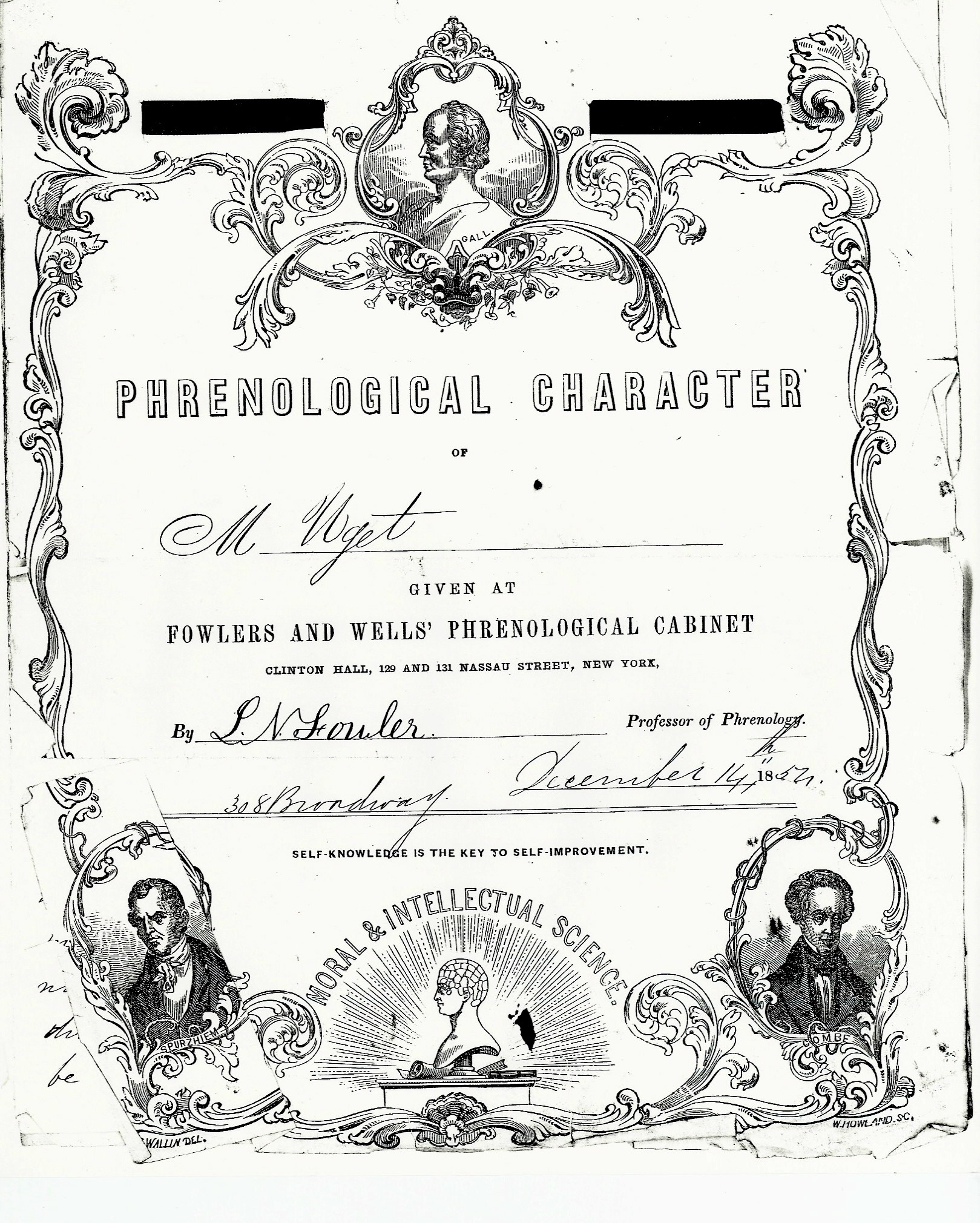
Uugaq was given a phrenological certificate after his examination. (From the Kenn Harper collection)
Uugaq visits a phrenologist
Second of two parts
One of the most bizarre aspects of Uugaq’s trip to New York was his visit to a phrenologist.
Phrenology was a pseudoscience very popular in the 19th century.
Developed in Germany around 1800 by a doctor, Franz Joseph Gall, its name comes from two Greek words meaning “mind” and “study.”
It held that there was a relationship between the attributes of the mind and the shape of a person’s head.
Phrenologists believed the brain was divided into areas of self-esteem, destructiveness, and so on. A trained phrenologist, they believed, could determine a person’s character, personality traits, even their tendencies toward criminality, by studying the shape of the head.
This was known as “reading bumps,” and it was quite fashionable to have one’s bumps read. Today, phrenology is discredited, and best practised late at night in bars, while very drunk.

On Dec. 14, 1854, Uugaq (identified as Mr. Uget), who was an Inuk hunter, visited the Fowlers and Wells’ Phrenological Cabinet, as the clinic was called, and was examined by Dr. Fowler himself, a professor of phrenology.
Fowler’s report tells us Uugaq’s head was “shaped somewhat like the European cranium” and that he was “less savage, revengeful and cruel, than the North American Indian.”
Whether the good doctor knew Uugaq’s marital history is unknown, but he went on to report, “He has more affection, friendship, love of wife and children, and interest in family and domestic enjoyment than the Indians generally have.”
(A contemporary New York newspaper that described Uugaq’s visit to the United States informed its readership that, “An Esquimaux is, in appearance, merely a short, fat Indian.”)
The report continued: “He is very fond of his wife” — it didn’t say which one — “and devotedly attached to children.”
He had “strong local attachment and interest in home as such.”

This was perhaps a natural observation to make about a man so far from home, and who might have been expected to be homesick.
The report continued:
“He does not develop his mind spontaneously, but dwells on subjects for a long time. He will be slow in maturing but will persevere in carrying out his plans and purposes. Combativeness is prominent, and he may be somewhat impulsive, but is not revengeful.
“Love of property is comparatively strong, but tact and duplicity, which is a peculiar characteristic of the Indian, is not prominent. He is naturally confiding and disposed to rely on the honesty and integrity of others. Is quite ambitious and very sensitive to the opinions of others; feels keenly everything said about him.”
Then, in apparent contradiction to some of the other qualities already mentioned, the doctor observed that Uugaq was “wanting in dignity, pride, manliness, self-love, and a haughty aspiring mind, but is firm, persevering, tenacious, unchanging.”

Continuing to check the bumps on Uugaq’s uncomprehending head, the doctor observed that he was “kind, generous, sympathetic and comparatively humane; is respectful and inclined to submit to law. But he is not particularly penitent and conscientious, although there is more of that faculty than we generally find in the savage head.”
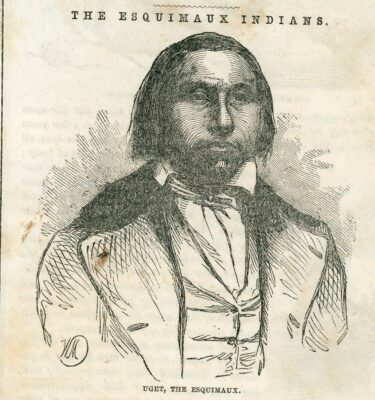
Uugaq was an Inuk hunter in his forties. (Illustration from Life Illustrated, Jan. 12, 1856)
Whether the doctor knew of the legendary Inuit ability to draw maps of familiar areas from memory is unknown, but he nonetheless reported, “The perceptive faculties are well developed. He has good observation — a good memory of forms and outlines — good talents to draw and copy — might make a good marksman — has an excellent memory of places and localities — and is very orderly and systematic; but has a poor memory of colours and events.”
Phrenology, apparently, could even discern one’s digestive properties, for the report noted, “He has a good appetite, and better digestion than the white man.”
His temperament was described as “digestive and arterial” — which must have meant something in phrenological jargon — and he had a “fair amount of muscular power and nervous energy.”
The bizarre visit over, Uugaq returned with Sidney O. Budington, a veteran whaler, to the serenity of Groton, Conn., to spend Christmas with the captain and his family and await the coming of spring and his return to the far North.
On April 11, 1855, Uugaq once again boarded the Georgiana with Capt. Budington, and returned to his wives in Frobisher Bay.
Taissumani is an occasional column that recalls events of historical interest. Kenn Harper is a historian and writer who lived in the Arctic for over 50 years. He is the author of Give Me Winter, Give Me Dogs: Knud Rasmussen and the Fifth Thule Expedition, and Thou Shalt Do No Murder, among other books. Feedback? Send your comments and questions to kennharper@hotmail.com.
Thank you Mr. Harper for another splendid read into the history of Inuit. Reading these two parts about a forty-year-old inuk’s trip to the Big Apple (as well as to Groton… how is it pronounced? 🤔…) is eye-opening… to be more than a fly-on-the-wall, to actually experience it, would be something else but your storytelling took me there.
“…Today, phrenology is discredited, and best practised late at night in bars, while very drunk.” … 🤔 this is a gem and I wish to try it one day. Thanks again Mr. Harper.
Groton is pronounced “Grow-tun”. It’s an interesting town. FDR was educated at a famous boarding school there.