


What’s the big deal about (not) flying Greenland’s flag?
City council voted in January to show support for the neighbouring Inuit territory, but nothing has come of it
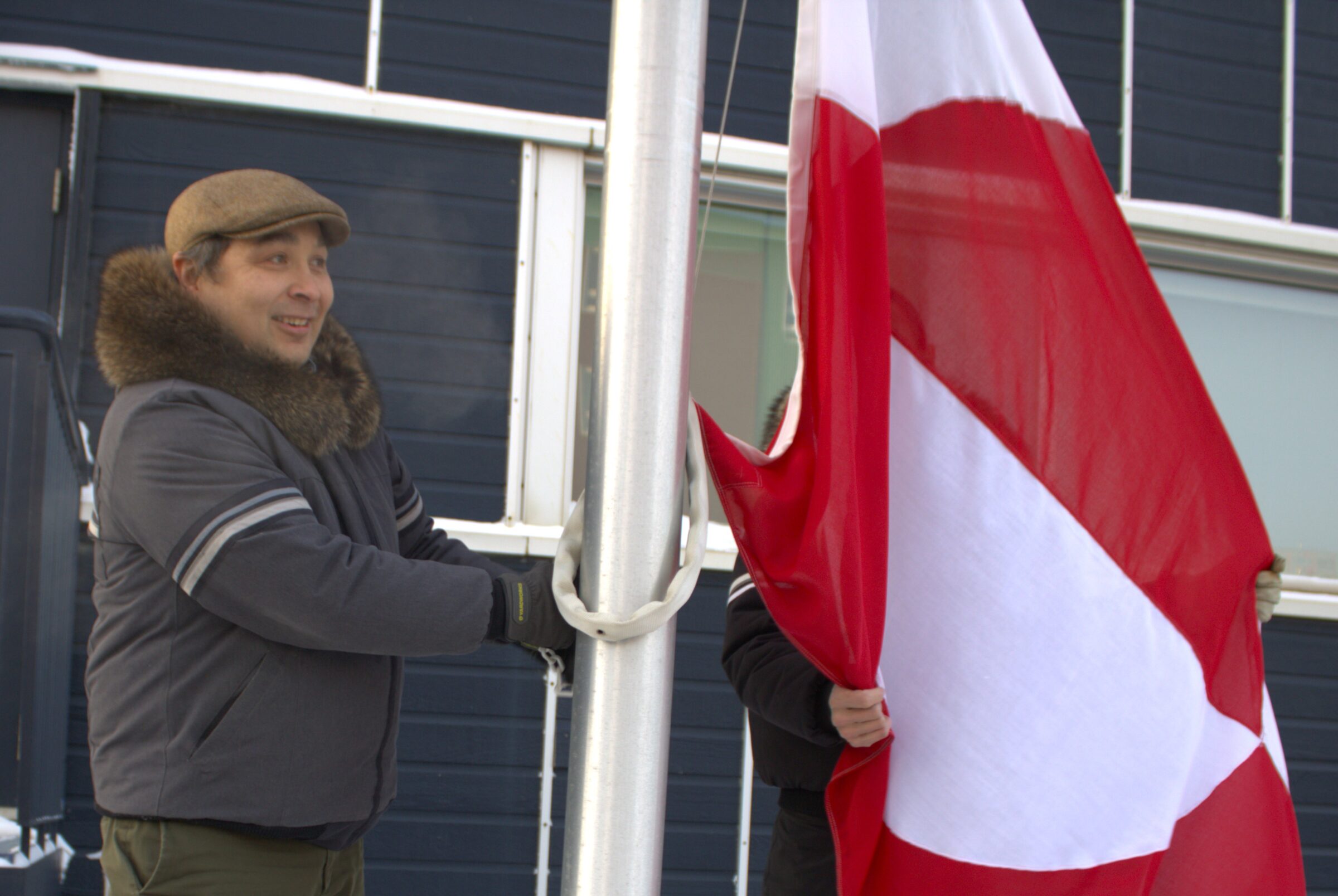
Nunavut MLA and Speaker David Joanasie hoists the Greenland flag in front of the Nunavut legislative assembly on Jan. 20. Six months ago, Iqaluit city council voted to do the same thing, but nothing has come of it. (File photo by Daron Letts)

So far, Nunatsiaq News has dedicated three stories — a total of 696 words — to what came of the Greenland flag that Iqaluit city councillors voted in January to hoist in solidarity with their northern neighbours, after threats from United States President Donald Trump.
Why do we care so much? It’s just a flag. The City of Iqaluit is responsible for many other more important things, like zoning issues, firefighting, animal control, and allocating hundreds of millions of dollars in water and sewer upgrades, just to name a few.
Nobody can blame readers who might ask this question as they see yet another headline about what really amounts to a simple performative gesture.
At the time of council’s vote, Iqaluit Mayor Solomon Awa had strong words about Greenland’s right to autonomy, in support of the roughly 55,000 predominantly Inuit who call the island home.
“This is our hunting ground,” Awa said in January. “This is where we grew up. And this is where we’re going to be for the generations to come.”
Since Trump was elected to a second term in November 2024, he has threatened to invade Greenland. He has suggested the United States buy it. He has argued that Greenland needs protection that only the U.S. military can provide. He has mused that the semi-autonomous territory that is internationally recognized to be part of Denmark is — and has always been — a United States territory.
Trump has at times gone quiet on the issue, like he seems to be doing these days, perhaps as other emergencies, like the stalled war in Iran, continue to chip away at his administration’s popularity.

Maybe this is partly why the city hasn’t flown the flag: Greenland has faded from the headlines. When Nunatsiaq News asked about it in March, spokesperson Geoffrey Byrne said timing was indeed an issue. The city, he said, wanted to wait until Greenland delegates visited for the Inuit Circumpolar Council general assembly in July.
But the general assembly came and went last week with no show of support.
The problem with raising it during the four-day event, Byrne explained earlier this week, was that the City of Iqaluit wanted to focus on Inuit unity across the circumpolar region.
The city still plans to raise Greenland’s flag, Byrne said. Perhaps wisely, he did not offer another timeline.
While the story here is about a flag, the underlying issue is that city administration has not executed a directive from city councillors. We’re not sure why.
Is the city having trouble procuring a Greenland flag? Is it missing? Damaged? Are the flagpoles not functioning? Does the right moment keep slipping away? Or is the flag a symptom of a deeper ineffectualness within the City of Iqaluit to make things happen?

The public elects city councillors to make decisions, and when councillors make those decisions, it’s on city administration to carry them out.
In 2021, city council passed a motion to have administration work with the territorial government toward compliance with Nunavut’s access to information law. In 2023, the city missed its self-imposed deadline for this, and we haven’t heard anything since.
If administration followed through on that motion, maybe by now there’d be a mechanism to get a clear answer on what’s going on with the city and its Greenland flag.
Apparently, after years of reporting on the City of Iqaluit, this is the scandal they have finally been waiting for.
There is no question that council motions should be followed. But turning the timing of a ceremonial flag-raising into evidence of some broader administrative failure is not serious accountability it is searching for a controversy and working backward.
Nunatsiaq reports on the City constantly, often scrutinizing routine municipal matters in a way rarely seen across Nunavut’s other 24 communities. Yet Iqaluit is arguably the easiest municipal government in the territory to scrutinize because its council meetings are livestreamed, and its agendas, motions, minutes, budgets and recordings are regularly posted publicly. The City’s website includes current council documents and meeting records for anyone including reporters to review.
That transparency has also been independently recognized. In its June 2026 municipal fiscal-accountability report, the non-partisan C.D. Howe Institute gave Iqaluit a B+, placing it seventh among 39 major Canadian municipalities and ahead of cities including Toronto, Calgary, Edmonton, Halifax and Yellowknife. The report specifically highlighted Iqaluit for using public-sector accounting standards consistently in its budget and called its presentation a first among the municipalities assessed.
None of that means the City is beyond criticism. It means criticism should be fair, proportional and supported by facts.
The City is managing water security, roads, firefighting, housing pressures, development, waste, sewer services and hundreds of millions of dollars in infrastructure. Nunatsiaq looked at all of that, all of those public records and all of those legitimate issues and decided the clearest sign of municipal dysfunction was that a flag ceremony had not happened….
At this rate, the only thing being raised more frequently than the Greenland flag is Nunatsiaq’s grievance with the City of Iqaluit. When will Nunatsiaq apply the same level of scrutiny to Nunavut’s other 24 communities that it so regularly applies to the City of Iqaluit?
“The problem with raising it during the four-day event, Byrne explained earlier this week, was that the City of Iqaluit wanted to focus on Inuit unity across the circumpolar region.”
An unbelievably flaccid excuse.
One has to wonder what Jim Bell would think of Nunatsiaq’s editorial standards today. He was never afraid to criticize governments, but he also understood the importance of distinguishing between evidence and speculation.
How complicated is it to put a flag on a pole
I am interested in learning more.