


‘Will you marry me?’ was not the question … Part 1
Ann Hanson explores the Inuit tradition of arranged marriages
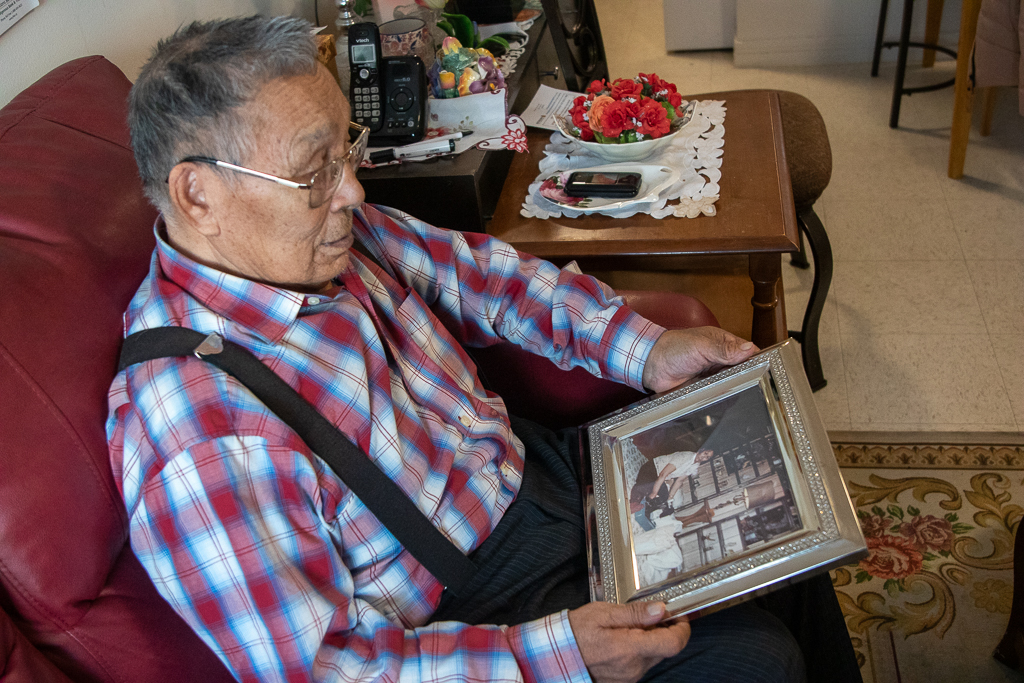
Aimo Mapaluk, an elder living in Iqaluit, says he is familiar with the Inuit tradition of arranged marriages. His own father and stepmother were married in the manner many Inuit were, according to an old tradition. (Photo by Jeff Pelletier)

Ann Hanson (file photo)
This is the first in a three-part series by Ann Hanson retelling the Inuit arranged marriage tradition, which was still practised in some parts of the North until the late 1970s.
As a little girl, I remember one of my aunts calling and screaming for help as she was being dragged out of our home.
No one helped. We weren’t allowed to.
I was frightened, because we seldom saw adults cry — only when someone died.
No one had died, but there was a big struggle as my aunt was being dragged out against her will.
She struggled and kicked — her arms trying to hold on to anything in her path — and cried all the way while being dragged out. While she did that, our meagre cups, tea kettles, Primus stove, and drying racks were being strewn around with bangs, clangs, thuds and many other noises not normally heard at night.
This was not a normal night.
My aunt was being dragged out by her new husband. This was the way to start a new life in a traditional arranged marriage.
Traditional marriage was arranged by parents and grandparents-to-be even before the baby was born, according to some interviews I’ve conducted over the years while working for the Canadian Broadcasting Corp., doing Inuktitut programming.
Leah Nutaraq, who was a constant contributor on Inuit traditions, once talked about this subject and said when a woman was pregnant, she would say, “If this is a boy, he will marry the girl my girlfriend had a few months ago.”
This often became a reality and sometimes not.
The other method was when the young man was able to hunt, build a shelter, when he became knowledgeable on weather conditions, ice conditions, when he could feed his family, share his harvest with the village, run a dog team, it meant he was ready for a wife.

That was the time to look for a girl who was skilled in skin- or pelt-preparations, making life-saving garments, preparing foods and food preservations. Looks didn’t matter.
When a girl was found in the same village or some other village, the young man’s mother or father wrote a letter to the girl’s parents asking them if they would agree to have their daughter marry their son.
Then there was a big life-changing discussion with the parents, the grandparents … but not the boy.
The boy didn’t have any say in this matter. It was all up to the parents and grandparents.
The same with the girl. She had no say whatsoever in the matter. It was kept in secret until the boy came to get the girl.

This was further confirmed by elder Aimo Mapaluk during our interview here in Iqaluit.
Not all traditional marriages were done this way.
There were a few exceptions. One was Mapaluk’s.
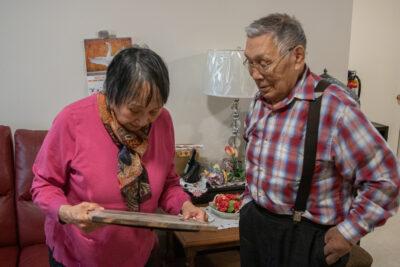
Aimo Mapaluk, an elder living in Iqaluit, right, talks to Ann Hanson about the Inuit tradition of arranged marriages. (Photo by Jeff Pelletier)
During our interview, Mapaluk said he knows the arranged marriage tradition very well, both from hearing old stories from the distant past and during his growing-up years with his stepmother Attuat and father Sappa.
Prior to having their daughters marry a complete stranger or some casual acquaintances, the mother got busy making a new tent — sealskins in the past, and canvas in recent years — gathering her clothing and kamiik and packing them for a trip. This was done all in secret without telling the daughter.
Sometimes the girl got suspicious and nervous. Mapaluk said this was done after all the agreements were completed. Sometimes when the parents could not agree with the girl’s parents, no partnership took place and they had to look for another girl.
The girl’s age was not the indicator for being ready for marriage, it was her menstrual cycle. That was when her mother knew she was ready and able to have children.
In some rare cases, the girl was given away to her new partner even before she had her first menstrual cycle. This was very scary for the child.
Mapaluk, an elder living in Iqaluit, said he knows of young girls being tied up with ropes when they struggled too much.
The girl’s arms and legs were tied up, she was carried to the sled, and then tied onto the sled.
This was equally frightening for the young man.
Mapaluk explained that the young man was obeying his parents’ wishes out of respect and fear. This is called ilirasuk in Inuktitut, a deep respect that compels young Inuit to do what they are told — ilirasuk for his parents and her parents.
With time and patience, the young couple got used to each other and were calmer.
They got to be friends and eventually love each other deeply for life.
Mapaluk remembered that some couples separated because they could not get along for several reasons.
With a soft voice, Mapaluk ruefully expressed that “some men were abusive, and when the leader in the village knew about this, he separated the couple.”
Mapaluk personally experienced this with his stepmother Attuat. One of her husbands had been abusive, before Attuat married Aimo’s father, Sappa.
Attuat solved her abusive relationship with her own strong traits. She got tired of being abused and thought to herself, “I am tired of being abused. I must make a plan.”
The next time her husband was beating her, she fought back and pinned him down and told him, “Next time you abuse me, I am going to use the axe and I will not let you free until you agree to have peace with me!”
Her husband stopped beating her and made peace with her.
Mapaluk fondly remembered his stepmother being intelligent and very strong, physically and mentally. She was also a very good hunter. Attuat went through five husbands during her long life.
Continued in Part 2 of ‘Will you marry me?’ was not the question …
Ann Hanson was the founding editor of Inukshuk newsletter in 1973, which became Nunatsiaq News in 1976. She was the third commissioner of Nunavut. She now lives in Apex.
Thank you for your truth-telling, Anne and Makpaluk.
It harkens back to the much-quoted: I am human and nothing human is alien to me.
love life because it loves you.
Terrible things may be done to us but we remain reasonable and the best comes from us: IQ
Arranged marriages have been common all over the world since before recorded history.
This is a fairytale.
Inuit did not have writing until after the missionaries arrived.
So, you’re saying this didn’t happen because it happened all over? What are you getting at?
“When a girl was found in the same village or some other village, the young man’s mother or father wrote a letter to the girl’s parents asking them if they would agree to have their daughter marry their son.”
Inuit did not have writing until the missionaries arrived.
Where in this story is it mentioned that this practice stopped when the missionaries came? Note she specifically included “recent times”.
Well yeah, you’re right. What’s your point? They’re speaking about the arrange marriage in Inuit culture. It happened in other cultures too (some still practice it).
What’s your point here? Point of the article is to share how Inuit experienced it. There seems a lot of nay sayers about Inuit, obviously we’re in Nunavut so it’ll be about Inuit just as Roman’s do in Rome.
Anyways, wishing you a more happy peaceful year👍 sending you positive thoughts.
> The girl’s age was not the indicator for being ready for marriage, it was her menstrual cycle. That was when her mother knew she was ready and able to have children.
I once had an Inuit coworker in a school lament that southern standards of adults not having sex with minors was stupid and wrong and not with Inuit traditions. I think that’s the first time I had culture shock up here.
Learning about these traditions is difficult. How traumatic for a child to be tied down to a qamutik and taken god knows where with who on earth and for what possible reason. It is not difficult to get that trauma would ensue from mismatched arrangements. It’s not difficult to understand arranged marriages are common in many cultures (still practiced today). What is difficult to reconcile is why this still happens anywhere. Working through this history is important to acknowledging and coming to grips with some of these mistakes, while still celebrating and being grateful for the successful arrangements which achieved their intended purpose. It’s also about learning from the past and sheding light on where thoughts and attitudes come from. We are only asked to listen, or in this case read quietly, with our eyes and not our thumbs.
This brings back a memory summer of 63, my stepfather wanted me to marry one of his nephews; I ignored this. I’m sure my father would be upset knowing that my stepfather wanted this marriage arrangement. Disgusting is all I can say, sorry but not sorry. Never liked my stepfather.