

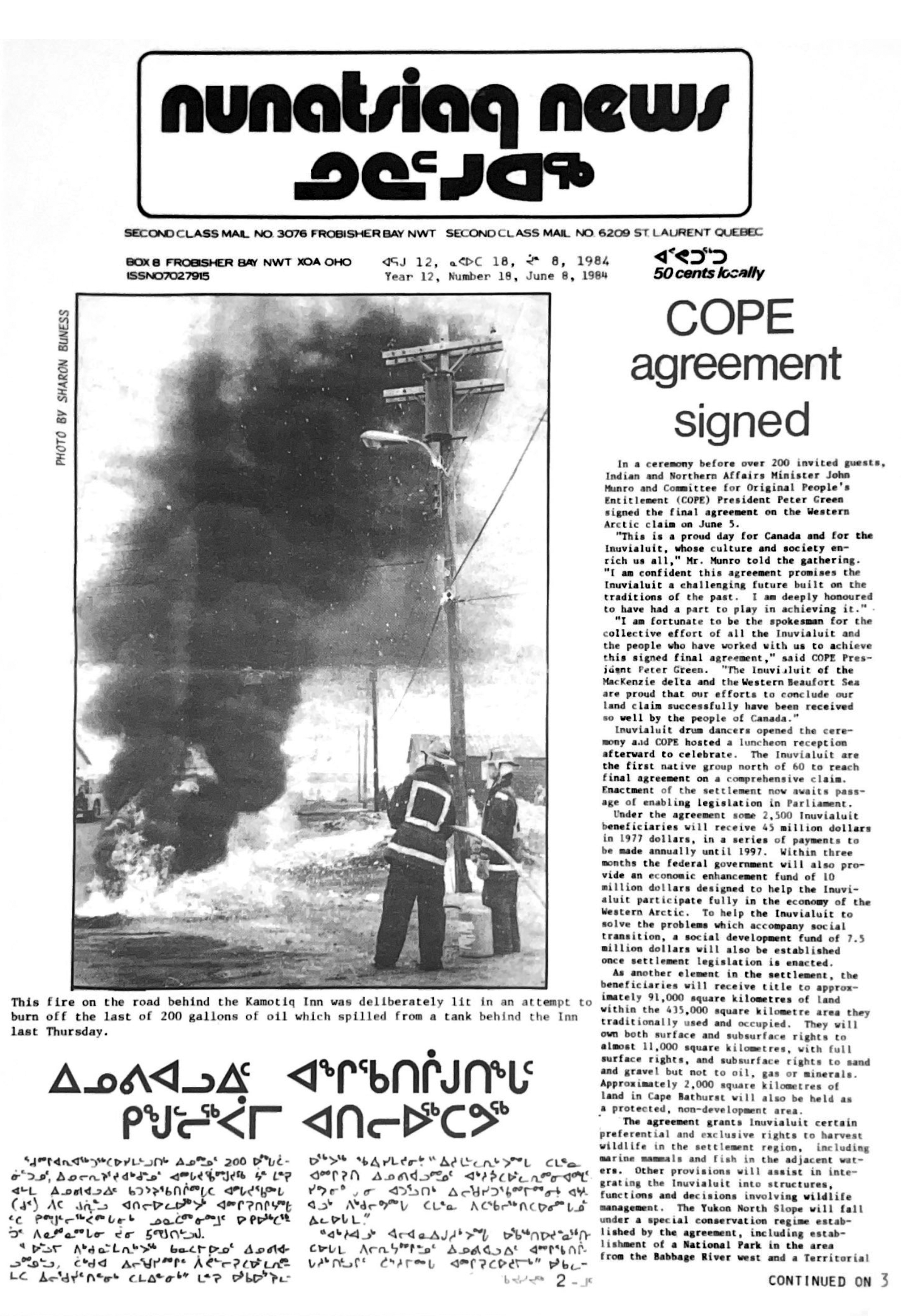
The June 8, 1984, front page of Nunatsiaq News. (File photo)
Yesterday’s News: A big deal for Inuvialuit, and a big fire in Iqaluit
A weekly look back at 50 years of front pages at Nunatsiaq News
Nunatsiaq News looked far to the west for its front-page story back on June 8, 1984.
The big news was the signing of the final agreement on the Western Arctic claim — legally known as the Western Arctic (Inuvialuit) Claims Settlement Act — and it was a big deal.
As Nunatsiaq News celebrates its 50th anniversary, each week we are taking readers on a tour through the past half century by showcasing some of our front pages from years gone by.
The paper started out in 1973 as Inukshuk, a community newsletter published in Frobisher Bay (before it became known as Iqaluit). Inukshuk was sold in 1976 and renamed Nunatsiaq News.
Closer to home in Frobisher Bay that week, an oil spill from a tank behind the Kamotiq Inn forced firefighters to stage a controlled burn to get rid of the mess.
But back to the Western Arctic claim.
That agreement gave Inuvialuit title to about 91,000 square kilometres in the Northwest Territories along what’s now the border with Nunavut.
That land was traditionally used and occupied by Inuvialuit, the story notes.
Importantly, it gave them full surface rights but only limits rights for the sub-surface, or below-ground portion. In that instance, they received rights to sand and gravel but not oil, gas or minerals.
The deal also included $45 million to be paid to about 2,500 Inuvialuit beneficiaries (or $117 million in 2023 dollars) spread over 13 years until 1997.
Millions more were promised by the federal government for economic development and social transition programs.
Calling it “a proud day for Canada and for the Inuvialuit,” then-northern affairs minister John Munro said the agreement “promises the Inuvialuit a challenging future built on the traditions of the past.”
The deal was negotiated through Committee for Original People’s Entitlement.

That group came together around 1970 to represent the interests of Indigenous people in the western Arctic when there was growing pressure to carry out more oil and gas exploration. Members were concerned all the benefits would flow south, and leave little for the Indigenous people living there.
The committee, called COPE for short, helped organize the first Northern Games, produced radio shows in Indigenous languages and interviewed elders to preserve history.
It also organized the first conference of Arctic native peoples, before it was eventually dissolved in the mid-1980s.
(0) Comments