


QIA’s plan to build homes in High Arctic depends on national funding
Association needs $18 million from CMHC, hopes to have homes ready by end of 2024 if funded
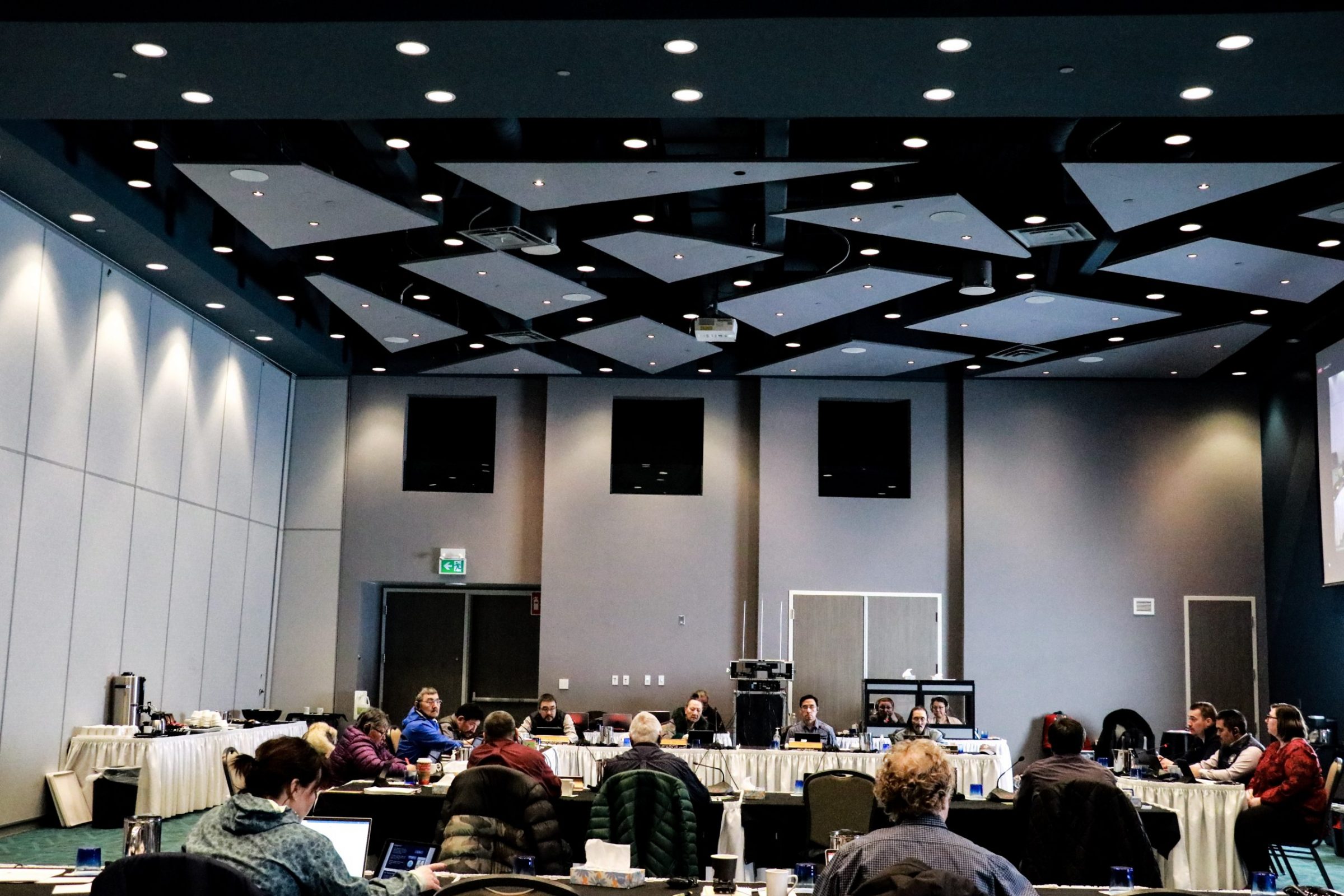
At its board of directors meeting March 30, shown here, Qikiqtani Inuit Association approved spending $12 million of the $30 million needed to build 21 homes in the High Arctic if it gets CMHC funding assistance. (File photo by Meral Jamal)
The Qikiqtani Inuit Association has committed $12 million toward a $30-million plan to build affordable housing in five High Arctic communities.
To be realized, though, the project is dependent on securing the other $18 million from Canada Mortgage and Housing Corp.’s rapid housing initiative, which could be a tough order, said Matthew Hamp, QIA’s executive director of infrastructure and development.
“This is an exciting time for QIA,” said Hamp.
At its March 30 meeting, QIA’s board of directors agreed to spend $12 million in what it hopes will be a $30-million project to build 21 homes across the communities of Arctic Bay, Pond Inlet, Clyde River, Resolute Bay and Grise Fiord.
Securing the $18 million from the CMHC fund will not be easy, Hamp said, because the rapid housing initiative is a competitive national program. Many other groups that apply are from urban centres in the south and have more resources than QIA does.
“It’s going to be super challenging for us to get it,” he said.
The motivation to build more homes in the High Arctic comes after QIA was able to get more housing-based funding from Nunavut Tunngavik Inc. as a result of that organization receiving infrastructure-specific funding in 2022, Hamp said.
The definition of affordable housing QIA uses comes from the CMHC, which states housing is considered affordable when a household spends less than 30 per cent of its gross income on shelter.
Hamp said QIA has asked that if it is approved for funding through the rapid housing initiative, that CMHC let it know by the end of April, rather than July 1, because QIA would be building in the North and needs more time to order materials.
If successful, the goal is to have people living in the homes by the end of 2024, Hamp said.
Even though there are barriers to getting funding, Hamp said if QIA is successful he hopes this project leads to more funding for home construction in the future.
“We’re working at full speed,” Hamp said. “We’re still optimistic.”

Wouldn’t it make sense to have the funding in place before announcing a plan….?
How is Nunavut Housing doing with their (ahem…) rent collecting?
Are Nunavut tenant arrears down to zero?
Where’s the royalty money from Baffinland Iron Mines you collect annually?
Asking for more funding from me (taxpayer to publicly-funded CMHC) to match funding from me (taxpayer to publicly-funded NTI and QIA)! Sheesh, ask Bill Gates or Jeff Bezos for the money; or let people build their own homes
30 Million for 21 homes brings it to 1.4 Million per house! Wonder who is gonna cover the O&M costs for these affordable units?
Thanks NunaInuk; as you say $1,400,000 per unit. Vancouver or Whistler price. In those places, half the cost is for the lot Not so in Pond Inlet, that’s certain. Maybe it’ll cost $50,000 to level and grade the lot, toss in a power pole, and pound a few spikes into the rock. Crazy place, Canada, that bases its society on identity religion to align the voters
There is no plan to solve Nunavut’s housing crisis.
The Nunavut housing crisis is needed, so some people can get very rich by not solving it.
That many lives get ruined in the process is just collateral damage.
That’s the price of High Arctic housing. There is no getting around that cost. The only alternative is forcible relocation, or a return to pre-Western lifestyles.
I can’t believe this are the new houses for the board of directors or some rich people will will just destroy the expensive house $30million for 21 someone is raking it in there pockets,
For that amount should be able to biuld 84 houses and we are not been told the truth on something here scratching my brain washed….
1.4 million per unit. That is sick. How many homes could be fixed up to habitable levels instead of building more multi-million dollar public housing units? At this price, can’t help but think QIA is making money off IIBA contracts. Start by sending up some remediation teams to fix up all the units that have fire damage and are just sitting vacant for eternity. Cause, lord knows the local housing authority’s arent gonna fix em. They’d rather drive around all day smoking cigs and going northmart!
Fold Nunavut Housing and hand the reins back to Yellowknife and the Feds
and collect owed rent by “tenants.”
Thank you Qikiqtani Inuit Association for committing $12 million toward a $30-million plan to build affordable housing in five High Arctic communities. Every community and all the others in Nunavut deserve such housing investments!
The Government of Canada spends a lot of our tax money to foreign countries all the while her citizens are in dire need. Even more so in the Canada’s far north, where everything is expensive. In 2021, the Government of Canada spent CAD$8.4 billion on international assistance (http://cidpnsi.ca/canadas-foreign-aid-2012-2/), and I am sure there are more funds spent on non-Canadian citizens.
Nunavut makes up 20% of Canada’s landmass, the country would be greatly reduced if the Inuit took the playbook from Quebec. Afterall, the Inuit were traditional nomads, and the within a short period of time, managed to change Canada’s map by adding Nunavut as a territory of the country. The International community claims that waters in Canada’s high arctic is international waters while Canada continues to try and be recognized as having ownership and sovereignty over the arctic.
According to the British North American Act, governments were supposed to sign treaties prior to having ownership and governing powers of the land. Canada purchased the Northwest Territories (NWT, later separated into NWT and Nunavut) from the Hudson’s Bay Company in 1869 and became a part of Canada’s territory in 1871. The Inuit were neglected for over 70 years after they became Canadian citizens, and lived a traditional life just like their ancestors. Then in 1940s and 50s, the Government began forcing the Inuit to live a ‘Canadian’ way of life. Children were sent to schools, settlements were formed and houses/infrastructure built, receiving dog tag names as Government issued Identification cards, etc. Alert, though a military base, probably has even the best facilities that another Nunavut community would never see.
Then there was the relocation to the High Arctic and to the smaller communities across the territory. I’m sure our Nunavut Premier boy has a lot to do with this housing plan through QIA, the GN, and his personal experience. The community of Resolute Bay and Grise Fiord and its people are Canada’s flagpole.
Prior to the 1950s, the High Arctic had no inhabitants, making it difficult for Canada to assert sovereignty, so they moved several families from Inukjuaq, Pond Inlet in 1953 and 1955 to form these two communities.
The Inuit paid a high price and continue to pay for it today to be part of Canada. Not very many people live in the north, and the traffic from the main supply (down south) is very low making everything expensive. I think that CAD$8 billion spent in International aid a bit far off when our country’s citizens, down south or up north alike, are in dire need.
It’s very expensive to do business in the north because the prices are high and the products are on low demand. It is quite difficult to not let other citizens complain about the amount of funds needed to make anything happen in Nunavut, anything spent on Canadian citizens is too much sometimes.
Those who don’t like the comment I made can’t accept the truth!
How much would it cost to fly from Grise Fiord to Inukjuaq and back? And how long would it take to get there and back?
It’s crazy expensive up here, but we’re still Canadians, it’s always going to be expensive in Canada’s north, deal with the high prices that the GoC spends on Nunavut and the North.
QIA has too many consultants blowing smoke… while overcrowding increases in Nunavut, lobbyists in south get rich.