


Keeping 2022 gold medal legacy alive, coach leads wrestling clinics across Nunavut
Chris Crooks and champion Eekeeluak Avalak working to support young athletes and coaches
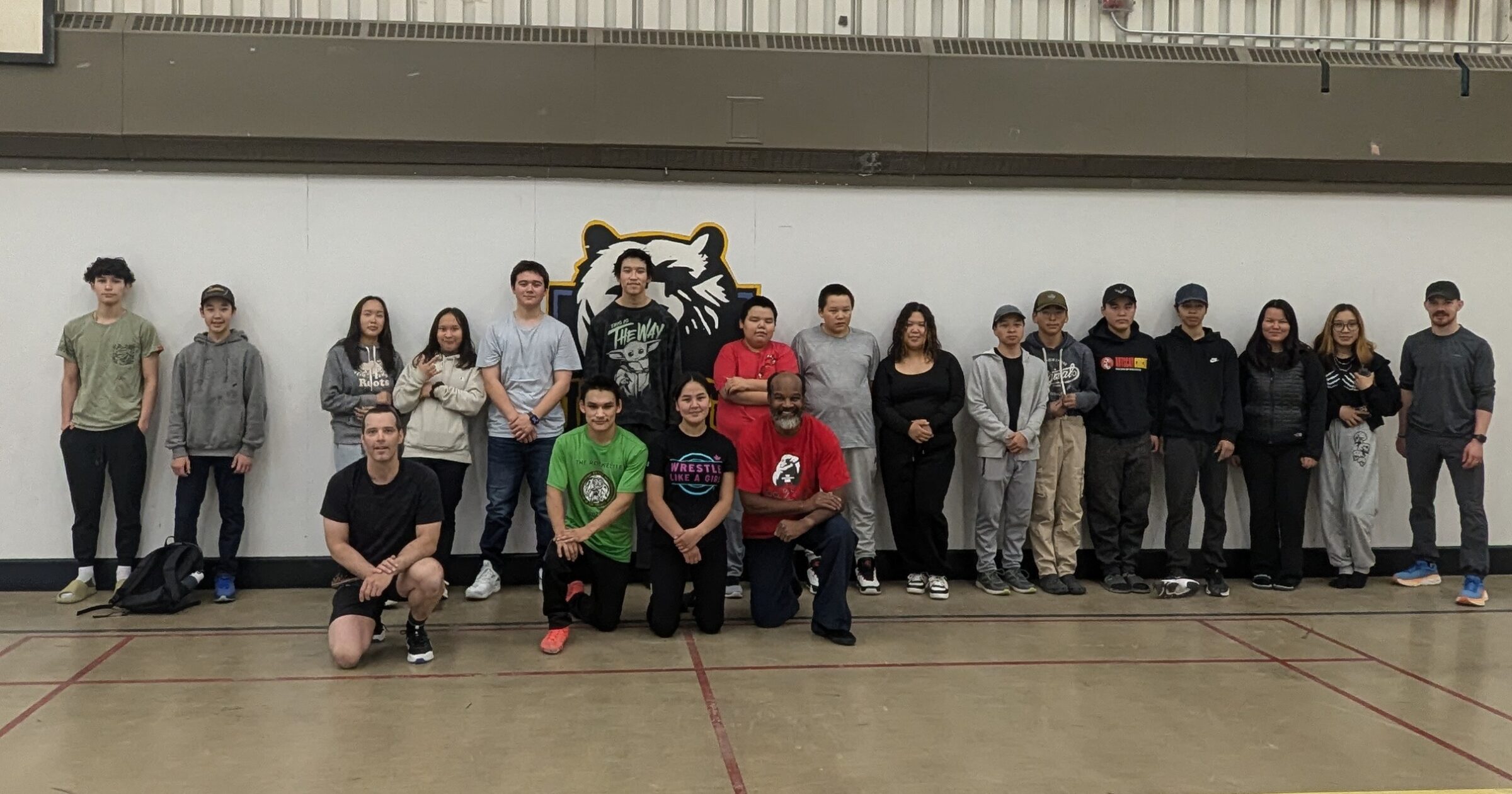
Wrestling gold-medalist Eekeeluak Avalak, front, in green; Cambridge Bay wrestler Kiana Ekpakohak, beside him, in black; and wrestling coach and president of the Cambridge Bay wrestling club Chris Crooks in front, in red, pose with youth participants at a clinic held in Kugluktuk this fall. (Photo courtesy of Chris Crooks)

Veteran coach Chris Crooks is running wrestling clinics across 10 communities in Nunavut for Inuit youth interested in the sport.
Most recently, he ran two clinics in Baker Lake from Oct. 8 to Oct. 9 at Jonah Amitnaaq Secondary School with the support of the Baker Lake Youth Athletic Association.
Now he is heading to the tour’s fourth stop, Chesterfield Inlet, on Thursday to run more clinics with assistant coach Zachary Cziranka-Crooks.
“We have the goal of supporting existing wrestling clubs in communities and to also see if we can encourage some new ones,” said Crooks, who founded the Cambridge Bay Wrestling Club in 2015.
“Kugluktuk, Baker Lake, Chesterfield Inlet and Clyde River haven’t had wrestling programs in their communities in decades, and some have never had one, so we’re trying to support the coaches there.”
Turnout for the clinics has been “positive,” Crooks said, adding the club’s target is to reach 250 athletes.
“We’ve completed clinics in Cambridge Bay and Kugluktuk and we’re already over 100 athletes in our third community, Baker Lake, so we’re well over our target for participants,” he said.

The clinics have also helped train five coaches so far.
Crooks runs them during gym classes at community schools and hosts evening sessions.
With funding from Wrestling Canada, the clinics, which began in September, are part of Crooks’ community initiative to bring sports to disadvantaged Indigenous youths in Nunavut and N.W.T.
Called the Inuit Project, the initiative includes an instructional video for wrestling coaches. It has a breakdown of what a two-hour practice looks like with step-by-step instructions for moves like the front roll, back roll and cross ankle.
Filmed in Cambridge Bay, the video includes demonstrations by 2022 Canada Summer Games gold medalist Eekeeluak Avalak, who Crooks coached.
While the video is still in its final editing stages, a booklet that will accompany it is ready to publish. With versions in English, north and south Baffin dialects of Inuktitut, and Inuinnaqtun, it includes a checklist of warm-up and cool-down activities, games, and wrestling techniques for coaching beginners or kids.
The guide allocates the first few minutes of every practice to include a discussion of the history of Inuit and Canadian wrestling.
Avalak and fellow Cambridge Bay wrestler Kiana Ekpakohak, who also competed at the 2022 Canada Summer Games, joined Crooks in coaching the Kugluktuk clinic in September.
Asked if there has been an uptick in interest in wrestling since Avalak’s win, Crooks said that while not everyone wants to wrestle, it has “made a difference in people’s acceptance to try something new.”
“That legacy is there and makes it easier for us when we go into communities as he is recognizable,” Crooks said.
“When you go into communities and they know that you’re coming in with good intentions to try to make a difference, it is easier for people to accept you.”

Asked if he has spotted another youth wrestling champion, Crooks said he hopes the clinics identify potential athletes and provide them with the monetary and moral support they need to practise and compete down South.
“I believe within Nunavut — and this may sound crazy — there’s dozens and dozens of Eekees throughout the territory, but it is a matter of finding them, engaging them in the sport and giving them the opportunity,” he said.
After the fourth clinic in Chesterfield Inlet, Crooks plans to head to Rankin Inlet and Arviat before landing in Iqaluit in time for the 2024 Recreation and Sport Leadership Conference from Oct. 18 to Oct. 20.
Igloolik, Clyde River and Pangnirtung are the final scheduled stops at the end of October.
Asked what’s required to begin a coaching program in a community, Crooks narrowed it down to “having the passion to make a difference in the lives of young people.”
That will go a long way in dealing with at-risk or disadvantaged youths in Nunavut and other remote communities, he said.
“Anyone can learn the technical skills, that’s not the hardest part. It’s wanting to give back.”
(0) Comments