


A brief history of the James Bay and Northern Quebec Agreement
Quebec plan to harness hydroelectricity set the stage for dramatic changes in province’s North
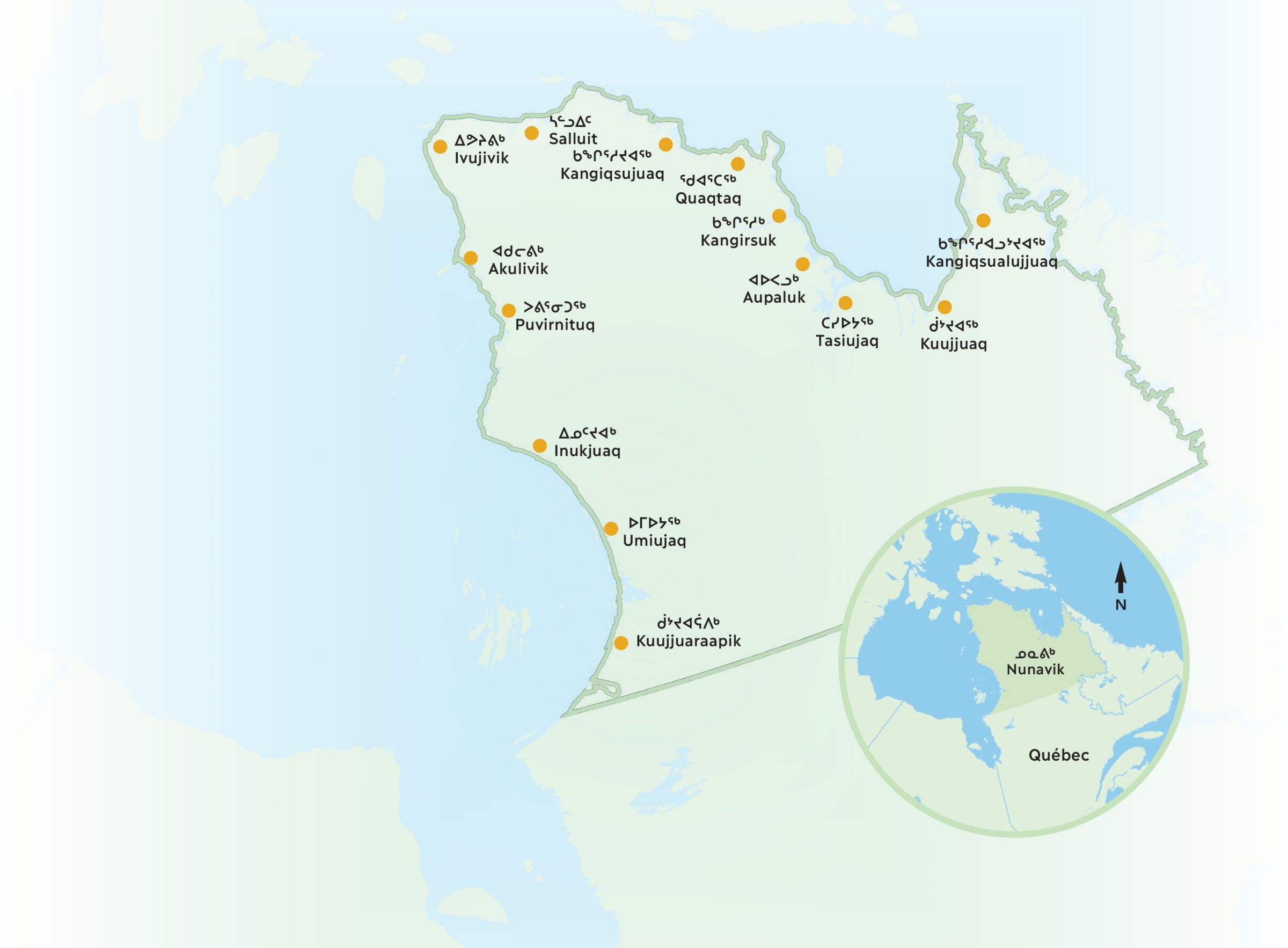
It has been nearly 50 years since the James Bay and Northern Quebec Agreement was signed. Nunatsiaq News will be running stories about the agreement this fall, leading up to the publication of a special section about the anniversary on Nov. 11. (Map by Nunatsiaq News)
The rivers of Nunavik have been travelled and fished by Nunavimmiut for thousands of years, with generations of Inuit having cared for the lands and waters of their home. That way of life changed dramatically in the 1970s as a result of the James Bay Project.
In 1971, Quebec premier Robert Bourassa announced the province’s power utility, Hydro-Québec, would build a massive hydroelectric facility in Nunavik using the strength of the rivers that empty into James Bay. Water from the Eastmain, Opinaca and Caniapiscau rivers would be redirected to dammed reservoirs on La Grande Rivière, almost doubling the flow of that river.
Giant spillway steps three times the height of Niagara Falls were blasted from the bedrock, changing the landscape. By the time it was completed in the 1980s, the James Bay Hydroelectric Facility was supplying electricity to a significant portion of Quebec, particularly in towns and cities in the south.
The Cree nations and Nunavimmiut were not consulted about the project and disagreed with the province’s actions regarding the water and land. The damming of the rivers flooded an area of 11,500 square kilometres — about twice the size of Prince Edward Island. Over 2,300 people living in the village of Fort George had to be relocated upstream to the new community of Chisasibi. Rotting trees and vegetation in the reservoirs released mercury into the water that poisoned the fish and caused the deaths of thousands of caribou. Traditional Cree hunting and fishing grounds were lost.
In 1972, Nunavimmiut formed a group called the Northern Quebec Inuit Association, composed of young emerging politicians in the region. At the beginning, they had one goal in mind: to stop the dam.
The province was not willing to listen to their concerns, so in 1973 Nunavimmiut took the Bourassa government to court. After hearing from 167 witnesses about how their lives were affected by the James Bay Project, Justice Albert Malouf ordered Hydro-Québec to stop construction of the dams. His decision was overturned six days later by a Quebec court of appeal, but Malouf’s decision recognized the land claims of the Cree and Inuit and forced the Quebec government to negotiate with them over compensation as the construction of the dam continued.
For the next two years, NQIA shifted its focus and argued its case against government lawyers who often treated them with disrespect.

ITN’s purpose was to oppose a specific clause that was signed in the James Bay and Northern Quebec Agreement that extinguishes the native claims and rights Inuit have to the land of Nunavik. They believed the repercussions of signing such a clause would destroy Inuit possibilities for self-governance.
The government wanted Inuit residents to surrender their land claims in Nunavik in exchange for $90 million over 20 years, to be used for housing, local governance, and social programs. NQIA also insisted that services be created in Nunavik, such as a school board, a regional government, and health care. After months of difficult negotiations, the James Bay and Northern Quebec Agreement was finally signed on Nov. 11, 1975.
Sarollie Weetaluktuk, one of the Inuit who signed the agreement, said, “We agreed to their [surrender] clause on the land. In return, with the creation of the Kativik Regional Government, we obtained the right to run our own health and social services, police, to run our own show. It looked really good, just thinking that we would be managing our own lives. But we were divided. Some understood, but others didn’t.”
Makivvik Corp. was established in 1978 to manage the money received in the government settlement on behalf of all Nunavimmiut. As the Inuit rights-holding organization in Nunavik, it continues to work to protect the rights and natural environment of communities in Nunavik.
The James Bay and Northern Quebec Agreement was the first modern Indigenous land treaty agreement in Canada, and became the standard for agreements around the world. Its repercussions, both positive and negative, can still be felt in the everyday lives of Inuit, 50 years later.
— With files from Cedric Gallant

This article is part of Nunatsiaq News’ commemoration of the 50th anniversary of the signing of the James Bay and Northern Quebec Agreement in 1975.

This project has been made possible in part by the Government of Canada.
The JBNQA was hotly contested time. Nunavik was not defined yet. Umiujaq and Akulivik were not communities. The region was also by government English not French. Inuktitut was not an official language. Actually French is only the official language but Quebec has to officially respect Inuktitut and Cree.
Let me tell you the other side of this story;
Cooperative movement in late 50’s early 60’s was the first Inuit organization that introduced the beginning of development and modernization of the early settlements in the region of Nunavik, but that movement was diverted as soon as NQIA was created by federal government, and the cooperative movement became that is now called FCNQ, and so on many bodies of organizations got DIVIDED indeed as my uncle said…
Theres a lot more to learn from past when we seek deeper, because our future are in our hands, so keep on posting the stories on this. Not to forget to encourage everyone to wear red poppies in memory of those that sacrificed their lives for our freedom!! For the November 11th never we forget! I salute to everyone.
Why is FCNQ (not local coops) so qallunaangajuq? Biggest potato company ever created. I dare the FCNQ board to restructure their management. You can’t see what the outsiders are doing, the words they say, and the business approach they have. They feed coops lies. So do Makivvik but at least its insiders lying to us. Form your own opinions instead of repeating what you think a smart Qallunaak has said.
Thank you Mr. Andrew, I am qallunaangajuk, I live everyday of my life dealing with racism on both side of my origins but hey! Im used to it, doesn’t affect me no more lol Theres no comparison or any competition on this serious subject of the past of who was right or wrong, no it’s much bigger than that, takes a huge expanded brain to understand reality, and you got none of it so again Nakurmiik aaqqilaaravingai
If we keep on being how we are as Inuit today, very soon Inuktitut language will disappear as Latin Language did, it will be looked at as an ancient language that was once spoken by I think what they call it now Thule people…
But hey look and wake up, we might still have a chance to make Inuktitut language official!! Clock is ticking… TikTok TikTok slap! Wtfu!
“The government wanted Inuit residents to surrender their land claims in Nunavik in exchange for $90 million over 20 years, to be used for housing, local governance, and social programs.”
When you look at 90 million in 1976 and adjust for inflation it equals around 470 million in 2025.
470 million is peanuts for the size of the area and effect on the culture.
It has failed. Intentions were not met and eventually lost. Our biggest failure has been education. We have zero capacity to govern. Zero competent beneficiaries, board members and ZERO competent executives. Only people who have a grasp are those who were educated outside the region and they don’t fully grasp the realities of Nunavik, making them knowledgeable of western structures but not having the wisdom to utilize it on behalf of the beneficiaries.
I agree with this Poster, education is the key to economic prosperity for the Inuit People, give a man a fish and he will eat, teach him how to fish and he will provide for the community and his Family
Can we buy it back?
Maybe one day
I proposed a training program for 20,000 natives for ring of fire.
Average salary rock truck driver$30-50,000
Or engineer $100,000
All hiring done by NAN exclusively for natives to be trained on the job for most roadbuilding and initial dirtworx at mine.
All income taxes collected by NAN at 15% to generate initial revenues to build a city for workers centrally located (eg Elliot Lake- people still live there)in ring of fire.
Property tax revenues in the centrally located mining town would be in the billions of dollars combined with the income taxes would primarily go to the mining city to build infrastructure.
can we stop with the this and that and the left and right of the party. let’s agree on one thing and go with it for the sake of us inuit. it is clear nunavik was defined by hydro quebec.
There’s major problems in Nunavik unrelated to The agreement signed almost 50 years ago. But that signing is blamed for the mess we see today. Yes maybe the signing was a failure, but the life we live today is a choice, not an outcome of an agreement. Our leaders didn’t do well as is well known, but today we are what we had choose with lifestyle. The education has been a choice of not being educated, as an opportunity was always there long before the signing, the signing actually provided more opportunities, not taken. The signing didn’t provide more drugs and booze, thats a myth. The signing didnt put so many in jails, and take children out of our care. Nunavik has made some real bad choices , yes maybe signing the Hames bay northern Quebec agreement was one bad chouce, but not the choice of our life we see today with our health and well being, and our lack of knowledge and education.
Being the first modern treaty in Canada, the JBNQA is a colonial treaty where governments recognize some rights for the Inuit and Crees and forced the surrender of their inherent rights to the land and to self determination. More recent treaties have abandoned this colonial approach for Indigenous people to surrender their inherent rights. It was seen as a step forward but in fact, it was probably and hopefully one of the last colonial treaties in this country.
Take the whole issue of the court system and the police: this is among the most colonial aspects of the Agreement where Inuit legal traditions and systems are blatantly ignored and where the system itself is causing more harm than good in the communities. Crime rates are way over the national average which is a sing of a dismal failure.