

15,000 Inuit kids benefited from food voucher program, government says
Families ‘suffering’ since Ottawa cut universal program that spent $89.5M over 2 years, Idlout says
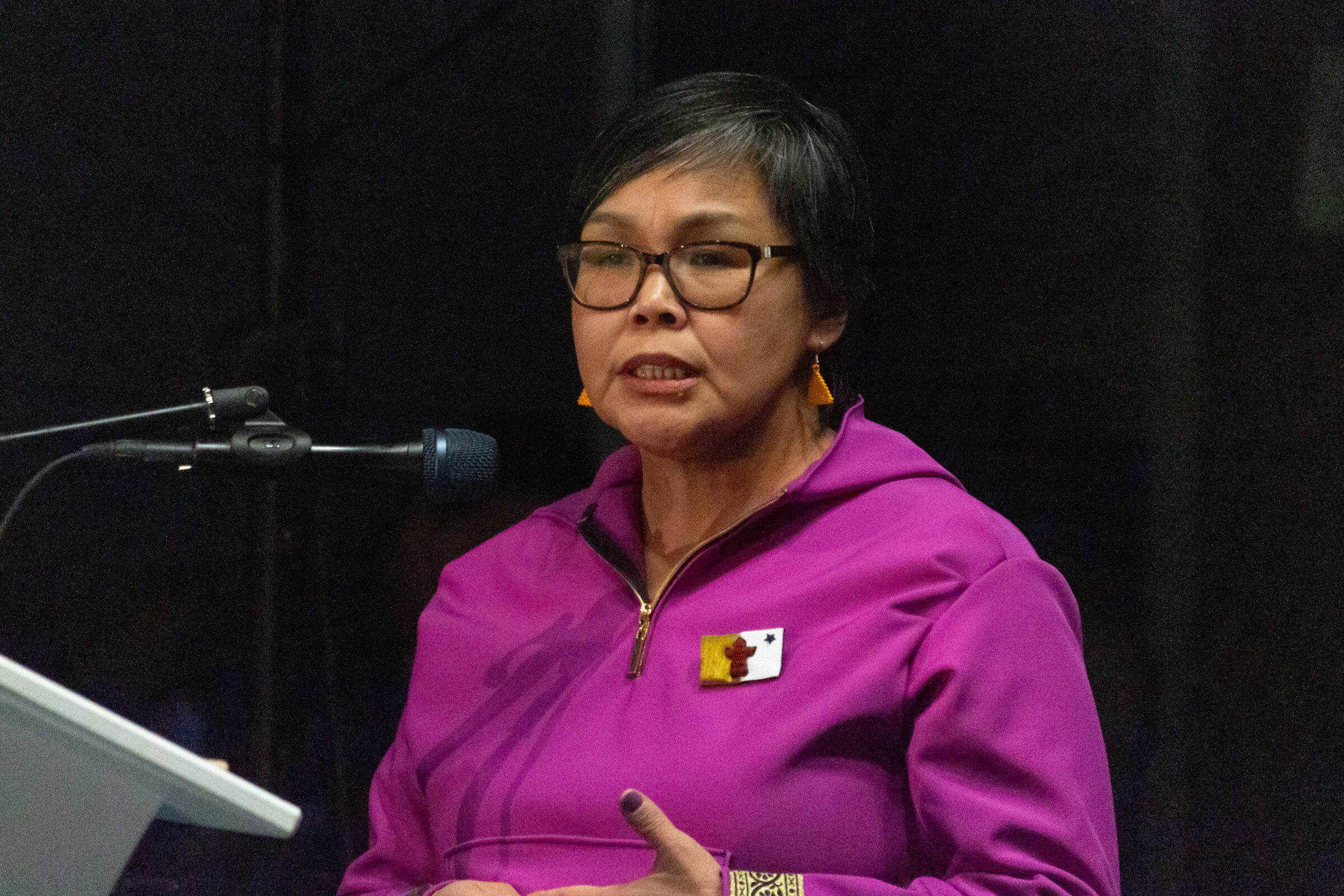
Nunavut NDP MP Lori Idlout says Inuit families are suffering after funding for a universal food voucher program was cut. (File photo)
A universal food voucher program helped more than 15,000 Inuit children and youths over two years at a cost of close to $90 million before it was discontinued by the federal government this year, says Nunavut MP Lori Idlout.
“A lot of families have been suffering after it was cut,” Idlout said in an interview Nov. 14, adding, “important programs like these need to be maintained.”
She said the data comes from a report provided to her on Oct. 29 by Indigenous Services Canada, in response to a written question she asked in the House of Commons in June.
Idlout said her staff calculated the average cost to be about $17 per child per day over the two years of the program, which started in the fiscal year 2023-24 and ended on March 31 this year.
The universal food voucher program was replaced by one based on the needs of each individual child.
“To see the number of Inuit using [the program] in each community is not a surprise to me because there are so few employment opportunities,” she said.
“So of course, there’s going to be many people that are going to have to rely on federal support.”

The numbers “showed just how little this federal government needed to do to have such a huge impact,” she said.
The universal program provided Inuit families $500 per month each for each child or youth to buy food, and an additional $250 a month for a child aged four and under to pay for items like diapers and baby formula.
The amount of funding provided varied by community.
Between April 1, 2024, and March 31 this year, in Rankin Inlet, approximately 1,048 children were supported at a total cost of $6,224,363, or about $5,939 per child.
In Iqaluit, the report showed, 1,300 kids were helped at a total cost of $4,068,653, or about $3,129 per child.
Programs in the communities started at different times, as hamlet administrations submitted their proposals to the federal Indigenous Services department.

“There was not a specific food program component under the Inuit Child First Initiative,” Jennifer Cooper, a spokesperson for Indigenous Services Canada, said in an email Friday.
“Each hamlet submitted a request to Indigenous Services Canada for group request funding to support Inuit children in their communities.”
The Inuit Child First Initiative provides socio-economic support for Inuit children and youths, including health care and education. It is funded by Indigenous Services Canada.
While funding for the food voucher program came from the Inuit Child First Initiative, it was not an official part of it.
In April, Indigenous Services Canada said it would no longer accept funding requests for groups of children and youths.

It switched instead to an individual needs-based system, effectively putting an end to the 24 food voucher programs that had operated across the territory.
That led to widespread concern among Inuit leaders, advocates, social workers and community members who feared that without government assistance children would go hungry.
The hamlet of Pangnirtung commissioned a study that showed ending the food voucher program would increase food insecurity.
“There were tears amongst health-care providers when they heard about the end of this program,” Dr. Sindu Govindapillai said in March. She is director of Qupanuaq, an Iqaluit organization that has received funding from the Inuit Child First Initiative for various programs in the Qikiqtaaluk Region.
In April, Nunavut mayors said they too were “deeply concerned” about the end of the universal food voucher funding.
The federal budget passed earlier this month contains no funding for the Inuit Child First Initiative beyond March 31, 2026. In an interview Nov. 7, Indigenous Services Minister Mandy Gull-Masty said the department intends to overhaul the program and make it permanent.
Nunatsiaq News asked representatives from Indigenous Services Canada on Nov. 17 a series of questions: how many Inuit children and youths were being supported under the new needs-based approach to funding; how much money had been spent; and whether a food voucher-type program would be considered in the future.
The department did not provide specific answers in its response.
“Each request is assessed on a case-by-case basis, taking into account the distinct needs of the child and gaps in other programs or services. Children can continue to apply individually,” said Anispiragas Piragasanathar, a spokesperson for Indigenous Services Canada.
“While the initiative can support families with temporary income supplements, such as rent, groceries, or utilities, to address immediate risk factors for children, it is not intended or structured to replace universal government programs such as food vouchers,” Piragasanathar added.
So the $17/day per kid helped as much as it did… that means 1 person in each home needs to work 1 hour a day per kid they have at minimum wage ($19/hr) and they would be able to feed their family better?
You’re missing the point – the income from a minimum wage job will also be going to getting to and from that job, housing to sleep at night to be able to work that job, any utilities needed for the housing, food for everyone in the household, clothing [especially warm clothing] for the people in that household, special needs items (maybe diapers, formula, diet specific foods) for that household.. that minimum wage job is very unrealistic in an isolated community.
Ask the mining companies that are making millions
ask them for what? a job?
OMG!!!
That sounds like that evil other four letter word…😱 Work.
Lord Have mercy.🤕
agreed, on paper approximately 15k children under 18 benefitted. But it was evident that a a certain percentage of “parents” (single-married /common) abused the system. How…you ask?
They cooked baked good and sold them for cigarettes, alcohol and drugs
They traded groceries for alcohol/drugs
Of the 15k listed at least 20 percent of the children didn’t eat from this program, if they did it was minimal. There was also an “expected” outcome to this program. Grocery price gouging by Northern/Northmart was out of control.
So that is not the fault of the system but once again the fault of the abusers of the system.
it would be interesting to look at all the stats for this time period. Having more disposable income allows you the freedom to continuing unhealthy habits that very much affect children.
has crime gone up or down?
Overdoses?
Number of addictions
number of hospitalizations due to drugs and alcohol?
number of kids in care?
sales from the liquor commission.
Throwing money at the problem won’t solve it. Elected leaders should be petitioning for long term solutions such as education and training as well as encouraging her people to get into the workforce and be reliable. Sometimes that means addressing the elephant in the room.
too often on social media the businesses in Nunavut have been critized for hiring
it would be interesting to look at all the stats for this time period. Having more disposable income allows you the freedom to continuing unhealthy habits that very much affect children.
has crime gone up or down?
Overdoses?
Number of addictions
number of hospitalizations due to drugs and alcohol?
number of kids in care?
sales from the liquor commission.
Throwing money at the problem won’t solve it. Elected leaders should be petitioning for long term solutions such as education and training as well as encouraging her people to get into the workforce and be reliable. Sometimes that means addressing the elephant in the room.
too often on social media the businesses in Nunavut have been criticized for hiring new Canadian’s (for lack of a better term) This is after years of trying to hire Inuit and either not getting the applicants or having huge attendance issue that affect the operations of their business. No one can say this because it is “racist” but it is the reality of all the business in Iqaluit. Lori needs to be the voice to rally her people to get out there and not just incentivize making babies adding to the housing issue.
The north also has to stop looking at each issue as existing in a vacuum. All of these are related. When you make a policy that rent is tied to household income then you discourage work which makes kids go hungry . You have done nothing to help the housing issue as the policy intends to do but you create another issue that you now need to throw money at
If you look at the Nunavut Statistics there aren’t even 15K children of all races in Nunavut under the age of 15. I would like to know what ages would be considered youth 20-25?
Why wouldn’t you just add this to the monthly income support payments?
Honestly, this story just shows how out of touch Ottawa still is with the realities in the North. A program that helped 15,000 Inuit kids for about $17 a day — in a place where milk can cost $15 — is not something you cut unless you have a stronger replacement ready to go. And clearly, they didn’t.
Universal support worked because it was simple, fast, and didn’t make families jump through hoops just to feed their kids. Switching to a needs-based system always looks good on paper, but on the ground it means fewer people get help, slower approvals, and way more stress. Even the frontline health workers were in tears when they heard it was ending — that says everything.
The federal government loves to talk about reconciliation and supporting Inuit, but when a program actually does what it’s supposed to do, they pull it before communities have anything to fall back on. The lack of transparency in their answers now just makes it worse. This decision feels like a classic case of Ottawa making cuts first and thinking about consequences later.
Thanks AI chatbot
Why don’t people just get jobs or maybe stop by cigarettes.
Lori will always be ignored because she only complains. She should be working for solutions (and just handimg all Inuit parents isn’t a solution, all that does is create a dependecy). The goal for Inuit should be self sufficient – not rely on the government (who they complain about) to live their daily life.
He a contributing member of society and Canada.
This is what you get for Voting NDP! Grow up people, why would you vote her in? Makes no sense why you people voted for her…….You get what you pay for….NDP Trash.
What all of this, beyond the mathematics, data review and analyses show; is that the system is broken. Broken badly. It has been broken for a long, long time. It is broken in a million ways! The truth is and no one ever wants to admit it, is everyone; Feds, GN, Inuit Org’s, Hamlets, Businesses, and we the people have done very little to address it or fix it in any meaningful way. That is, other than throwing money at it, putting on some window dressing from time to time and adding more band aids. The core issues always remain and we all know what they are…just read some of the comments already on this subject posted here.
The reality is, it has long since been time that everyone sits down and figures this out. Everyone, together. Mrs. Idlout is clearly not the one to be leading this campaign for change and solutions. She is merely interested in playing the victim and politics at the detriment of Nunavummiut’s she is supposed to serve.
Message to the new GN and everyone else mentioned above. Enough spinning in a circle and let’s figure out how to address this once and for all! Ultimately, it’s the children who pay the price and that is all that should matter!
In 2015, as part of the legal settlement reached between NTI and our levels of government, NTI successfully alleged that Inuit annually lost $214 million in wages from not fully participating in government employment.
10 years have since past, and efforts continue to increase the level of Inuit employment in government including the moderately successful Makigiaqta Contribution Program. This work is by no means complete.
The “lost” wages to Inuit from not being educated or prepared for work must be considerably higher considering other jobs in sectors such as tourism, mining, transportation, and construction.
The point being, hundreds of millions in wages each and every year are on offer to Inuit today in Nunavut.
This potential injection of cash directly into the hands of Inuit, no strings attached, completely and utterly dwarfs the $90 million for a food voucher program for Inuit to feed our families because we have no money of our own to go to the store to buy food for ourselves.
And before anyone says that out of work Inuit cannot be possibly trained for all these jobs, let us please consider the upward mobility possible by Inuit already working, that could be trained for higher level work, leaving entry level jobs for others.
This whole topic of food vouchers entirely misses the mark in describing the current situation. Our MP could be well advised to shift her outrage from the loss of handouts to the absolute crying shame of any Inuit idle with a whole territory on the move need to be run and grow.
We lead Canada in GDP growth. Are food vouchers actually a solution to any of our problems?
If we are collectively fine with the idea that no matter of how much government and development we have, a good chunk of our people will still be doing nothing, then I think more fundamental questions exist besides how to feed 15,000 children, including where in the garbage our IQ principles go.
Does NTI do much more than waste time looking for lawsuits? Dont they sort of own the new hotel in Iqaluit? Maybe they can explain why they barely have any inuit working at an inuit owned hotel? I’m sure they could find some lost wages there too? Maybe they can sue QIA next?
The most frustrating part of seeing an Inuit-Owned hotel – which is flaunted and advertised as such – being ran by non-Inuit everyday.
Perhaps if the inuit who are looking for more food vouchers show up for work regularly this would solve the problem. Customers get upset when there’s no cooks, servers or clean beds to sleep in for $350 a night.
So the hotel. Prefaced off shore. Didn’t use Canadian materials and now operated with low inuit participation. These organizations impose employment and local spending requirements on contractors but choose to ignore thier ownpolicies. Peculiar ehe.
There are no Inuit working at the hotel for the same reasons they aren’t working at any other establishment in town. These incentives incentivize not working. 4 kids is $2000 a month in groceries. No working puts you at the bottom end of the wage scale and then you get income assistance.
Then there is the attendance and reliability issues. How can you operate a hotel when you don’t know if you will have employees coming to run the front desk, clean the rooms etc. At some point you have to make a decision to operate the business or not. If you are Inuit and looking for a job all these places will hire you because the cost of hiring non-Inuit is not cost effective
Sure they all benefitted from it, but how many truly needed it?
Why be born today as a inuk child. That’s what I often think about. There’s no jobs for young families, always starving not maintain well. Why be born today, because of lack of living as a different culture. Use our language perhaps here. Don’t talk in other languages even.
Ata, if you have problem with inuit being born today, please pick up condoms from your local health center, they’re free
Lori should be encouraging these kids to finish school and not depend on handouts. We need teachers, nurses, lawyers, accountants and the list goes on. These positions need high school diploma and college or university degree. Like I said before, Nunavut would be a much better place if my Inuuqatik didn’t depend on handouts.
Lori forgot to factor in the number of parents that were assisted also.
Suddenly, as if out of loving government hearts, $500 dropped per Inuit child in households across Nunavut. It didn’t matter much if a parent or parents made good money.
The game was now set to strip the money suddenly away after all were hooked on it. And they did.
Causing as if on cue, crying, panic, with calls the free money must come back. Victims-hunger stories filled the air.
While few voices and zero politicians were demanding more jobs, think tank solutions, staying in school, improving education or innovation thinking.
Now that the government has all right where they want, to soon drop their improved solution. Without anyone needing an education, to stay in school or even a job.
Simply sign up for digital ID if want to continue easy access to free money.
But wait, there’s more. Like Covid shots, Nunavut will probably be the first to implement Universal Basic Income for all. No longer just free money for kids under 18. John Main talked about UBI back in the day when he was a regular member years ago. And the innocent little world planned steps keep moving forward.
The Senate has now passed the second reading of its S-206 bill on November 6, 2025, in the Senate. So much for sober second thought.
Of course, you’ll have to obey the government to receive the UBI, or you’ll be cut off. Every purchase, every item will be monitored. And down the road tied to carbon credit and social credit scores. Maybe must buy lab-grown meat only to save the caribou from climate change? Wonder if the Liberal/NDP safe supply of free drugs will be okay?
Thus, the reliance on the government for digital-free-money will guarantee significantly higher taxes and no motivation to work.
The massive ongoing conservation land grab across Nunavut snatches the land away, and UBI captures the people… both without notice.
Its crazy how some people dont even have the opportunity to get a job in smaller communities but looked at like every parent can get a job within that community. And there are single parents that has to work extra to be able to get by, some have to work 2 or more jobs because their rent is sky high and so is everything else.
The Inuit that struggle with mental health often comes from generational trauma, which often means some parents turn to an addiction to hide their mental health, some try forget but fall deeper because of the choices they made. Im pretty sure if these people went thru the same truth and reconciliation, they would speak on how to get out of the trauma caused from the past generation trauma and a mix of todays trauma, that some dont know how to cope with. Some day someone will speak on behalf of our Inuit, someone that is aware of not only the ones that abuse the system but to better understand why ICFI and other issues that come to place. This high cost of living in Nunavut, needs to change