

A king nighter
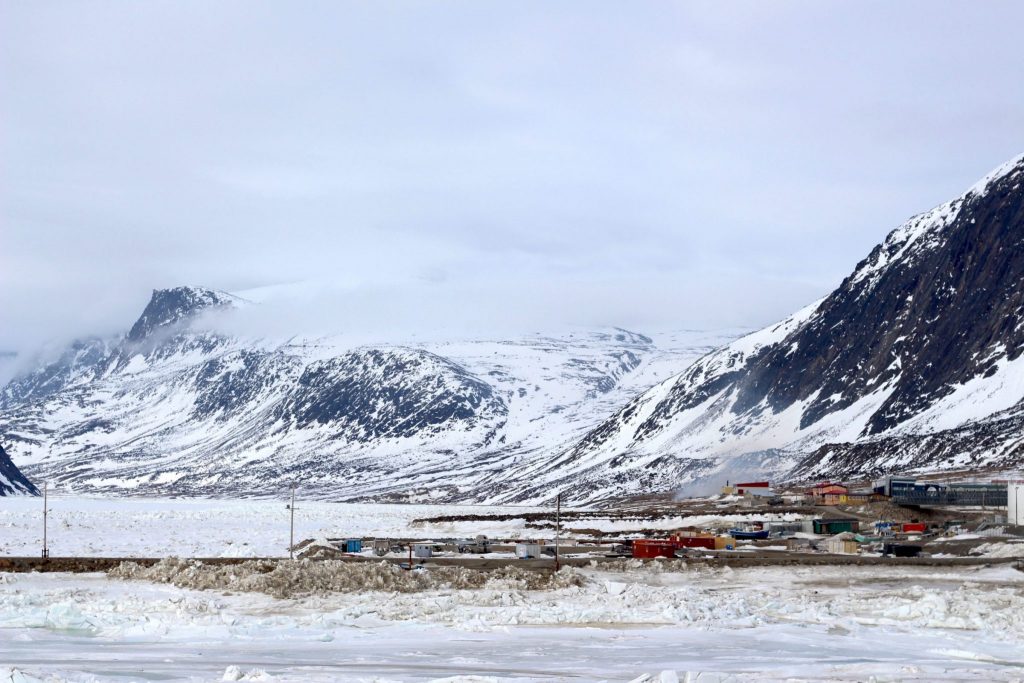
Pangnirtung is a notoriously windy hamlet, writes Kenn Harper. (File photo)
Pangnirtung is famous for many things, including its sheer beauty and the ferocious winds that occasionally pummel the community.
These winds are occasionally the subject of news reports.
On Jan. 12 this year, CBC reported that winds of 160 km/h had hit the community just as the sea ice was finally forming, and blew the ice away. This happened at a time of year when hunters were hoping to finally have the ice as a stable platform for seal hunting and ice fishing.
Instead, they were boating again.
Local people told the CBC reporter that at least the conditions were good for clam digging.
In 2010, Nunatsiaq News ran a headline: Blasting winds wreak havoc in Pangnirtung. Wind gusts were as high as 140 km/h. The wind tore the roof off a fiveplex, sent boats flying through the air and flipped over a car. A resident described “three-quarter-inch sheets of plywood flying like Frisbees.”
An over-enthusiastic writer for UpHere Magazine once wrote that in Pangnirtung the “wind will blow the wrinkles out of your face.”

I lived in Pangnirtung from 1969 to 1971 and was there for one of the community’s worst windstorms. Six houses were damaged or destroyed, debris and construction material flew everywhere. People who were frightened to remain in their own houses, which were shaking in the wind, took refuge in the school.
I had never experienced such wild weather. I had spent three years living on the other side of the mountains, in the relative serenity of Qikiqtarjuaq and Padloping Island. Padloping was often windy, but not with the gale-force winds that lambasted Pangnirtung.
Looking from the community up to the head of beautiful Pangnirtung Fiord, with mountains on two sides framing the scene, it’s easy to imagine the winds barrelling down Akshayuk Pass — usually called Pangnirtung Pass — from the height of land and continuing down the fiord to the community. That’s what most outsiders think.
But my friend, Ross Peyton, told me that that wasn’t what happened. He said the wind comes from Kinngait Fiord, a large fjord roughly parallelling Pangnirtung Fiord, crosses the peninsula separating the two, and comes around Mount Duval and then on to Pangnirtung.
Probably every Inuk already knew that, but Qallunaat generally didn’t.
In 1975, longtime northerner Bert Rose, then living in Qikiqtarjuaq, snowmobiled with some other teachers to Pangnirtung at Easter.

Two years earlier, Bert and his wife Joanne had hiked from the head of North Pangnirtung Fiord, through the pass, and on to Pangnirtung.
In 1975, the teachers camped overnight at Summit Lake, the height of land. When they arrived in Pangnirtung late the next day, they learned Pangnirtung had had a terrible windstorm the night before — one of the bulk fuel tanks had a large dent in its side like a Coke can that someone had squeezed. And yet, the teachers from Qikiqtarjuaq had not experienced any wind at Summit Lake.
I was surprised a few months ago when reading an old document about Capt. John Spicer, once the most influential American whaleman in Cumberland Sound, about his experience of the famous wind. Except he wasn’t in Pangnirtung Fiord. He was in the opposite fiord, Kinngait Fiord. Exactly where in the fiord is unclear.
And Spicer had even given the devastating winds a name. He called them king nighters.
The document says, “Whirlwinds, called king nighters, come down from the high hills of the north and rage with terrible fury, tearing whaleboats from the ships and smashing vessels against the fast ice.
“In one of those wind storms, Spicer… suffered the loss of two boats. A native [Inuk] in Spicer’s employ was nearing the ship with a message when the wind raised his boat high out of the water, overturned it and the Indian fell into the seething foam. [Spicer usually referred to Inuit as Indians.] He was saved by grasping a hook which the captain had reached to him and was drawn to the side of the ship and scrambled on board, expressing gratitude in his way for the timely assistance.”
What about that name? Why king nighter? Spicer was in Kinngait Fiord. Kinngait means “the hills.”
It’s the same word as Kinngait, the current name for the community formerly known as Cape Dorset. Official maps name the fiord incorrectly as Kingnait Fiord. Spicer seems to have thought of it as two words: King and Night. Qallunaat today often make the same mistake, pronouncing “kingnait,” instead of “kinngait.”
Perhaps the winds Spicer experienced happened at night, making the term king nighter all the more appropriate.
Inuit probably knew the word king nighter too, in the heyday of the whaling era. Most of the Inuit men who worked seasonally for the whalers learned to speak some English, to communicate with the Americans and the Scots.
Some of it would have been a kind of trade jargon, a simple mixture of words from English and Inuktitut. But some of the men would have learned more. King nighter was probably part of their vocabulary then, a word to describe a wind that wrought destruction on anything in its path.
Taissumani is an occasional column that recalls events of historical interest. Kenn Harper is a historian and writer who lived in the Arctic for over 50 years. He is the author of Give Me Winter, Give Me Dogs: Knud Rasmussen and the Fifth Thule Expedition, and Thou Shalt Do No Murder, among other books. Feedback? Send your comments and questions to kennharper@hotmail.com.
I well remember the great wind Kenn Harper writes of in 1975. I was there in Pangnirtung as a legal aid lawyer travelling with the “Court Party”. We were flying in NWT Air’s specially equipped DC – 3. It was dedicated to court charters with tables for the Judge and court officials. Expecting forecasted winds, the crew firmly anchored the DC 3 at the airport facing north. Those furious winds, which we were told had reached 160 mph, created a vacuum that not only compressed the community’s large fuel tank like a tin can but also blew the entire roof off the Hudson’s Bay store, sending merchandise… shoes, clothes down the fiord. Along with many community members, we were evacuated to the school, with its generator providing power. After the wind subsided, I walked around town, amazed to find that the plane was still there, but the control surfaces had blown off our plane. It could not be flown without flaps, rudder and elevators! We had to fly out on another plane. Though the wind was frightening and tore several houses loose from their foundations, one happy consequence, for the citizens of Pangnirtung was the opportunity to “salvage” merchandise from the HBC store by foraging on the ice south of town…
Yes, thank you for not letting me die while I tended to your boat *insert eye roll*
The next fiord on south of Pangnirtung fiord can have worst notorious wind than Pangnirtung.
Kangituruluk notorious wind can peel off the fiord ice in the middle of the winter and the ice thickness could be 3 to 4 feet thick.