


Nunavut’s top public health doctor optimistic over TB numbers
Public awareness and education key to ending tuberculosis by 2030, says Dr. Ekua Agyemang
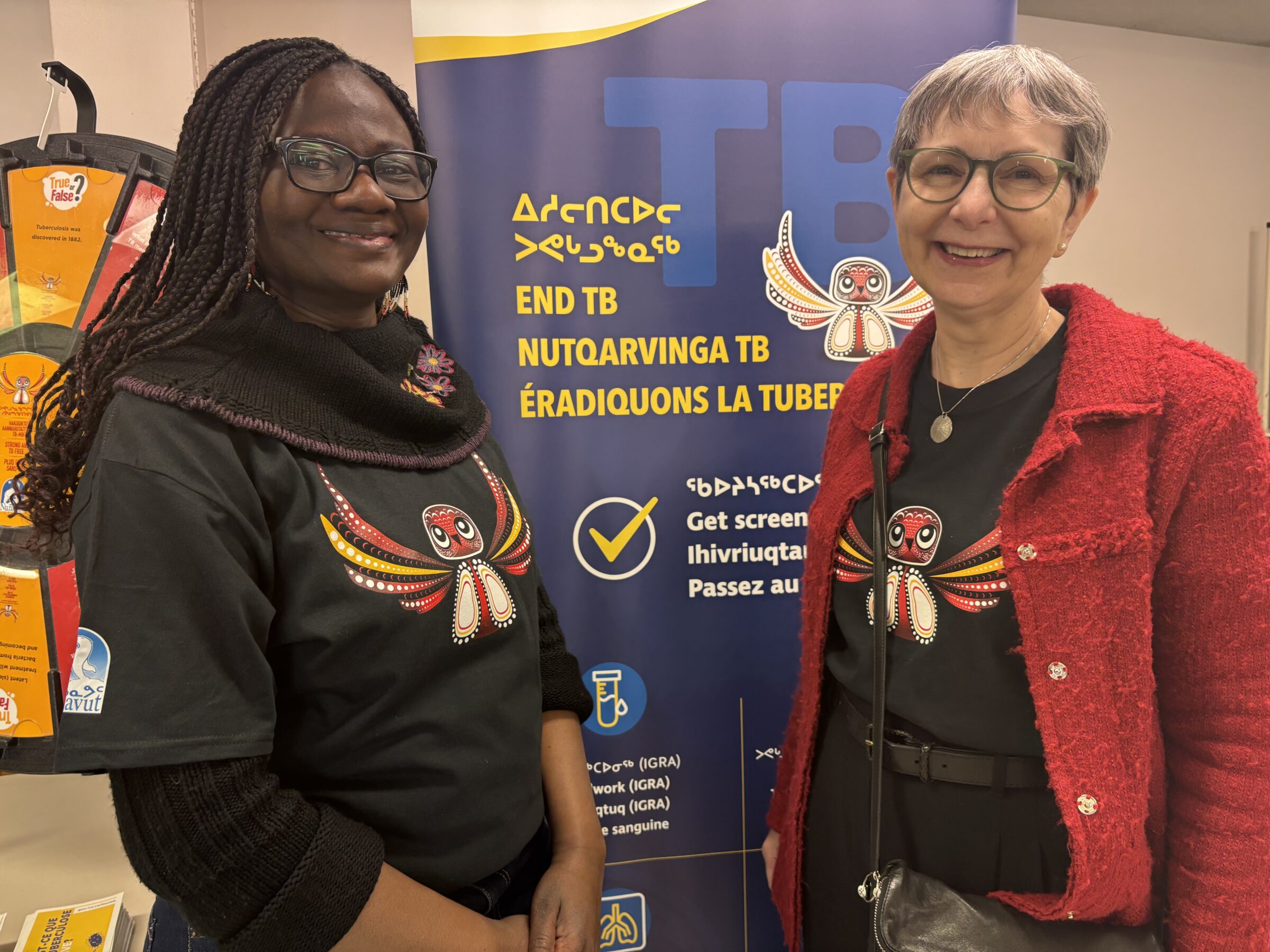
Dr. Ekua Agyemang, left, Nunavut’s chief public health officer, and Dr. Natasha Crowcroft, Canada’s acting chief public health officer, host an event for World Tuberculosis Day in Iqaluit on Tuesday. (Photo by Daron Letts)

Fewer than five cases of active tuberculosis have been diagnosed in Nunavut this year as of mid-March — and that’s reason for optimism compared to previous years says Dr. Ekua Agyemang, the territory’s chief public health officer.
She hosted a tuberculosis awareness event Tuesday at the Catholic parish hall in Iqaluit to mark World Tuberculosis Day as designated by the World Health Organization.
The theme, which included educational games, prizes and country food, was “Yes! We can end TB. Led by communities. Powered by partnerships.”
Tuberculosis is caused by airborne bacteria and typically affects the lungs, spreading through prolonged close contact especially in enclosed spaces.
The disease is curable with antibiotics, and medications are available within Nunavut communities. If left untreated, it can be fatal.In 2023, the national TB rate was 5.5 cases per 100,000 people, compared to 204.2 per 100,000 among Inuit, according to the Public Health Agency of Canada.
The Government of Nunavut has set a goal of eliminating tuberculosis in the territory by 2030.
“If we consistently put in the effort that is needed and we sustain it, it’s possible,” Agyemang said in an interview.

Compared to the fewer than five active cases detected so far in 2026, during the first three months of 2025, six people were diagnosed with active tuberculosis.
Incidents of active TB in Nunavut have been in decline since 2023. That year there were 67 cases, then there were 36 in 2024, and 26 for all of 2025.
All the cases diagnosed in 2026 have been in Qikiqtaaluk Region.
Increased vigilance and ending stigmatization of the infectious disease were the goals of Tuesday’s event, attended by Dr. Natasha Crowcroft, Canada’s acting chief public health officer.
“The work that’s been done in Nunavut has been incredible to try and address this issue,” Crowcroft said. “We have a strategy to eliminate tuberculosis in Canada.”
Agyemang co-chaired the federal tuberculosis strategy, which was drafted in March 2025 and is in the late stages of being adopted nationally.

Pangnirtung acting mayor Markus Wilcke said the optimism at Tuesday’s event is far-fetched. He previously raised concerns about tuberculosis spread during discussions with fellow leaders at the Baffin Mayors Forum in Iqaluit earlier this month.
“Tuberculosis is not just a medical condition, it is a social condition, a mental health condition, as well as a condition of poverty,” Wilcke, a nurse, said in a phone interview Tuesday.
TB remains “a time bomb” for Nunavut as long as the housing shortage and other social issues related to health persist, he said.
“It is my humble opinion that to think that tuberculosis can be eliminated by 2030 by improving health education is completely unrealistic,” he said.
Iqaluit resident Ahmee Papatsie, who attended Tuesday’s event said she had tuberculosis twice in the 1990s.

Asked if events like these will help curb the spread of tuberculosis, she struck a middle tone.
“It will help,” she said. “A bit.”
This is hopeful. Thanks for publishing this article. More information has to break through about this critical issue. It’s a brutal disease that preys on less fortunate people and the rest of the world does not know that part of Canada is suffering.