


Nuclear in Nunavut — The big idea
Part 1 | While ideas fit for the Arctic remain in conceptual stage, companies have peddled their ideas to northerners
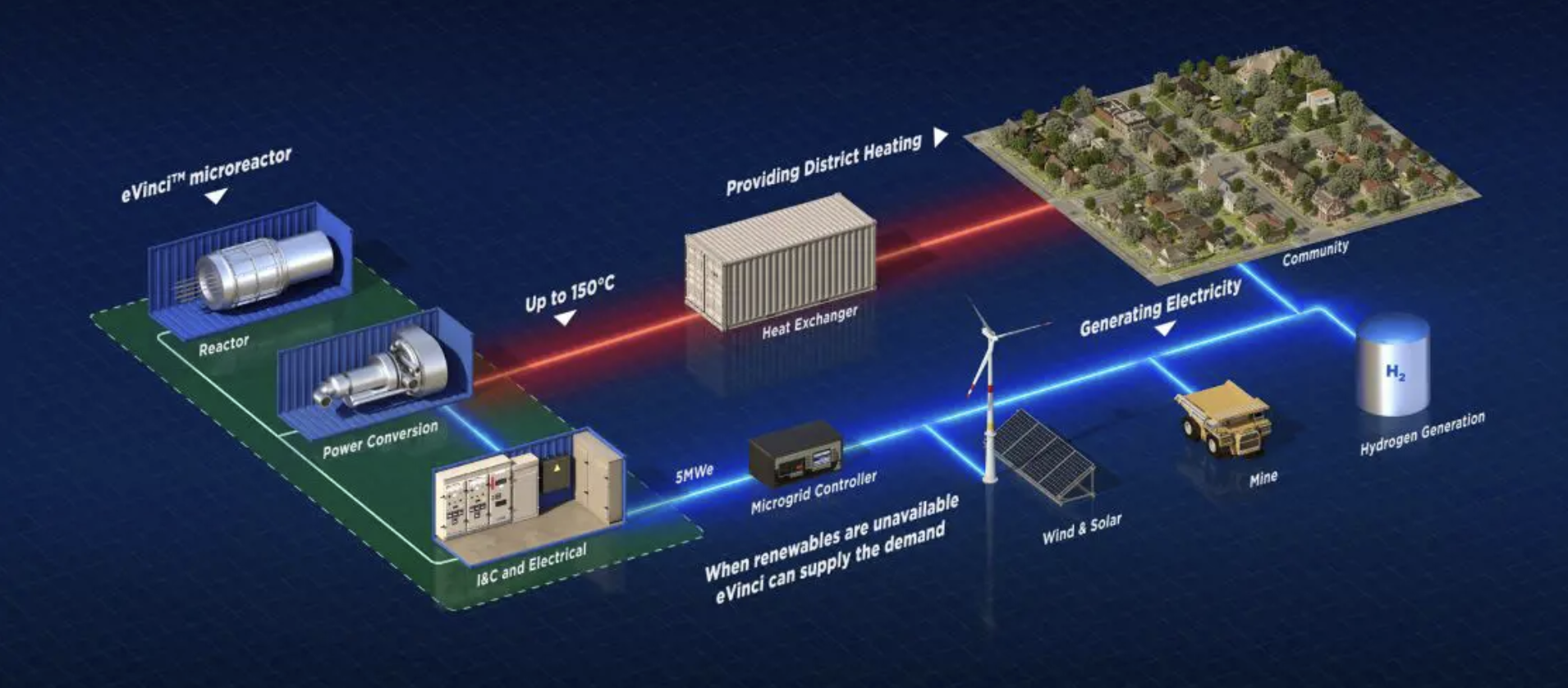
U.S.-based Westinghouse Energy Co. has been to Iqaluit in recent years to promote its eVinci microreactor, a five-megawatt advanced nuclear reactor designed for use in remote areas. (Image courtesy of Westinghouse Electric Co.)

Nuclear in Nunavut is a four-part series exploring how advancements in nuclear technology might impact the territory.
Imagine a nuclear reactor about the size of a sea can.
Inside it is a fuel cell that can produce electricity for several years with no refueling. It’s made to be transportable in pieces and assembled on site. When it’s time to decommission the reactor, it can be carted off leaving nothing behind, not even nuclear waste.
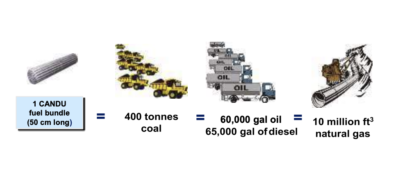
This image shows the amount of energy contained in a 50-centimetre bundle of nuclear fuel compared to other fuels. (Image courtesy of Government of Canada)
“When most people hear the words ‘small modular reactor,’ that’s what they think about because they’ve seen a video online of a semi or a truck going down an ice road with a little reactor on the back, delivering it to a community,” said David Novog, an engineering professor at McMaster University in Hamilton, Ont., who specializes in small nuclear reactors.
There has been a proliferation of small nuclear reactor designs over the past 20 years, Novog said.
There are more than 80 ongoing small nuclear reactor projects in various stages of design and development globally, according to the International Atomic Energy Agency. Two are in operation — one in Russia, the other in China.

Because nuclear energy advancements could make the technology more affordable and transportable in the coming years, Nunatsiaq News is exploring the ideas and the possible risks and benefits they could bring to the North.
What is a small modular nuclear reactor?
Small modular nuclear reactors can range in size from something that would fit on the back of a flatbed truck to others that are several metres high.
They’re modular, meaning they are fabricated in parts in a centralized factory. The parts are shipped to their destination, then assembled.
And they use enriched uranium to generate electricity. Traditional nuclear reactor technology — what exists now — involves using enriched uranium to boil water. Steam from the boiling water spins a turbine, creating energy that produces no greenhouse gas emissions.
Canada is on track to be the first G7 nation to produce a small nuclear reactor. The project, under development in Darlington, Ont., will be capable of producing 300 megawatts of electricity, which could power approximately 300,000 homes. Four reactors are under construction, at an estimated cost of $21 billion.

While classified as “small,” the Darlington reactors are about 20 metres tall.
“Canada likes to put up its hand and say we’re building one,” Novog said.
“But the reactors at Darlington are not really what we’re talking about for the North. You know, in the North, what would be ideal is advanced microreactors.”
What is an advanced microreactor?
Advanced small, or micro, nuclear reactors are made to provide anywhere from a few hundred kilowatts of energy — enough to power a small remote community — to five megawatts, suitable to provide electricity to about 3,000 homes.

They are designed to run autonomously with little human intervention, making them ideal for remote communities and mines.

David Novog is a professor of engineering physics at McMaster University in Hamilton, Ont., with a specialty in nuclear engineering and energy systems. (Photo courtesy of David Novog)
The problem is they don’t exist yet. Advanced nuclear technology remains in the conceptual stage.
“My one caution when I talk to northern communities or First Nations communities is that nobody is there yet,” Novog said.
“There’s not a commercial package where you could say, ‘I’m Community X, I’m ready to go. My populace is all on board and we’re excited to have it. Let’s go, bang. Here’s my money, bang.'”
But that isn’t stopping companies from peddling their ideas to northerners.
U.S.-based Westinghouse Electric Co. came to Iqaluit in April 2025 to highlight its eVinci microreactor project, a five-megawatt miniplant intended for remote use. Later that spring, Westinghouse hosted northerners on a trip to its Pittsburgh, Pa., facility to see the reactor project itself.
Representatives from Qulliq Energy Corp., Nunavut’s three regional Inuit organizations, Nunavut & NWT Chamber of Mines, and Agnico Eagle Mines Ltd. were a few from the group who travelled to Pittsburgh.
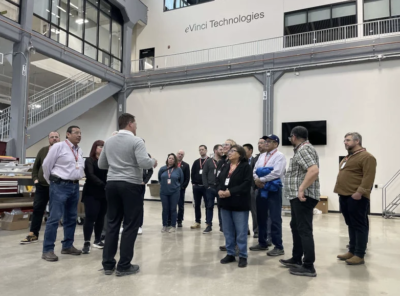
A group of representatives from Nunavut, including the three Inuit organizations, NWT and Nunavut chamber of Mines, and Qulliq Energy Corp., take a tour of Westinghouse Electric Company’s eVinci reactor project in May 2025. (Photo courtesy of Westinghouse Electric Company)
Sometimes at conferences and conventions, “we’d have some interaction with companies that were interested or just trying to get the general sense of where Nunavut was at in moving toward nuclear power,” said Hudson Lester, acting executive director of the Nunavut and NWT Chamber of Mines, of the chamber’s interactions with Westinghouse.
“But that was our first, I’d say true, ‘Come check it out, here’s our idea.’”
Today, Westinghouse is focusing efforts on developing a different type of reactor through an $80-billion deal with the U.S. federal government.
But dozens of other projects remain in development across the world.
“If things keep proceeding where we have these demos and commercializations, then maybe five or 10 years from now we will have a commercial product,” Novog said.
Meanwhile, across the Arctic horizon in northern Russia, a small nuclear reactor provides power to a community called Pevek, population 4,000.
Coming up in Part 2: The story of the world’s first floating nuclear reactor, and how a similar idea could someday sail into Canada’s Arctic.
This article is right that only 2 civilian microreactors are operating globally. But calling the technology a conceptual “big idea” misses the point: compact reactors have more than 70 years of proven operating history.
This is not an untested scientific breakthrough. The core engineering dates back to the 1950s, when compact reactors were developed for naval submarines. Westinghouse itself supplied the reactor for the USS Nautilus, the world’s first nuclear submarine, and later built the world’s first commercial pressurized water reactor. These typically are between 30 to 50 Megawatts in size.
What is happening now is not invention from scratch. It is the adaptation of proven defense technology for civilian licensing, financing, and deployment.
Nuclear navies have operated small, isolated, self-contained energy systems for generations in some of the world’s most demanding environments.The question is not whether localized, reliable, off-grid nuclear power can work. That has already been proven. The real challenge is whether modern civilian regulators, supply chains, and project economics can make microreactors a practical infrastructure option for remote Arctic communities.
There is still a difference from the modular nuclear concept. The reactors on naval vessels still rely in specialized and highly trained crew to operate and maintain them. The modular reactor concept is more akin to the nuclear battery idea: you plug it in, it does what it needs to do, you pull it out and replace it when needed.
Also tending to get glossed over is that it requires a significant investment in training operators, even if the nuclear component itself requires none of them. All these plants work by using the power to boil water, creating high pressure steam that is fed into turbines to power generators. The problem is that this in itself requires specialized training. You can’t simply transfer over the mechanics maintaining the diesel generators. Right now, no such system operates anywhere in the territory, so there is literally no one, unless they’d worked at a thermal power plant down south, who has the necessary training and skills.
The training argument is valid, but it is not unique to nuclear power. Diesel technicians, hydro operators, power-system operators, water-treatment staff, and airport maintenance crews all require specialized training, supervised experience, and site-specific qualification. A diesel mechanic is not created overnight either typically via a 4 year program.
The U.S. Navy, by comparison, trains nuclear power plant operators in roughly 18 months, taking recruits from no nuclear background to qualified operation of compact reactor systems. That is serious training, but it also proves the workforce can be built through a disciplined program.
It is also misleading to suggest that microreactor technology is completely foreign to existing power workers. The main differences are the heat source, cooling system, scale, and regulatory requirements. The broader plant still involves familiar industrial systems: pumps, valves, generators, controls, heat transfer, electrical distribution, maintenance procedures, and operating discipline.
No one is saying a diesel mechanic could run a microreactor tomorrow. But existing mechanical, electrical, and utility skills would provide a foundation for nuclear-specific training. The workforce challenge is real, but it is a planning issue not proof that the technology is impractical.
Most micro nuclear concepts being pursued today are along the lines of a nuclear battery.
They are not reactors.
A nuclear battery works by harnessing the energy from the natural decay of radioactive materials. This is fundamentally a passive process.
A nuclear reactor is a controlled, active nuclear fission process. This is a higher energy, dynamic process that requires constant management.
From the point of view of having to operate or manage a nuclear battery, there is actually not much, if anything, to be done.
To this point the most notable use of nuclear batteries have been in space exploration to power probes. The Voyager 1 and Voyager 2 probes have been continually operating for over 47 years in deep space with zero human intervention even possible.
A nuclear battery deployed into a Nunavut community would probably just involve digging into the ground or permafrost and burying the unit so that nobody can tamper with it. All you would see is cables coming out of the ground.
It would be remotely monitored by trained technicians in the south. The main workers you would need in a community would work on power distribution, the same as Qulliq Energy Linesmen.
As usual when it comes to alternative energy, while the western world dithers, China delivers.
A 10MWe truck mounted nuclear battery is currently being tested by the FDS Consortium in China. Obviously, this nuclear “battery” approach is beyond conceptual.
It may be hard for anyone to believe that this Chinese effort will be progressed beyond testing anytime soon. For micro or ultra small nuclear reactors, for us here in the west, we are now well used to the outlandish claims, overconfident timelines and broken promises of the many companies who have tried and are trying to develop reactors for this market space.
The advantage of a state controlled one party economy in China is that the communists can commit significant resources consistently for years towards a specific problem (from theory to application) without political pushback. The Chinese also do not have to deal with the worry of achieving a rate of investor return in the short term that the western investor demands.
We see the contrast clearly between the Chinese and Westinghouse; China has not dropped the ball on micro nuclear because someone waved some free money in their faces.
That is also why companies like Westinghouse who have operated for more than a century, have not developed a far superior super critical carbon dioxide power turbine in all that time, while China achieved this last year.
China is currently the world leader in nuclear power plant construction, with Chinese companies currently building 37 albeit larger and conventional nuclear power plants worldwide. Chinese nuclear power projects have the reputation of having the fastest build times and the lowest costs of any competing country or technology.
The Chinese will almost certainly beat the Americans and us Canadians to market with a functioning and safe micro reactor, for around the same price as a new diesel power plant, probably within the next 5 years.
Nunavut communities should probably be now pivoting to determine when and if they will accept an FDS 10MWe reactor into their community to carry their base load.
Here come the 3 eyed caribou,and 4 eyed fish
What about a decommissioned
Nuclear submarine reactivate
With new reactors
Naval reactors are very different than civilian reactors. They are extraordinarily expensive due to the conditions they must be able to operate in. They also run on highly enriched uranium which is not allowed in civilian reactors.