


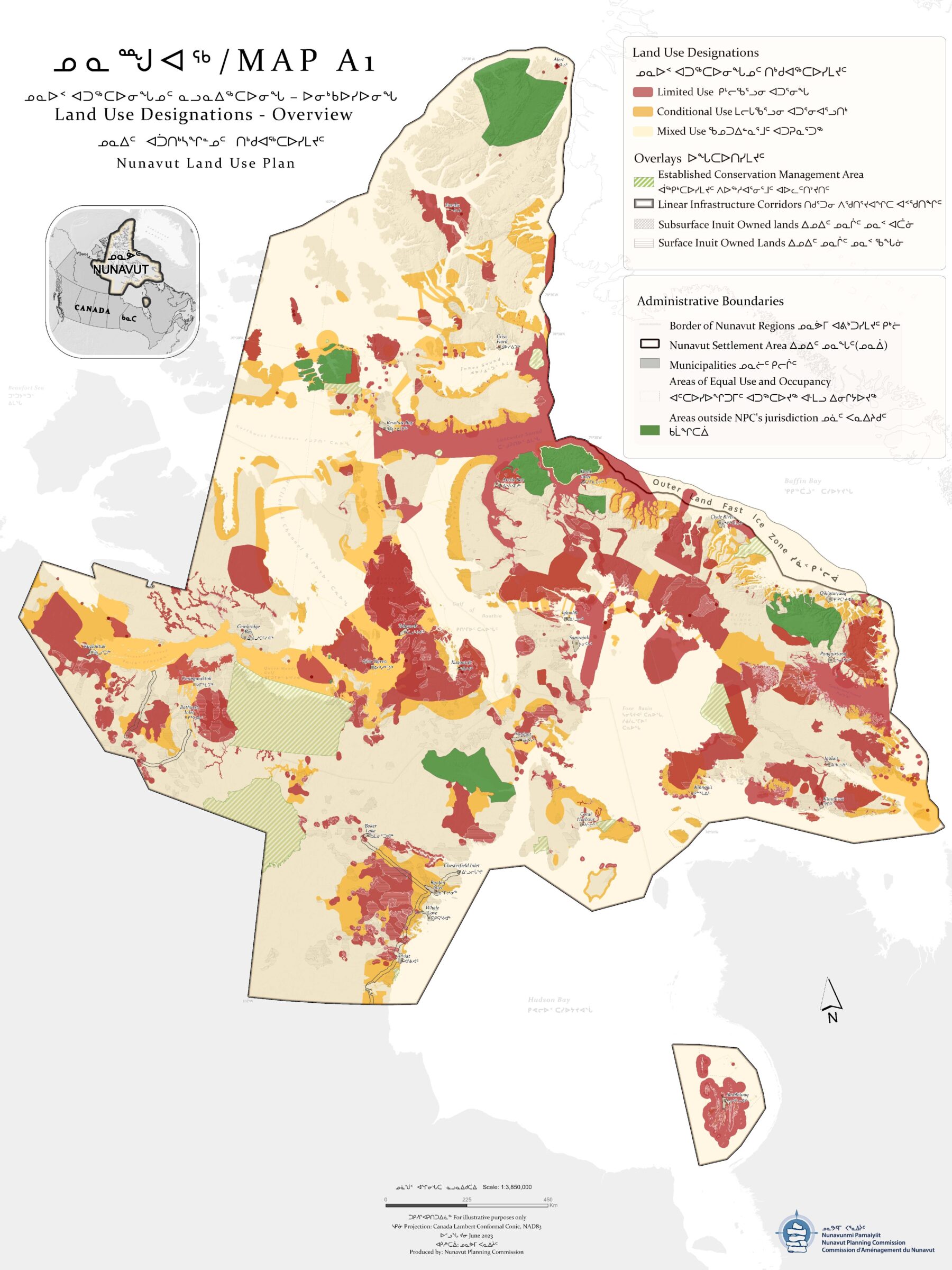
Nearly 15,000 square-kilometres of limited use areas, seen in red on this map, have been staked, says a lawyer for an advocacy group. (Image courtesy of Nunavut Land Planning Commission)
Ottawa, NTI, GN could face lawsuits for land use plan delay: advocates
Advocacy group says delays could lead to litigation and costs for taxpayers
Two years after the Nunavut Land Use Plan was handed off to the three signatories responsible for its passage, an advocacy group says their delay in signing it impacts Inuit rights and raises legal and financial risks.
In an interview Tuesday, a lawyer representing Friends of Land Use Planning said the land claims agreement stipulates that a land use plan should be created as soon as “practicable,” which means, “You’re required to move to an action, on an urgent basis.”
“Delay matters, not just because it is a legal obligation, but also because that delay is having real consequences,” said Nick Leeson, a senior lawyer at Woodward and Company LLP in Victoria, B.C.
The Recommended Land Use Plan, the latest draft of which was submitted to the federal government, the Nunavut government and Nunavut Tunngavik Inc. in 2023, would limit mining and exploration in certain regions. It has been decades in the making.
In emails, the signatories said they were working closely to ensure the plan is in the long-term interests of Nunavummiut.
“This is not a decision the federal government makes alone. The process was designed to reflect the shared decision-making framework established under the Nunavut Agreement,” said Erika Lashbrook Knutson, press secretary to Northern Affairs Minister Rebecca Chartrand, in an email on Tuesday.
At the territorial level, responsibility for the land use plan falls under Environment Minister Brian Koonoo.

“We remain committed to reaching a well-informed decision that reflects the extensive input received throughout the planning process,” he wrote.
NTI interim president Paul Irngaut and CEO Kilikvak Kabloona were unavailable for comment.
In the last two years, companies have staked more than half of Nunavut’s 52,000 square-kilometre mining claims, according to a Tuesday news release from the Friends of Land Use Planning. Close to 15,000 square kilometres of that land is designated for limited use in the land use plan.
Reversing those claims could be a costly legal process if the companies do not willingly relinquish their claims, Leeson said. Taxpayers would essentially foot the bill if Ottawa had to seek legal action to get the miner to give up their rights to a site, a process that could take 10 years.
Further, the GN will be responsible for litigation once devolution is fully implemented.
Other possible legal consequences could come from Inuit beneficiaries themselves. A hunters and trappers association, for instance, could file a lawsuit because the three signatories have not acted in a “practicable” window.

While NTI and the GN declined to comment on the Friends of Land Use Planning’s legal claims, Chartrand’s office said they would review its report, though it “will not speculate on potential legal claims,” Knutson said.
Leeson noted the problem isn’t that the signatories haven’t agreed. It’s that they haven’t decided or provided reasons for amendments. He also noted that the legal claims are not about “anti-development, it is about doing development in the right way.”
This seems like a ENGO bullying exercise disguised as local people that have got enough money from Nunavut already and wants the arctic to be pristine as there legacy. Not about Inuit its about a white man savior complex once again, different form of colonial saving the environment after colonialist started the destruction of the environment before their time. True story!