


Inuit ingenuity and a whaler’s wife: how the Pang hat became a symbol of Nunavut
As Nunavut celebrates 27 years, Nunatsiaq News digs into the provenance of an accessory unique to the territory
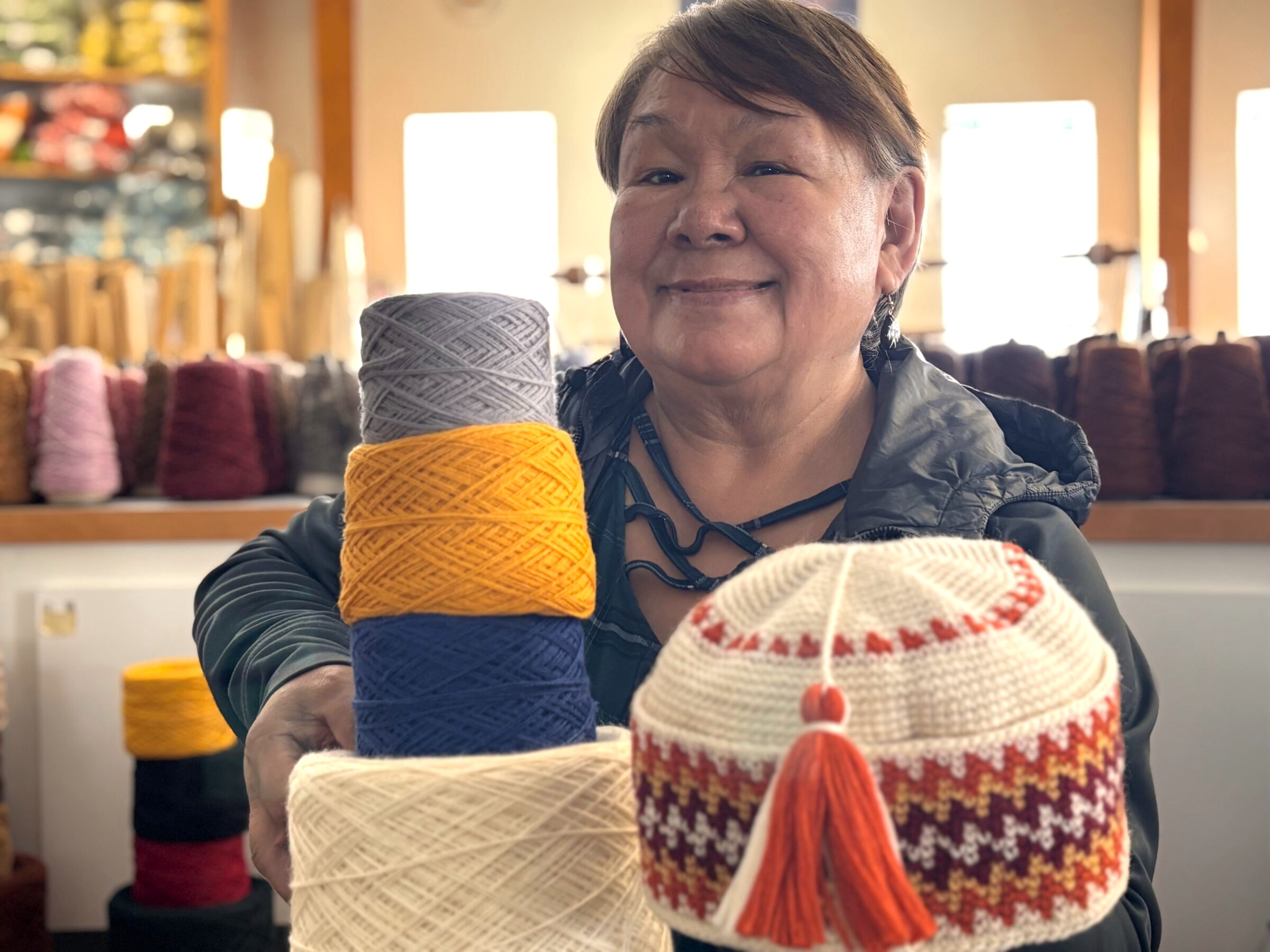
Artist Eena Angmarlik displays a Pang hat and the wool used to create it at the Uqqurmiut Centre for Arts and Crafts in Pangnirtung. (Photo by Daron Letts)

Functional and fashionable, the Pang hat is one of Nunavut’s iconic symbols.
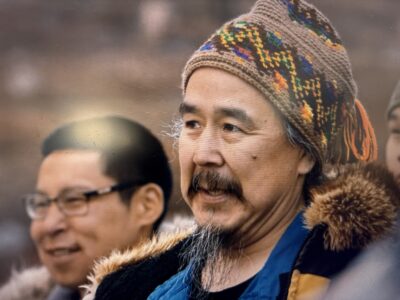
Arviat actor Vinnie Karetak wears a Pang hat in a closing scene of North of North. (Screenshot courtesy of CBC)
It gets its name from its origin community, Pangnirtung, where artists connected with the hamlet’s Iqqurmiut Centre for Arts and Crafts churn them out non-stop.
“Lots of people make the hats,” said Eena Angmarlik, a weaver and printmaker at the centre. “I crochet hats every day.”
Made from durable, tightly knit Canadian wool, the hat’s brim folds over itself, creating a double layer for added warmth. They are decorated with geometric patterns in up to three colours. Each is topped with a tassel that dangles from a string of plied yarn.
As Nunavut celebrates 27 years as a territory, Nunatsiaq News is taking a closer look at the Pang hat, its unique design, and where it came from.
Many crocheters in Pangnirtung pick up kits from the Uqqurmiut centre with enough yarn for six hats. One hat takes two or three days to complete.
“Hunters wear them,” Angmarlik said of their functionality.
The Iqqurmiut centre’s gift shop maintains a stock of more than 200 hats in many colours and sizes. But they are available outside Pangnirtung as well.
The centre welcomes custom orders with words in letters or syllabics. Staff mail special orders to customers straight from a Canada Post location tucked in a corner of the centre.
The Winnipeg Art Gallery gift shop, as well as distributors in Rankin Inlet and St. John’s, N.L., also stock them.
“The demand for Pang hats has really gone up in the last few years,” said Simon Gilpin, manager of North End Gallery in Whitehorse, which also keeps the accessory in stock.
“We get asked about them a lot, and often can’t keep up with demand.”

What makes the hat so popular?
“The way it’s designed,” said Angmarlik. “The way the hat fits and the colours.”
Nunavut Premier John Main, who has owned “a bunch” of Pang Hats over the years, agrees the hat owes its popularity to its design.
“The hats are very functional – warm and cozy, in addition to being fashionable,” he said.
The hat’s celebrity status might have as much to do with where it’s from as it does with how it’s made, he said.

“Pangnirtung has certainly helped make the hat famous,” Main said. “It is a beautiful place surrounded by majestic mountains and the residents are so welcoming.”
Who came up with the Pang hat design that so many people love?
Nobody knows for sure.
The Pang hat predates Angmarlik, who said she knows they were being made before she started working at the centre, which was established in 1990.
Jessica Kotierk, curator of Iqaluit’s Nunatta Sunakkutaangit Museum, said she also does not know.
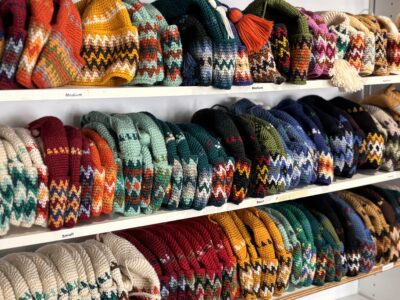
Pang hats at the Uqqurmiut Centre for Arts and Crafts in Pangnirtung in April 2026. (Photo by Daron Letts)
Nunavut historian and author Kenn Harper, who lived for years in Pangnirtung, agreed the Pang hat has been around for a long time and its original designer might be lost to history. But the person who introduced knitting to the people of the area might not be.
Harper recalls hearing stories from Inuit women in the 1960s and 1970s who said they learned to knit from a “Mrs. Penny.”
“Margaret Penny was the wife of the whaler William Penny,” he said. “She accompanied her husband to the Arctic and spent one winter there, on his ship at Kekerten [Island] in Cumberland Sound, near Pangnirtung, in 1857-58,” he said in an email to Nunatsiaq News.
Penny often hosted groups of Inuit women for tea aboard the ship.
Harper gleaned these details and others from Penny’s own written account, drawn from her diary and published in 1997 as This Distant and Unsurveyed Country: A Woman’s Winter in Baffin Island, 1857-58.
“I give credence to the Inuit statements in the 1960s and 19760s that Mrs. Penny taught the Inuit women to knit,” Harper said. “I can’t prove it, but that’s what I’ve heard and believe.”
So it was likely Mrs. Penny introduced a new way of making apparel to the women in the area. But it wasn’t until 1969 that a weaving shop was established in Pangnirtung. Donald Stuart, a goldsmith and artist from Montreal, travelled to the community that year to teach women weaving techniques for tapestries.
From there, the weavers began converting the skills they were learning on the loom to “weaving of linear patterns into utilitarian items such as sashes, scarves and hats,” according to a 2003 article that appeared in the journal Arctic.
The hat represents Inuit ingenuity, said Nunavut MP Lori Idlout, as it provides an alternative to traditional caribou and sealskin headwear.
“It reflects the ability of Inuit to modernize with the times,” she said. “The Pang hat is not simply an accessory – it is a living representation of identity and connection to place.”
Couldn’t tell how many great memories, relationships and pieces of hardware I have from Nunavut but can say that few more cherished than my well-worn 25 year-old Pangnirtung hat from Kitikmeot region. If I don’t stop wearing it I’ll lose the rest of my hair and the hat will lose the rest of itself
Beautiful hats indeed. The one that Vinnie is wearing is not a Pang hat; the hat he is wearing is made by Tapisa Hughes from Arctic Bay. Maybe change the picture to show a real Pang hat. Cheers
It’s the style that originated from pang that makes it a pang hat.