

Ottawa should help Nunavut with high medical travel costs, Main says
Canada’s premiers discuss health care, looming U.S. tariffs at premiers’ meeting in P.E.I.
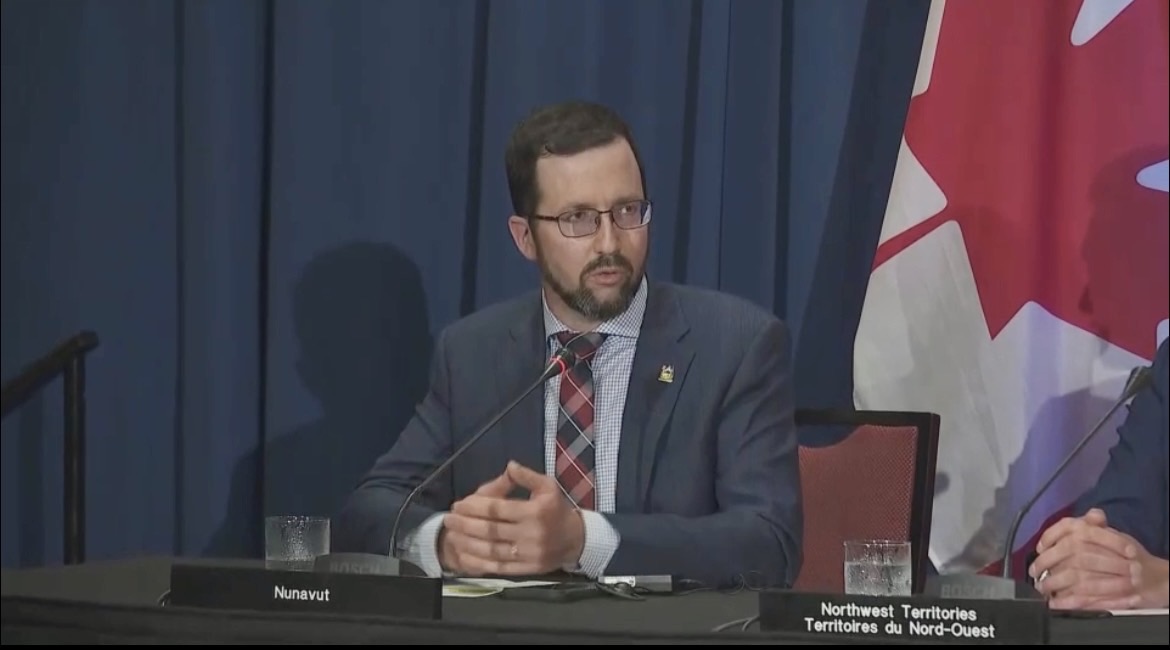
Nunavut Premier John Main speaks at the closing news conference of the Council of the Federation summit in Charlottetown, P.E.I., on July 22. Main says Nunavut’s high medical travel costs highlight the need for more health care services closer to home and stronger federal support. (Photo courtesy of CPAC)

Speaking at a meeting of Canada’s premiers, Nunavut’s John Main said the territory’s biggest healthcare cost is not medication — it’s jet fuel.
That’s why Ottawa must help deliver health care in the North, he says.
“We are spending tens of millions of dollars each year to send patients halfway across the country, in some cases, to access specialized care. So, we want to change that,” Main said Wednesday at the Council of the Federation meeting in Charlottetown, P.E.I.
The premiers’ news conference was broadcast by CPAC.
“We want to build care closer to home, and we need a strong partnership from the federal government that recognizes our increased spend.”
Main said he intends to raise the issue with Prime Minister Mark Carney when they meet in person Thursday for the first ministers meeting in Charlottetown, the final day of the three-day summit.
A major focus of the talks is the looming 50 per cent U.S. tariffs on Canadian goods, set to take effect Aug. 19. Premiers are calling for a co-ordinated approach to negotiating with Washington.

The White House cited Canadian provincial boycotts of U.S. alcohol products as one reason for the tariffs.
“We can’t keep rolling over for Donald Trump,” Ontario Premier Doug Ford said. “You don’t negotiate through weakness with President Trump.”
British Columbia Premier David Eby said Canada must balance protecting workers and industries while responding to U.S. demands for access to Canadian resources.
“The United States needs to decide what they want,” Eby said. “Do they want a strong partner in Canada where we work together, or are they keen to go it alone?”
Main echoed other premiers’ concerns about Canada’s imposition of counter-tariffs in the ongoing trade war with the U.S., saying impacts on the cost of living are “magnified” in the North.
“So everything that you want to do in Nunavut, from building a house to starting a business, could potentially get harder under new tariffs,” Main said.

In a closing statement, premiers called for continued federal investment in health care, housing, transportation and infrastructure, while urging Ottawa to maintain close consultation with provinces and territories during negotiations.
We want devolution, we, want devolution, oh, but we also want more federal support!
Maybe we need to look at how the medical travel program is being run currently to see if we can internally reduce costs. There’s a reason its often referred to as Eskimo vacation by oh I don’t nearly everyone.
It is a vital system without a doubt, but it is highly abused and very, very poorly managed, everyone knows people who have bookings that turn out to be booked on the wrong week communicated and you show up at the Doctors down south to be told, uh your appointment isn’t until next week and you have to do the flights and hotels all over again. It is so poorly run, its both frustrating for the patient, doctors down south serving us and a waste of money, straining the budget further.
And yes, you absolutely do and will hear about the bad more than the good, but its the frequency you hear about the bad that is very alarming. It’s not just small one off events. Its routine errors.
Then you also do have the clear exploitation, people that know they can get away with certain complaints and issues and we just don’t have HC resources here to actually verify if its actually an issue or not so its played safe and people who are looking to exploit are easily able to convince they need to go south for care, hit the casinos, the bar, and head back home, all expenses paid. I don’t know how you prevent that, doctors don’t want to risk someone who actually needs care not getting it, and so its hard to call a person out for crying wolf.
The reality will be though that for almost all communities aside from Iqaluit, its unlikely we will ever see real care / specialists and significant equipment in the north so we do need to try to iron this system out since its going to be with us for a long, long time yet, I suspect until we actually have a full virtual setup in every-town where things can be done from distance.