


Documentary to bring Inuit story of food, family and resilience to big screen
‘Nirilaurta: Let Us Eat’ scheduled to première Aug. 6 at Montreal’s International First Peoples’ Festival
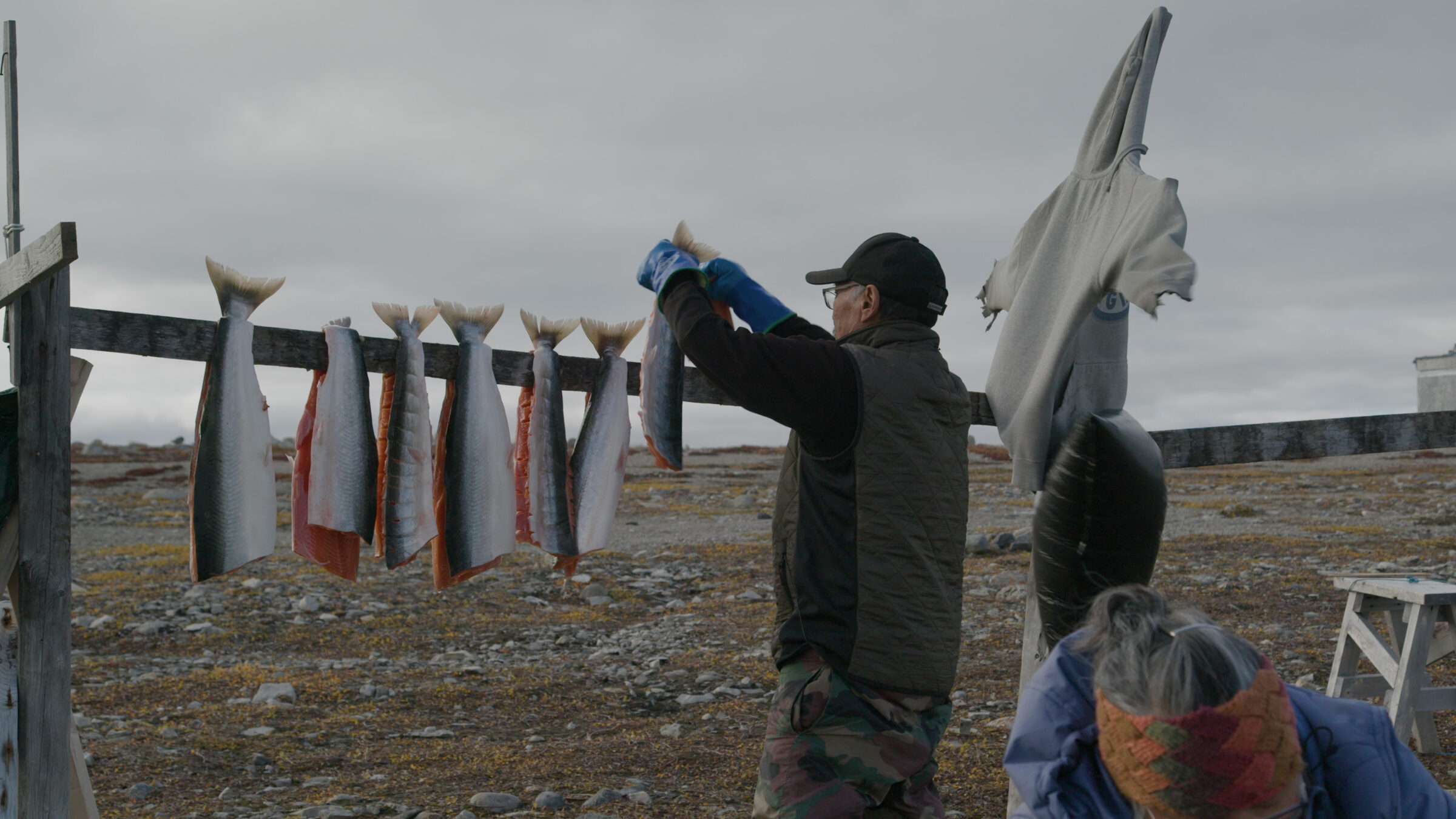
A still from Malaya Qaunirq Chapman’s documentary, “Nirilaurta: Let Us Eat”, features Nauyaq and Jamie Ugyuk of Taloyoak preparing their catch after a successful fish netting. (Photo courtesy of National Film Board of Canada)
After more than four years of work, Inuk filmmaker Malaya Qaunirq Chapman is preparing to screen her first feature documentary in front of audiences.
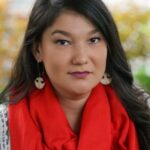
Filmmaker Malaya Qaunirq Chapman is set to première her first documentary, Nirilaurta: Let Us Eat. (Photo courtesy of National Film Board of Canada)
Nirilaurta: Let Us Eat is set to make its world première Aug. 6 at the International First Peoples Festival in Montreal, a milestone Chapman says is both exciting and nerve-wracking.
“I’m about to share a project that feels vulnerable,” she said. “I want to do a good job for the family. I hope I did them justice.”
The documentary focuses on Taloyoak through the experiences of the Ugyuk family as they fish, hunt and prepare meals and gather around the table.
It also examines how rising costs affect every aspect of life in the North. People across Canada know grocery prices are high, Qaunirq Chapman said, but that’s not the entire picture.
Beyond expensive groceries, Qaunirq Chapman said the equipment needed to harvest country food — fuel, ammunition, warm clothing and hunting gear — has become increasingly difficult for families to afford.
“The un-affordability of food also transfers to the un-affordability of access to our land,” she said.
Qaunirq Chapman, who is from Iqaluit but now lives in Kuujjuaq, said she felt it is important to see northern issues explored from the point of view of northerners.
“There are so many documentaries that tell Indigenous stories from a western mindset. You cannot tell an Indigenous story authentically unless you’re an Indigenous person,” she said.
For her, access to food is personal.
Raised by her great-grandmother in Nunavut, she remembers growing up with these challenges before later living in Los Angeles, where she witnessed a very different relationship with food and abundance.
“I grew up with hunger,” she said. “Leaving home allowed me to realize how unique home is and the juxtaposition of both became very clear to me.”

Those experiences later shaped Qaunirq Chapman’s work as a reporter with APTN News, where she covered stories on Nutrition North Canada and the grassroots Feeding My Family movement — a social media project started in 2013 to show southerners just how much food costs in Nunavut — before transitioning into filmmaking.
Her career has taken her through journalism, acting, writing and television. She appeared in the comedy series Qanurli and later in the Nunavut-based sitcom North of North, and has hosted several TV series.
Making a feature documentary, Qaunirq Chapman said, felt like the natural next step.
“It was a really tough challenge, but I finished it,” she said. “I wanted to give up so many times.”
As filming progressed, Qaunirq Chapman’s idea of who the film was for also changed.

Initially, she imagined southern audiences would be her primary viewers. Instead, she hopes the documentary will inspire other northern communities.
Qaunirq Chapman points to Taloyoak’s land guardian program as an example of a community-led response to food insecurity. The program employs local hunters to monitor the health of the land while harvesting country food that is shared within the community.
“What the community has done is instead of waiting for somebody to fix what’s lacking, they came together and said, ‘We’re going to fix food insecurity in our community,'” she said.
Following its Montreal première, the film will travel north for a community screening in Taloyoak.
“I’m accountable to them,” she said. “I hope I make the family proud.”
Drugs are the problem not the high cost of food people I no here in arviat first thing is buy or order drugs and left over money on food and this is in a increase they don’t care only think of drugs before food.
Here in kuujjuaq , crack and cocaine are , the big problem .
I don,t mean to rain on your parade, it’s probably a good movie. but there are dozens of movies of life in the north we know these things for along time now, money could have been used to help people eat, just my thought, Thanks.
Way to go Malaya! I’m sure that it is great. I have seen you on everything else that you have done and I can’t wait to see this one. Good for you on this one and I hope you become a great success! 🙂
I don’t think southerners are going to have the same appreciation for fly covered pissi as the Inuit.
The Taloyoak Land Guardian program may be locally led, but it was initiated federally and is federally funded:
“$3.53 million over three years through Fisheries and Oceans Canada (DFO) to establish and expand the Inuit-led Marine/Land Guardians program in Taloyoak, Nunavut, managed locally via community associations like the Spence Bay Hunters and Trappers Association and the Taloyoak Umaruliririgut Association (TUA)”.
As such, this program can hardly be held up as an example of Inuit food resilience, or of a community doing something instead of “waiting for somebody to fix what is lacking”.
The Taloyoak Land Guardian program began with proposal development and administrative support from arcticonnexion, a Crown-Indigenous Relations and Northern Affairs Canada funded pretendian proxy group.
This group is active in our Territory to tell the Government of Canada what Inuit think when they don’t like what our actual elected Inuit Orgs have to say.
Reality is, Taloyoak waited just long enough for CIRNAC to convince DFO to fork over $3.53M in taxpayers money, (money in part from southern Canadian taxpayers that are equally food insecure), to allow their HTO members to get paid to go out hunting.
This $3.53M could have been used to put food in the mouths of some of the 9.8M (including 2.4M children) other food insecure Canadians living in our southern provinces, yet it was earmarked for Nunavut.
This fundamental truth goes counter to the Inuit elite narrative that Canada ignores the needs of Inuit, and goes against the well established Nunavut mode of living off the Ottawa gravy train kept going with regular doses of manufactured guilt.
It is quite possible this movie will be laced with these inferences instead of highlighting that Canada has actually acted to support Taloyoak big time.