


Auditor general points out ‘fundamental weaknesses’ in Nunavut’s foster care
Family Services Department is unaware of number of children in its care, failed to do in-person checks, and didn’t support caregivers, report says
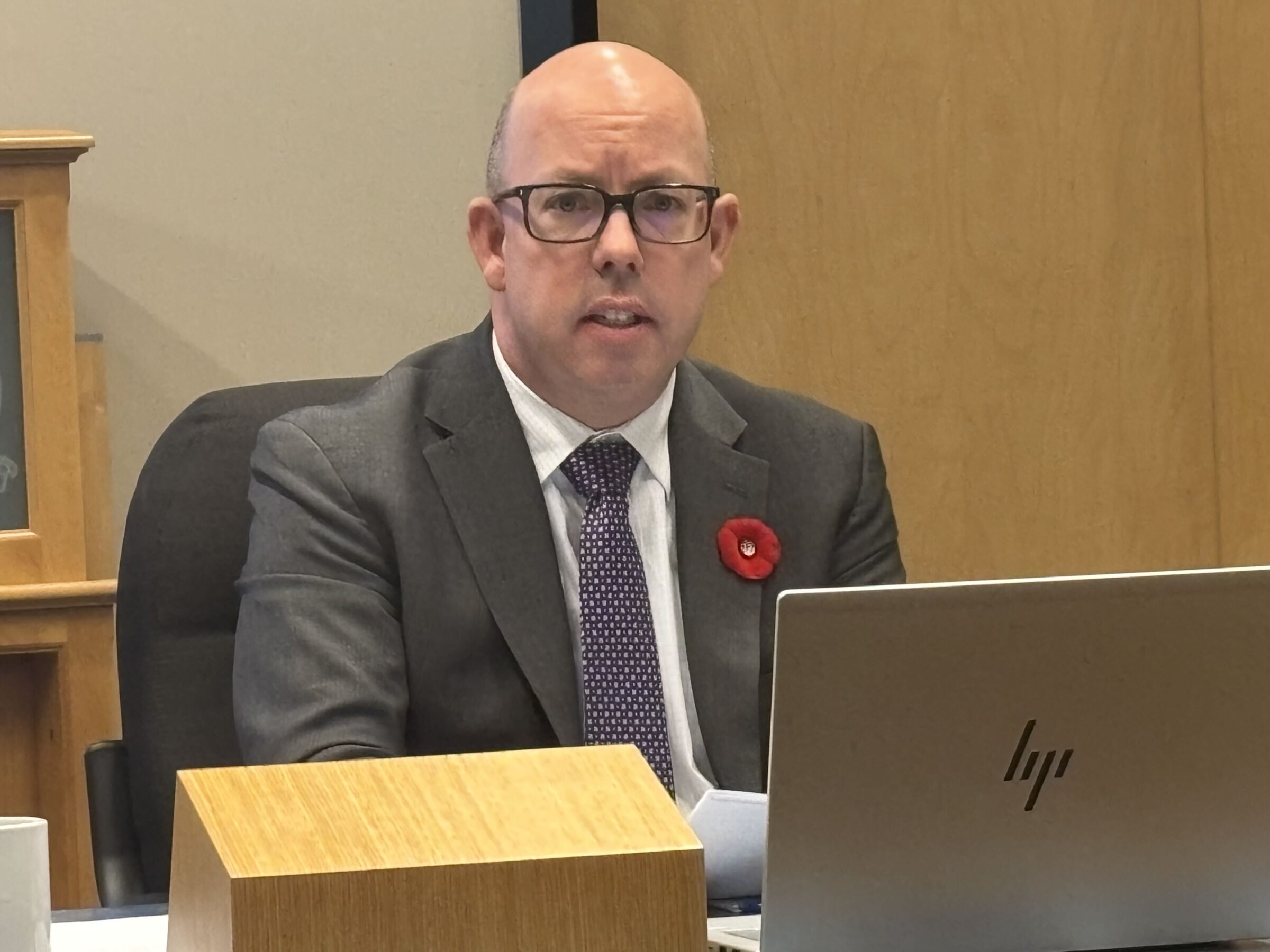
Andrew Hayes, the deputy auditor general of Canada, speaks at a news conference Tuesday afternoon after delivering a report on the state of foster care in Nunavut. (Photo by Daron Letts)

This story was updated on Tuesday, Nov. 3, 2026, at 5:53 p.m. ET.
Nunavut’s Department of Family Services “did not provide timely and effective foster care services to protect and support the safety and well-being of children,” says Canada’s deputy auditor general Andrew Hayes.

Family Services Minister Gwen Healey Akearok sits in the Legislative Assembly last week. On Tuesday, Canada’s auditor general published a report that found her department “did not provide timely and effective foster care services to protect and support the safety and well-being of children.” (File photo by Lilli Akpaleeapik)
He tabled the report, Foster Care in Nunavut, in the legislative assembly Tuesday. Family Services Minister Gwen Healey Akearok had announced in March that the audit was underway.
“Fundamental weaknesses” in the territory’s foster care system includes “failures to maintain regular contact with children in care, weaknesses in the screening and monitoring of foster homes, and unreliable information on children and their placements,” according to a news release issued by the auditor general’s office Tuesday, ahead of Hayes’ tabling of the report.
While it’s estimated that about 400 children are in the foster care system, the department remains unaware of the exact number or where the children are located, the latest report states.
This is despite the department rolling out a centralized reporting framework called Matrix three years ago.

The audit states that the department relied on a manually compiled list instead using the software.
Additionally, the department failed to keep up monthly in-person contact with children and foster caregivers, “a basic safeguard intended to protect children in care,” the report states.
“In more than 90 per cent of the files we reviewed, there was no evidence that the required monthly contact with children or foster care caregivers had been maintained,” Hayes said at a press conference in the legislative assembly, where he tabled the report earlier in the afternoon.
In five cases, there was no documented contact with a child for more than one year, including one gap of more than 17 months.
The report also found cracks in the department’s screening process. Family services conducted 52 per cent of home studies, which evaluate the safety of a foster home, before it placed a child.
Long-term monitoring also fell short, with annual reviews that confirmed a foster home remained safe were missing or incomplete in 62 per cent of examined cases.

Caregivers were not given important information about a child — such as health, family or trauma history — in 32 of 44 files.
An onboarding process for new caregivers was absent, training for caregivers was infrequent and the foster caregiver manual had not been updated in more than 10 years, the report states.
“There’s recruitment and retention issues that the department needs to address,” Hayes said. “In some cases, housing can be a problem.”
Previous audits in 2011, 2014, 2023 and 2025 found similar problems, including one finding from 2023 that the department could not provide an accurate count for the number of children in its care.
Following the October 2023 report, former family services minister Margaret Nakashuk apologized for the department’s failure to protect children in its care.

“Ultimately, we need to see more from the department and improve services to these families and children,” Hayes said.
“Hopefully there is an urgency that is being recognized by the department and that the legislative assembly members can use our report and the department’s responses to hold the department accountable for making the improvements that they’ve committed to.”
The auditor general will release another report in the spring of 2027, on the department’s “quality assurance work,” he said.
Akearok thanked the auditor general for the report and its recommendations, saying it validates many of the actions already underway in her department.
“Meaningful change requires accountability, consistent follow-through, and sustained action,” she said in a Government of Nunavut news release issued after the report was tabled.
Akearok said her department is strengthening prevention and family supports, improving oversight, equipping staff with tools and training, and supporting foster caregivers.
Update: This story was updated to include comments from deputy auditor general Andrew Hayes and a comment from Family Services Minister Gwen Healey Akearok.
(0) Comments