

Auditor general points out ‘fundamental weaknesses’ in Nunavut’s foster care
Family Services Department is unaware of number of children in its care, failed to do in-person checks, and didn’t support caregivers, report says
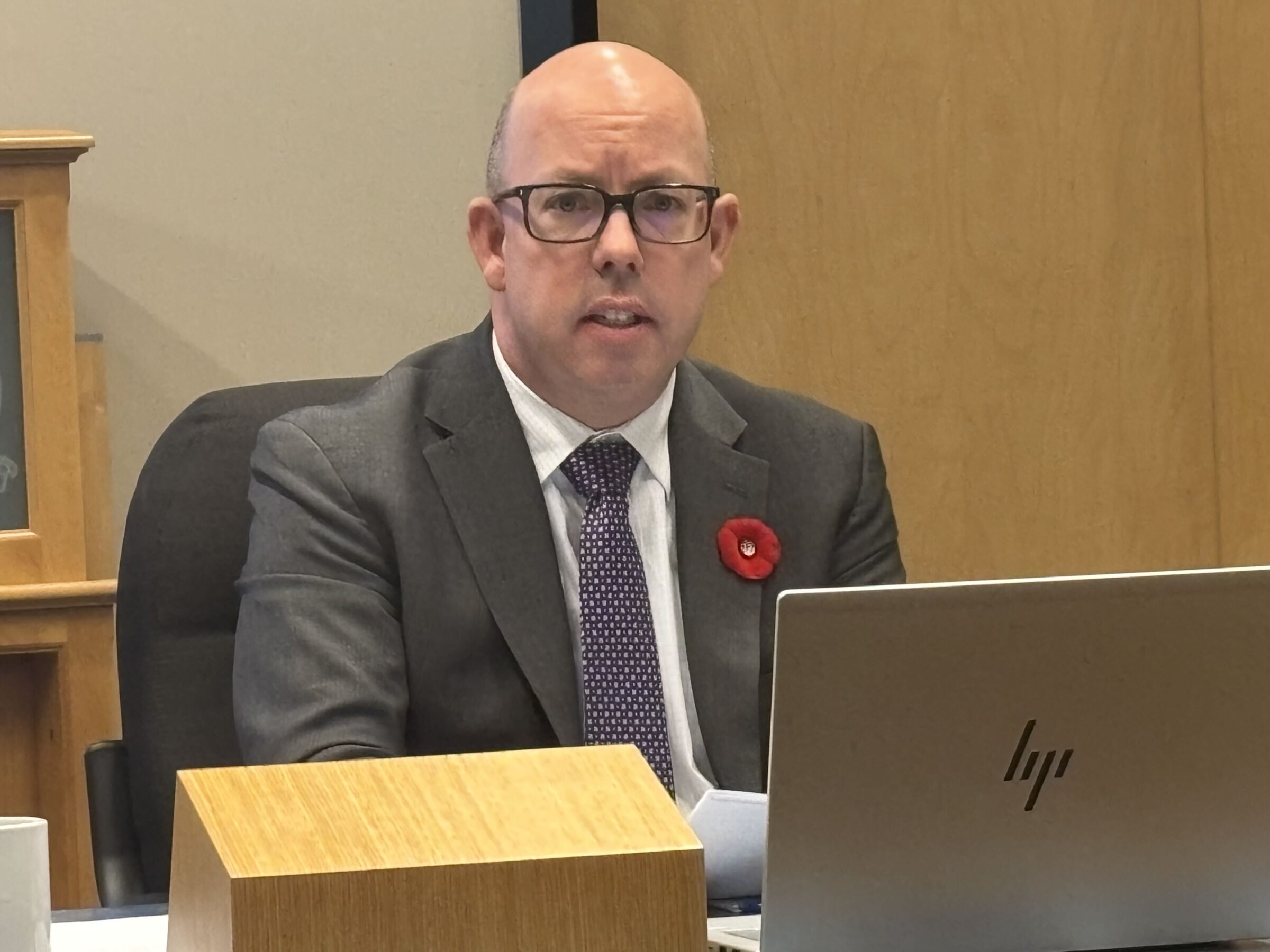
Andrew Hayes, the deputy auditor general of Canada, speaks at a news conference Tuesday afternoon after delivering a report on the state of foster care in Nunavut. (Photo by Daron Letts)

This story was updated on Tuesday, Nov. 3, 2026, at 5:53 p.m. ET.
Nunavut’s Department of Family Services “did not provide timely and effective foster care services to protect and support the safety and well-being of children,” says Canada’s deputy auditor general Andrew Hayes.
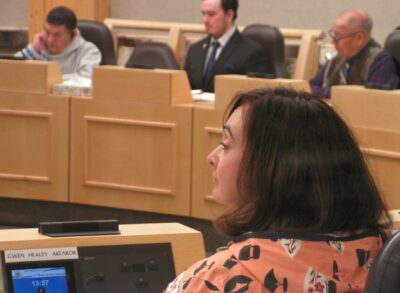
Family Services Minister Gwen Healey Akearok sits in the Legislative Assembly last week. On Tuesday, Canada’s auditor general published a report that found her department “did not provide timely and effective foster care services to protect and support the safety and well-being of children.” (File photo by Lilli Akpaleeapik)
He tabled the report, Foster Care in Nunavut, in the legislative assembly Tuesday. Family Services Minister Gwen Healey Akearok had announced in March that the audit was underway.
“Fundamental weaknesses” in the territory’s foster care system includes “failures to maintain regular contact with children in care, weaknesses in the screening and monitoring of foster homes, and unreliable information on children and their placements,” according to a news release issued by the auditor general’s office Tuesday, ahead of Hayes’ tabling of the report.
While it’s estimated that about 400 children are in the foster care system, the department remains unaware of the exact number or where the children are located, the latest report states.
This is despite the department rolling out a centralized reporting framework called Matrix three years ago.
The audit states that the department relied on a manually compiled list instead of using the software.
Additionally, the department failed to keep up monthly in-person contact with children and foster caregivers, “a basic safeguard intended to protect children in care,” the report states.
“In more than 90 per cent of the files we reviewed, there was no evidence that the required monthly contact with children or foster care caregivers had been maintained,” Hayes said at a press conference in the legislative assembly, where he tabled the report earlier in the afternoon.
In five cases, there was no documented contact with a child for more than one year, including one gap of more than 17 months.
The report also found cracks in the department’s screening process. Family services conducted 52 per cent of home studies, which evaluate the safety of a foster home, before it placed a child.
Long-term monitoring also fell short, with annual reviews that confirmed a foster home remained safe were missing or incomplete in 62 per cent of examined cases.
Caregivers were not given important information about a child — such as health, family or trauma history — in 32 of 44 files.
An onboarding process for new caregivers was absent, training for caregivers was infrequent and the foster caregiver manual had not been updated in more than 10 years, the report states.
“There’s recruitment and retention issues that the department needs to address,” Hayes said. “In some cases, housing can be a problem.”
Previous audits in 2011, 2014, 2023 and 2025 found similar problems, including one finding from 2023 that the department could not provide an accurate count for the number of children in its care.
Following the October 2023 report, former family services minister Margaret Nakashuk apologized for the department’s failure to protect children in its care.

“Ultimately, we need to see more from the department and improve services to these families and children,” Hayes said.
“Hopefully there is an urgency that is being recognized by the department and that the legislative assembly members can use our report and the department’s responses to hold the department accountable for making the improvements that they’ve committed to.”
The auditor general will release another report in the spring of 2027, on the department’s “quality assurance work,” he said.
Healey Akearok thanked the auditor general for the report and its recommendations, saying it validates many of the actions already underway in her department.
“Meaningful change requires accountability, consistent follow-through, and sustained action,” she said in a Government of Nunavut news release issued after the report was tabled.
Healey Akearok said her department is strengthening prevention and family supports, improving oversight, equipping staff with tools and training, and supporting foster caregivers.
Update: This story was updated to include comments from deputy auditor general Andrew Hayes and a comment from Family Services Minister Gwen Healey Akearok.
how is it that this issue rears irs ugly head again. the last time family services senior management was all axed and replaced by new people. they are there right now. yet on we go. heads should roll yet again. this is incompetence at the highest level.
Except the fact that all the new people they have in charge are people who have been there for years on the front line, just collecting paycheques, and there is no motivation for real change.
I’m embarrassed to see those working in senior management from family services in public. They place all their blame on their front line staff. What do you expect from people who are overworked, do not get properly trained, and don’t have enough time in a day to get to all of their clients and intakes, with thousands of hours of paperwork to do? The whole system needs to be changed and front line staff need help.
Not to mention the fact that they implemented Matrix and then don’t even move forward with using all the functions it supposedly had built in.
Sad and embarrassing. This update isn’t even surprising anymore.
Told you so !
When a government takes a child into care, it assumes responsibility for that child’s safety and well-being. Nunavut’s latest foster care audit indicates that responsibility is not being met.
According to Nunatsiaq News, more than 90% of the files reviewed lacked evidence of required monthly contact with children or foster caregivers. Five cases had no documented contact with a child for more than a year, including one gap exceeding 17 months. The department still could not reliably account for the number of children in its care or their locations. Similar concerns have appeared in audits since 2011.
For almost 50 years, I have advocated for Indigenous children and families in the North. I have witnessed the devastating consequences of colonial policies that separate children from family, language, culture and community. Repeated findings and promises of improvement offer little comfort to a child whose safety is not being checked or a parent struggling to bring their child home.
Inuit family structures, kinship and community knowledge must guide the care of Inuit children. Families need practical support to stay together, independent advocacy when children enter care, and meaningful help with safe reunification.
An Inuit-led system offers hope. It must come with authority, sustained funding and the resources to repair the damage caused by colonization: safe housing, food security, healing, family supports and a skilled local workforce.
Government must act now to verify every child’s safety, support their caregivers and maintain their family connections. Accountability means clear responsibilities, public timelines and evidence that children’s lives are improving.
These people are supposed to be qualified
We always hear you need qualifications for that job
So what happened
Yet time and time again they hire incompetent workers and claim Inuit are not educated enough
Yet they fail Inuit children with government money and structure
Check this out nunatsiaq won’t let this show
So what is the sense to give a place to comment if nunatsiaq can’t hack what we say
They really can’t handle it, it’s pathetic sometimes.
On an upnote I’ve noticed the last 3 editorials were not written by Corey, let’s hope he has moved on and we can start having some real talk for once.
How many reports will it take? We’re at what? The 5th one in the last 15 years? That’s a report every THREE years people. However, if you watched any of the recent years’ worth of sittings of the LEG; all we have heard are all the great things that are supposedly happening. All the incredible steps being taken to “fix, address, clean up, initiate new programs, etc, etc…” I am sure if we back up in time over 15 years this is the same regurgitated words (i.e. nonsense) being recycled and reused.
What’s worst, is how the Government, Premier and Ministers react to the Auditor General’s (AG) Report. It’s like a broken record in Nunavut. The AG is called in to look at a department. It then goes on to list massive irregularities, failures, dysfunctionality, incompetence, etc, etc.. within multiple areas (departments) of Government. It also contains direct recommendations on ACTION to FIX the issues. What do Nunavummiut then get? They get the Minister of the concerned department thanking the AG for the report and going on to say, quote, “it validates many of the actions already underway in her department. “Meaningful change requires accountability, consistent follow-through, and sustained action,” What a bunch of nonsense babble. “Accountability”? I think with 5 reports in 15 years that word should definitely NOT be used. The New (not new anymore) Government has been in place for a year. What the AG is and has identified in the last 15 YEARS are the same issues. Wash, rinse, repeat. It never actually gets fixed! They just give it a backhand swipe, a few words of recognition and then just continue down the exact same path. No big deal.
We are talking about children here. CHILDREN! The issues and failures identified in the AG report are grounds for everyone in Nunavut to be sickened by how the Government has managed it’s one singular most valuable resource. THE CHILDREN! People should be DEMANDING this get fixed once and for ALL!
So, here is a simple idea. USE the AG Report that way it is supposed to be used. As a road map to ACTION. Stop talking and using big words, excuses and “we’re getting there” and actually get there. Get the job done!
Nunavut’s Children deserve so much better than the failure we have provided them.
PSC
Family Services in Nunavut is becoming a joke, and someone needs to start asking some serious questions!
The Government of Nunavut continues to talk about Inuit employment, Inuit representation, and providing services that reflect the people of Nunavut. Yet how much of that commitment is actually being demonstrated within Family Services?
How many frontline social workers are Inuit beneficiaries? How many can communicate effectively in Inuktitut? How are families, especially elders and those who are more comfortable speaking their mother tongue, expected to navigate sensitive situations when language and cultural understanding become barriers?
This is not about where someone comes from. It is about whether the people hired to serve Nunavummiut have the communication skills, cultural understanding, and qualifications necessary to provide effective services.
Family Services deals with some of the most vulnerable children and families in our communities. Language barriers and a lack of cultural understanding can have serious consequences.
We know all too well who these services are supposed to benefit: Nunavummiut, especially our children and families.
The Government of Nunavut needs to demonstrate that its commitments to Inuit employment, Inuit language, and Inuit Qaujimajatuqangit are more than words on paper.
Where is the accountability? Where is the investment in training Inuit to become social workers? And where is the commitment to ensuring Nunavummiut can receive services in their own language?
Nunavut was created so Inuit could have a meaningful voice in the decisions and services that affect our lives. We should not have to continuously fight to be understood in our own home. Ningaanami
Before Family & Children Services amalgamated, a social worker from Health & Social Services (H&SS) back then was responsible for Adult Corrections, Young Offenders, Foster Care Program, Old Age and Disabled were some of the tasks to be supervised. Today, departments have taken responsibility to carry on the tasks and they’re is possibly an overload of work that a worker may not carry on his/her duty. It takes commitment to care and be concerned for the people we serve, especially to assist families and children involved. Working for the Nunavut government is not all about making all the money. Yes, it’s a necessity in order to survive, but everyone needs to pull up his/her socks to avoid such audit.
Taimaa