


Six months to fix foster care failures is a tall order
Auditor general’s office says it will be back next spring for ‘quality assurance’ after damning report on Nunavut’s foster care
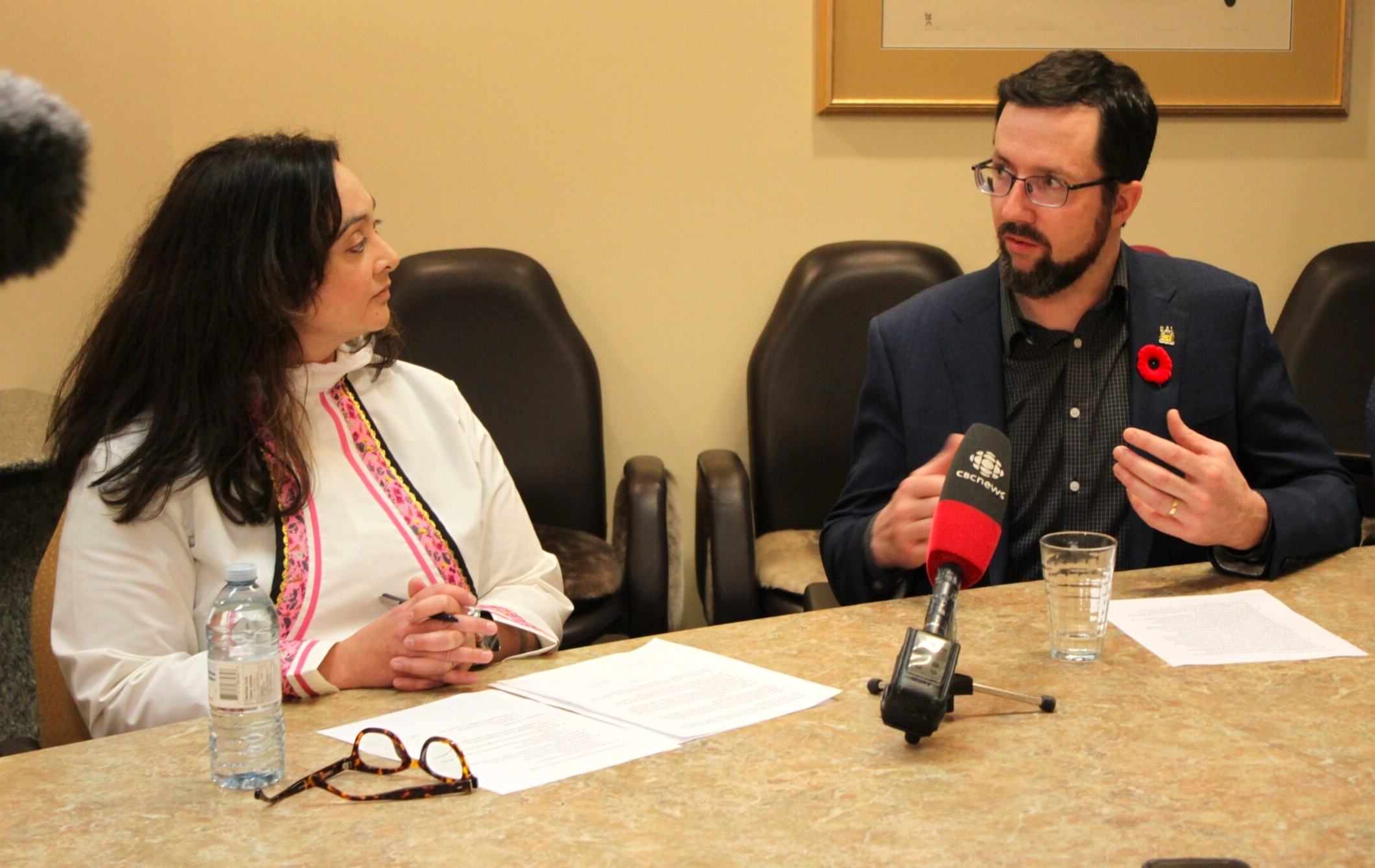
Family Services Minister Gwen Healey Akearok, left, and Premier John Main hold a news conference Wednesday morning at the legislative assembly. They discussed the Auditor General of Canada’s report on the territory’s foster care system. (Photo by Lilli Akpaleeapik)

Six months isn’t much time to fix a problem that has festered for 15 years.
But that’s the task ahead for the Government of Nunavut after the federal auditor general presented a scathing report on the state of foster care in Nunavut, pointing to “fundamental weaknesses” that have persisted for years.
Deputy auditor general Andrew Hayes presented the report titled Foster Care in Nunavut on Tuesday. It’s the fifth time the office of the auditor general — responsible for probing the effectiveness of government programs — has looked into Nunavut’s foster care since 2011.
The Family Services Department can remove children from their family homes and place them in foster care when their parents aren’t able to meet their needs or provide a safe environment.
This week’s report is a litany of failures — basic things the GN’s Family Services Department didn’t do well enough. It includes failing to do in-person checks on children once a month in 90 per cent of the files the auditor general looked at. In five cases, there was no documented contact with the child in more than a year.
Screening of foster caregivers was weak. In just 52 per cent of cases, the department completed the home studies to assess whether a new foster home was a safe environment to place a child in.
And the department didn’t provide the caregivers it relies on with adequate tools, information or financial support.

In March, there were approximately 400 children receiving protective services, including 260 who had been removed from their family home. But the government doesn’t actually know the precise number of children in care because the department relied on a manual list instead of one generated by a software package known as Matrix that was introduced three years ago.
Premier John Main and Family Services Minister Gwen Healey Akearok held a press conference Wednesday to respond to the report. But their explanations boiled down to “we’re working on it; we’re trying to do better.”
Main called the report “upsetting” and pledged a “whole government-wide effort” to make improvements. Time will tell. The “whole-of-government” line is one that politicians use to convey a sense of urgency or that something is a priority.
“Our sincere hope is that future audits will show real improvement,” Main said.
Does the GN really need a government-wide effort? What help can the Environment Department, for example, offer in terms of fixing the foster care system? Instead of a government-wide effort, why not just get Family Services’ house in order?
Healey Akearok said her department is making progress. Workers are getting trained on the Matrix system, 97 per cent of home studies have been done and 82 per cent of annual reviews have been completed.
“There’s still work to be done,” she said.
Hayes said Tuesday, the auditor general’s office will be back in the spring to release another report on the GN’s “quality assurance” work. Family Services pointed to the quality assurance framework it implemented to address at least four of the report’s recommendations, including calls to provide support payments to caregivers, determining if a child in care has special needs, and emphasizing to social services workers the importance of documenting care plans.
The report makes you wonder about Nunavut’s capacity to deliver bigger, more complex programs — like health care and education.
Foster care is a relatively small part of the GN’s operations. If there are so many “fundamental weaknesses” in foster care, imagine the weaknesses that must exist in other departments.
(0) Comments