


Basking in the glow of Northern Scene success
“It was very special, what happened here”
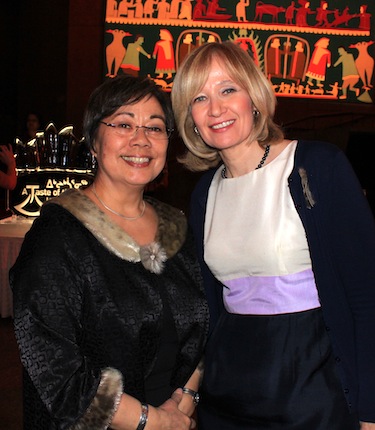
Premier Eva Aariak poses with Laureen Harper, the Prime Minister’s wife, at a Taste of the Arctic, a formal gourmet extravaganza of food and entertainment hosted annually in Ottawa by Inuit Tapiriit Kanatami. Several hundred well-heeled Ottawans paid $199 each on April 29, to savour a sampling of Arctic foods prepared by National Arts Centre Executive Chef John Morris. Those dishes included pepper-seared rare tataki of caribou loin and ragout of hare. (PHOTO BY LISA GREGOIRE)
The executive director and producer of the National Arts Centre’s wildly successful Northern Scene festival in Ottawa, April 25 to May 4, says the only thing she would have changed about the recently concluded 10-day event would have been to add extra performances for some of the more popular shows.
But Heather Moore says there was no way to predict which shows would draw crowds, or whether Ottawa residents would even support a festival where many of the artists were unknown.
She needn’t have worried. Her best-case scenario, where residents snapped up tickets well in advance, and even lined up for extra tickets when shows sold out, came true.
“I feel something like post-partum depression,” she said May 8. “It was very special what happened here, and I was sad to see them all go.”
Every two years, the NAC holds a festival of visual and performing arts that focuses on one part of the country. Northern Scene was the sixth such “scene,” the one with the most aboriginal content—more than 70 per cent—and one of its most successful.
Heather Daley, executive director of Iqaluit’s annual Alianait Arts Festival, offered this explanation as to why Ottawans came out in droves.

“There is a mystery about the North,” said Daley, who attended some of Northern Scene and was extremely impressed by, and proud of, Nunavut performers. “The North is in the spotlight now. People see little things here and there and it captures their imagination. But they haven’t been to the North.”
Ticket affordability helped. With a few exceptions, most shows were under $20 and patrons could buy a $40 festival pass good for four shows. There were also plenty of free events.
While it’s obvious the city embraced this northern smorgasbord of talent, audience members were likely unaware how much fun the artists were having, just hanging out together and attending each other’s shows.
A camaraderie usually develops among performers during these types of festivals, Moore said, but at Northern Scene, it was more intense because northern artists are scattered from east to west and have few opportunities to get inspired from each other and to collaborate.
Moore said the affection and support that grew among the artists as the festival unfolded was magical. Musical jams at the downtown Holiday Inn, where artists stayed, went into the wee hours most nights.
“What I couldn’t have predicted was the spirit and energy and passion that came from them as a collective,” Moore said. “They felt part of something larger.”

Even artists selling their wares at the Northern Scene marketplace—a new addition this year—talked about the importance of sharing ideas.
“It’s really inspiring to see the different types of artwork people are producing,” said Elisapi Aningmiuq, an artist from Iqaluit who makes sealskin accessories. Our interview during the festival was repeatedly interrupted by customers wanting to buy her dyed sealskin bracelets.
“So many new ideas,” she continued. “It’s great to see the different media people are working with.”
Nelson Tagoona, rapper and throat-boxer from Baker Lake and one of the festival favourites, also talked about how privileged he felt to be among the North’s best and brightest stars.
Laureen Harper, wife of the Prime Minister, who attended the Inuit Tapiriit Kanatami’s Taste of the Arctic event on April 29, said that Northern Scene allowed Nunavut to shine in the South.
“Everyone is always amazed at the breadth and depth of talent in the North and that’s terrible because of course there’s lots of talent there,” said Harper. “Nonetheless, for some people, it’s still surprising.”
Not surprising for many Inuit. Premier Eva Aariak, attending the ITK event, said Inuit are not far removed from a generation who made everything with their hands—clothing, tents and iglus, qamotiqs, ropes and tools, even children’s toys.
“We come from a very creative society. It is evident among our young people today. There is a great surge,” said Aariak. “Our traditional ways are not the old ways. They are alive. Our young people are embracing them, reinventing them, making them modern, popular, even sexy.”
Today, there is no shortage of northern performers reclaiming their musical traditions in a contemporary way, including some of Northern Scene’s biggest stars: Sylvia Cloutier, Laakkuluk Williamson Bathory, Nelson Tagoona, Mathew Nuqingaq, Tanya Tagaq, Beatrice Deer and Lucie Idlout.
Anna Hudson, a media and culture professor at Toronto’s York University, has been studying the evolution from visual to performing arts in Nunavut and says traditional carvers and printmakers sold their art to southern markets and many never saw them again as collectors, galleries and auction houses resold them for thousands of dollars.
Performance art, on the other hand, gives artists more freedom of expression and more control over the message. Plus, the target audience is first and foremost northerners. She points to the Tulugak play as an example.
“They owned it, shaped it, performed it the way they wanted. It’s an Inuit production, produced by Inuit that rose out of a colonial structure,” said Hudson. “This generation of artists coming up, they’re going to be leaders. They’ll take Inuit art into the international, contemporary sphere. They will finally control their own destiny with the ambition of making art for Inuit first.”
(0) Comments