


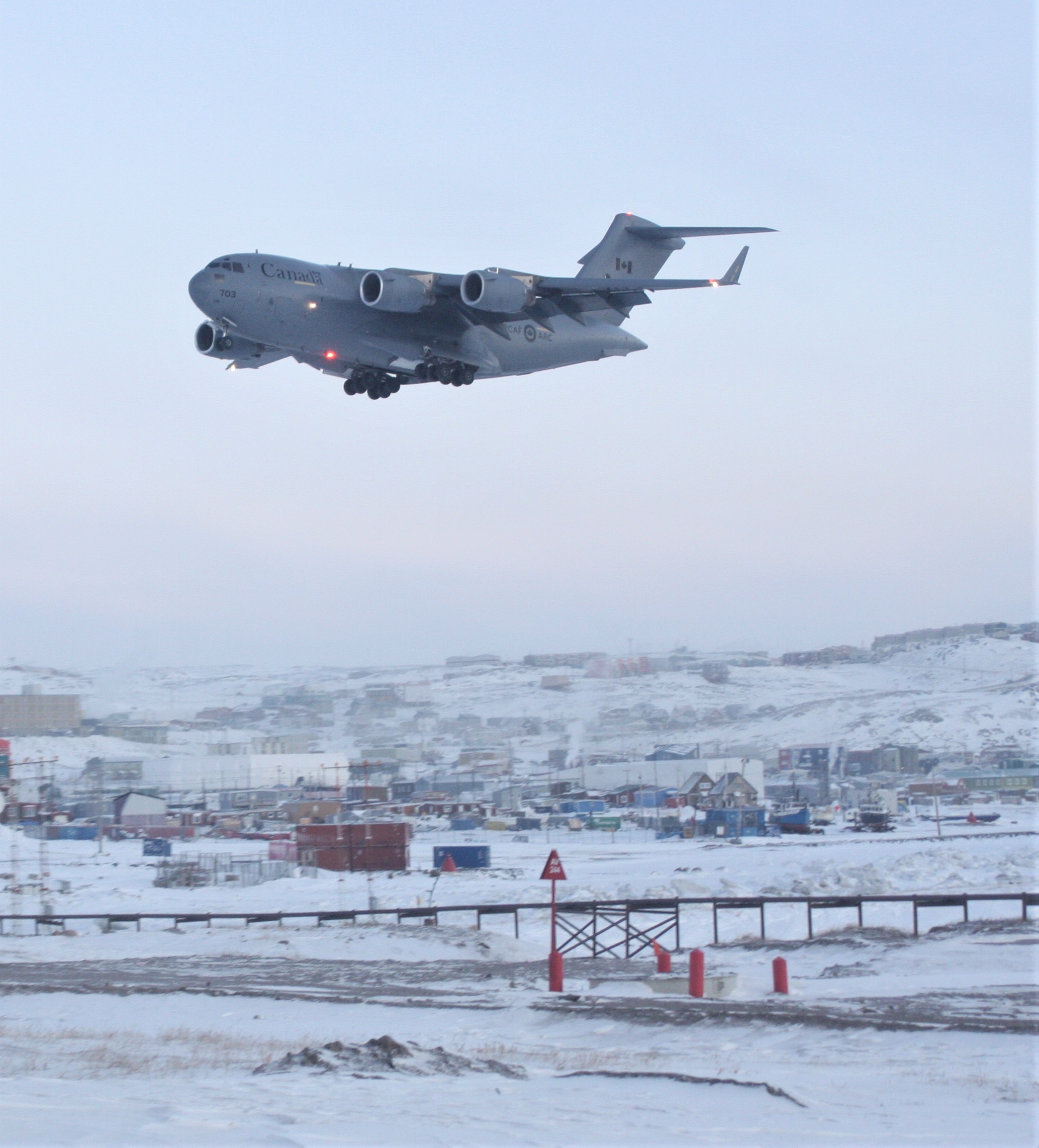
A Canadian air force cargo plane approaches the Iqaluit airport in a file photo from 2022. Defence Department representatives are scheduled to hold a public engagement session Thursday in Iqaluit to describe infrastructure the federal government plans to build at the forward operating location in Iqaluit as part of its plan to modernize the North American Aerospace Defence Command, known as Norad. (File photo by Corey Larocque)
Defence Department plans Iqaluit ‘engagement session’
Government officials to discuss plans for Norad modernization, forward operating location
This week, the Department of National Defence plans to host a public engagement session in Iqaluit about its plans to build infrastructure to modernize Norad and to beef up Arctic defence.
The event is planned for 7 to 9 p.m. on Thursday at the cadet hall, media advisory from the department says.
Government officials will provide an overview of the forward operating location in Iqaluit and North American Aerospace Defence Command modernization plans. They will also answer residents’ questions.
Earlier this year, Prime Minister Mark Carney’s Liberal government made a flurry of funding announcements about military and Arctic defence spending.
In March, the prime minister visited Iqaluit to announce $32 million to upgrade forward operating locations in Goose Bay, Inuvik, Iqaluit and Yellowknife. The work will include airfield improvements, new hangars, ammunition and fuel facilities, and warehouses.
Forward operating locations hold fighter aircraft and have storage facilities, maintenance buildings and airstrips. They are used to send aircraft into remote locations across the Arctic.
Iqaluit’s was built in the mid-1980s and features hangars for six jets, with accommodations for up to 200 support personnel.

In March 2025, Carney announced $6 billion for Canada’s Arctic over-the-horizon radar system, part of the government’s plan to modernize NORAD.
The system is being developed with Australia and defence contractor BAE Systems Australia. It will be able to detect targets hundreds of kilometres beyond the scope of conventional radar.
The federal government expects the project will add an estimated $290 million annually to Canada’s gross domestic product and about 2,270 jobs annually between 2026 and 2033.
(0) Comments