

The greening of the North: climate change shrinking tundra, says study
“Imagine the vast, empty tundra in Alaska and Canada giving way to trees”
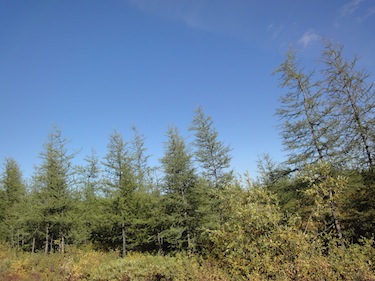
This photo was shot in Kuujjuaq last summer, showing how the treeline has marched northward along the Ungava Bay coast. (PHOTO BY JANE GEORGE)
RANDY BOSWELL
Postmedia News
The vast Canadian tundra will get lost in the woods this century as the treeline marches northward to the Arctic Ocean and all but wipes out the desolate but caribou-friendly bioregion from mainland Canada, a new international study predicts.
Forecasting profound changes to all Arctic ecosystems “fuelled by human-induced global warming,” the U.S.-led team of scientists has mapped the expected vanishing of moss- and lichen-covered land across much of the Canadian North, where up to 44 per cent of the terrain now classified as tundra could be replaced by invading boreal forest or shrub environments by 2099.
The team’s study, published in the latest issue of the scientific journal Climate Dynamics, concludes that tundra landscapes — characterized by deep permafrost, mossy ground cover and little other vegetation — will persist throughout Canada’s High Arctic islands and even expand in Greenland as its mammoth ice sheet retreats.
But huge stretches of tundra throughout mainland Canada, in Alaska and across Russia would disappear, the researchers’ climate-change models indicate.
Nunavut and the Northwest Territories would see the bulk of the transition toward forest or shrub-covered lands, but the Yukon, Quebec’s Ungava Peninsula and Labrador would also witness significant change.

“Imagine the vast, empty tundra in Alaska and Canada giving way to trees, shrubs and plants typical of more southerly climates,” says a summary of the study published by scientists from the University of Nebraska, the Korean Polar Research Institute and Seoul National University.
Study leader Song Feng, a University of Nebraska climatologist, told Postmedia News that the iconic caribou — also known as reindeer, and featured on Canada’s 25-cent coin — would be among the wildlife species affected by the changes.
“Increasing growth of trees may encroach on the habitat for many birds, reindeer and other locally beneficial species . . . thus adversely affecting local residents,” she said.
In the study, the researchers synthesized temperature projections from previous research projects and mapped the expected effects on Arctic vegetation under various climate-change scenarios covering the next century.
Even by 2050, much of the tundra in mainland Arctic Canada will have retreated rapidly because of warming temperatures and the advance of new plant species that previously couldn’t grow so far north, the study states.
By the last decades of this century, only small, scattered patches of tundra are expected to remain along the mainland Arctic coast.

“The projected warming leads to large shifts in climate regimes in the Arctic regions,” the Climate Dynamics paper concludes. “The areas occupied by polar climate types and subarctic continental climate type are projected to steadily decline, while the areas covered by temperate and boreal oceanic climate types are expected to steadily expand.”
The paper notes that while wholesale shifts in the boundaries of Arctic bioregions are expected by the end of the century, northern lands have already begun to transform.
“The ecosystems in the Arctic region are known to be very sensitive to climate changes,” the authors state. “The accelerated warming for the past several decades has profoundly influenced the lives of the native populations and ecosystems in the Arctic.”
(0) Comments