


GN spells out plan to deal with climate change
“Nunavummiut will need to prepare to adapt to these very real and tangible impacts”
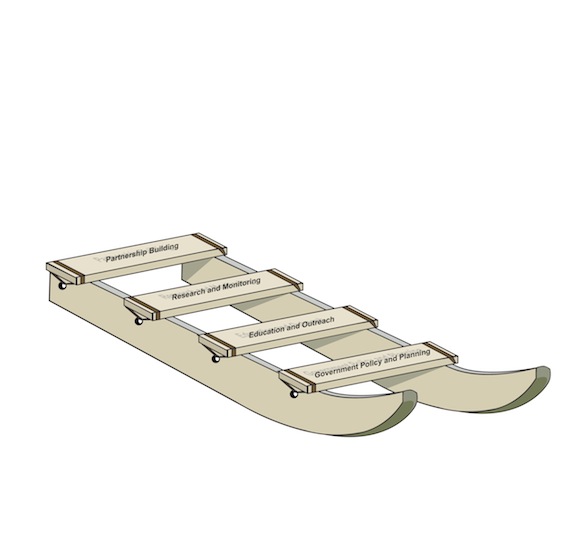
The four napuit or struts across this qamutik are Upagiaqtavut climate change plans’s four supports: partnership building, research and monitoring of impacts, education and outreach and government policy and planning.
Nunavut set out its course for climate change adaptation in a document tabled last week in the territory’s legislative assembly, with the Government of Nunavut promising various actions to help Nunavummiut adjust to climate change.
Called “Upagiaqtavut – Setting the Course, Impacts and Adaptation in Nunavut,” the document aims to inform and guide Nunavummiut, government agencies, and Inuit organizations about their activities “to help them become more resilient and adaptive to climate change,” a June 10 Government of Nunavut news release said.
“Climate change is already having a significant impact in Nunavut,” said Daniel Shewchuk, Nunavut’s environment minister, who tabled the document in the legislature.“Nunavummiut will need to prepare to adapt to these very real and tangible impacts that are affecting our land and way of life. This document provides strategic direction to ensure that Nunavummiut are prepared with the tools, skills, and knowledge to adapt to a changing climate.”
The Department of Environment prepared Upagiaqtavut in collaboration with other GN departments, and drawing on information from public consultations and research on climate change adaptation in Nunavut, the news release said.
In the 30-page Upagiaqtavut, the GN says what actions it intends to take, such as setting up an interdepartmental climate change group to work on community-based approaches to adaptation, creating a climate change website and ensuring climate change is incorporated into school curricula.
The GN presents its strategy by comparing it to a hunter’s qamutik.

“Just as a hunter plans his course and packs his qamutik with the necessary tools for the journey, Upagiaqtavut sets the course and identifies what is needed for Nunavut’s future. It is built on a solid foundation that marries science and Inuit wisdom gained through a close relationship to an ever-changing landscape,” the document says.
The four napuit or struts across the qamutik are Upagiaqtavut’s partnership building, research and monitoring of impacts, education and outreach and government policy and planning.
In Upagiaqtavut, the GN promises, among other things, to integrate climate change considerations into all government decision-making, identify new economic opportunities associated with climate change, and ensure climate change impacts are considered in emergency planning.
As for what the GN has already accomplished with respect to climate change in Nunavut, Upagiaqtavut says:
• climate change adaptation action plans have been developed for five pilot communities, Iqaluit, Arviat, Cambridge Bay, Whale Cove and Kugluktuk;
• a climate change adaptation planning tool kit is being created to assist with adaptation planning in the other Nunavut communities;
• a two-hour classroom or web-based climate change educational module has been developed;
• Nunavut youth and community members have been provided training and jobs in climate change projects.
• watershed and drinking water supply vulnerability analyses have started in Iqaluit, Clyde River, Arviat, Whale Cove and Rankin Inlet;
• a Nunavut Permafrost Monitoring Network has been set up in 11 communities,
• a Nunavut-wide sea level rise assessment is underway; and,
• a landscape hazard mapping is ongoing in Clyde River, Pangnirtung, and Iqaluit, with preliminary work completed in Kugluktuk, Cambridge Bay, Whale Cove and Arviat.
Upagiaqtavut is available for download from the Department of Environment Climate Change website.
(0) Comments