


$575M commitment a ‘first step’ in Inuit Child First transition, minister says
Five-year funding commitment was announced in Budget 2026
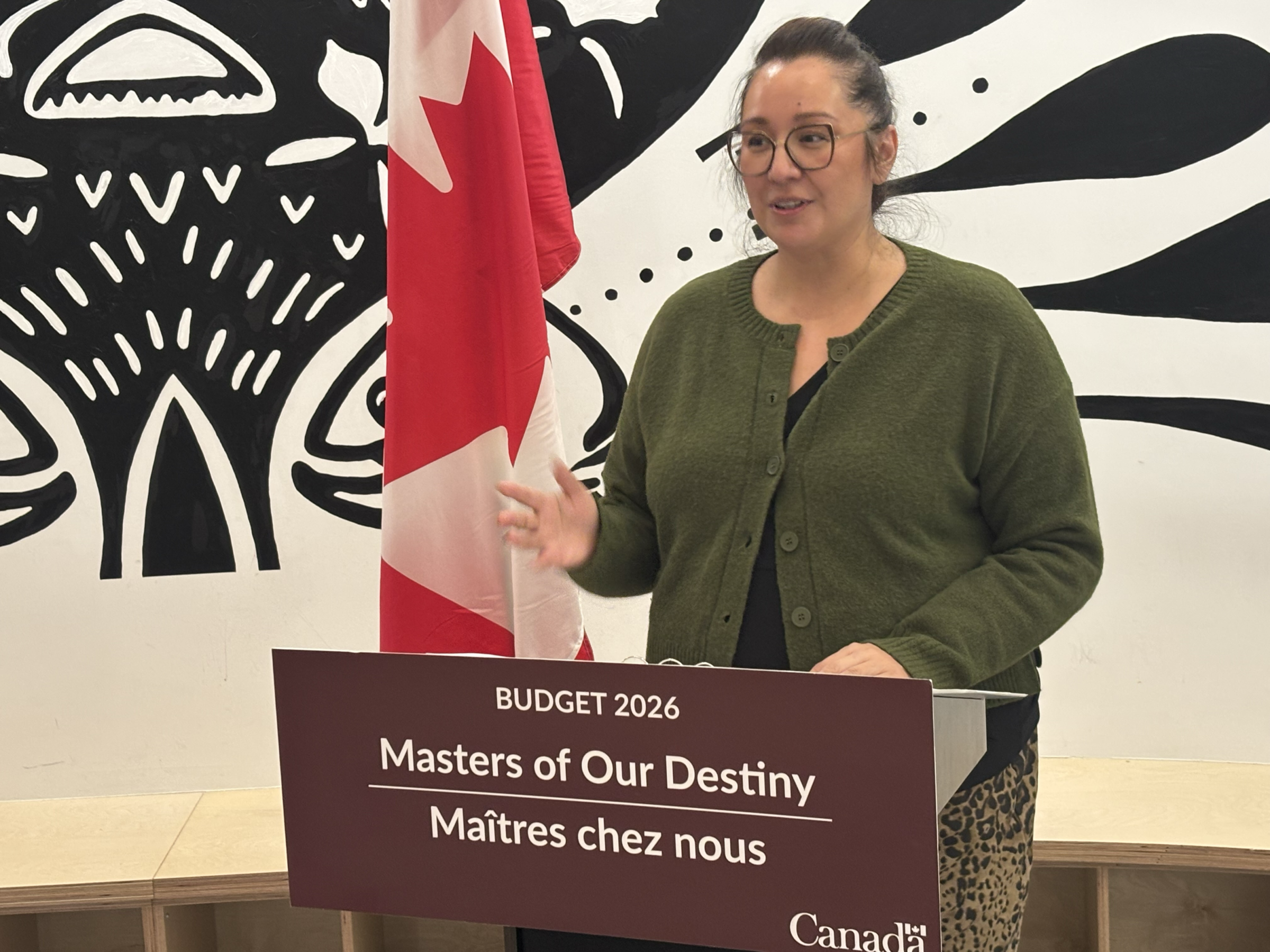
Indigenous Services Minister Mandy Gull-Masty speaks with reporters about the Inuit Child First Initiative at Iqaluit’s Inuusirvik Community Wellness Hub on Saturday. Gull-Masty called the $575-million commitment in Budget 2026 the “first step” in a broader transition for the program. (File photo by Daron Letts)

The $575-million, five-year commitment to the Inuit Child First Initiative in Budget 2026 is the “first step” in a broader transition, says Indigenous Services Minister Mandy Gull-Masty.
The program, rebranded as Pirutsiagutiit and developed with Inuit Tapiriit Kanatami and the four Inuit treaty organizations, is expected to launch April 1, 2027. Delivery will be transferred from Indigenous Services Canada to the treaty organizations or their designates.
“I’m really proud of the work that was done by ITK and all of the partners in the space for Inuit Child First Initiative,” Gull-Masty said during a news conference at the Inuusirvik Community Wellness Hub in Iqaluit on Saturday.
“We’ve had a lot of feedback. They’ve given us a lot of data. They’ve given us a lot of information. That’s what helped us to be able to bring forth the funding commitment.”
Gull-Masty said further announcements are expected from Northern and Arctic Affairs Minister Rebecca Chartrand and Crown-Indigenous Relations Minister Rebecca Alty.
“This is the first step in what you are going to see. The next step that comes forward is built with the essential input of our partners,” she said.
ITK said in an email to Nunatsiaq News that it would provide more details in the coming weeks, as well.
Nunavut MP Lori Idlout said the change in program delivery could have significant impacts for Nunavummiut.
“Inuit leading how the program will be delivered could have creative solutions, like maybe providing more for hunters so that they can provide for their families, for their children, so that children can go to school with having food in their bellies,” Idlout said in an interview with Nunatsiaq News on Saturday.
The federal government launched the Inuit Child First Initiative in September 2018. It provides health, social, educational and other supports to Inuit children and youth.
The program’s funding ran out in 2025 and was extended through one-year commitments while Ottawa and Inuit partners worked on a replacement.
In November 2025, Gull-Masty told Nunatsiaq News the program would be retooled and made permanent but did not provide a timeline for the replacement.
The new funding commitment is $25 million below the $600 million ITK requested in its pre-budget submission.
“The fact that they can find billions of dollars for military spending — in fact, one in five dollars is going towards military spending, much of which is going to happen in Nunavut — but couldn’t even meet by $15 million what was requested, I think is kind of patronizing,” said NDP Indigenous services critic Leah Gazan in an interview with Nunatsiaq News Monday.
Gazan also criticized changes introduced last February that required funding requests to demonstrate a child’s individual needs and include supporting documentation.
The changes also restricted funding for community-wide programs, including hamlet food voucher programs.
“We will continue to push the government to make sure that this actual transition occurs and it doesn’t fall by the wayside, like we’ve seen in the past,” Gazan said.
— With files from Daron Letts.

Here’s to hoping the program is truly means tested, and it isn’t designed in a way that just gives chunks of money to people just because theyre Inuit. And here’s to hoping it is delivered in a manner that actually benefits children, rather than in a way that allows parents to simply trade vouchers to support their bad habits.