


Maud keeps luring Norwegians to CamBay
The ship’s anchor winch came from the Fram
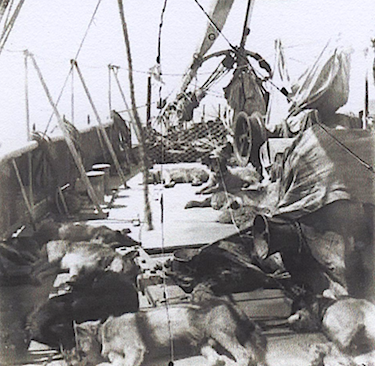
This how the anchor winch looked when it was on the Fram — some of Roald Amundsen’s dogs, which he learned to drive while wintering in Gjoa Haven, can be seen sleeping on the deck. (PHOTO COURTESY OF AKER SOLUTIONS)
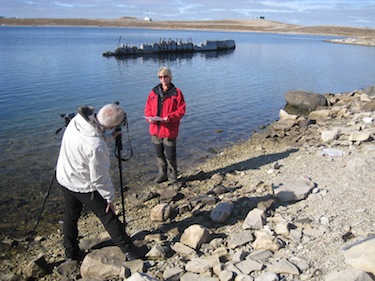
Ann Marchioro Ystad of Aker Solutions stands in front of the wreck of the Maud, once sailed by Norway’s national hero, Roald Amundsen. (PHOTO COURTESY OF AKER SOLUTIONS)
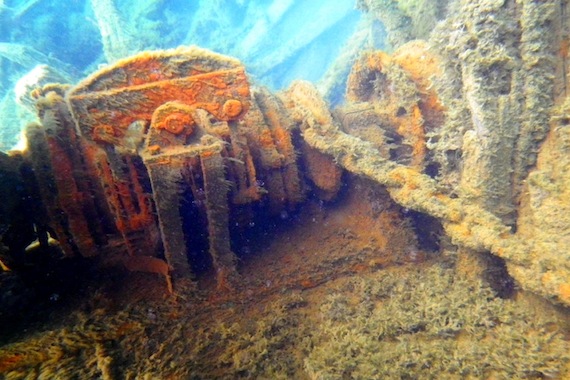
Here’s how the anchor winch on the half-submerged Maud — once sailed by the Norwegian explorer Roald Amundsen — looks today. (PHOTO COURTESY OF AKER SOLUTIONS)
Nunavut is already feeling the echoes of the growing hoopla in Norway around its famed polar explorer Roald Amundsen.
Next month marks the 100th anniversary of Amundsen’s successful trek to the South Pole.
His Dec. 14, 1911 arrival at the South Pole was the second “first” for Amundsen, who was also the first European to successfully traverse the Northwest Passage in 1906.

This Dec. 14, several commemorative expeditions plan to converge on the South Pole, where Norway’s prime minister Jens Stoltenberg, will be on hand to greet them.
That’s how big Amundsen and his achievements still remain to Norway.
And this helps explain why Kristen Grenlee and Ann Marchioro Ystad recently travelled thousands of kilometres from southern Norway to Cambridge Bay in western Nunavut.
The two wanted to take photos of an anchor winch that travelled with Amundsen to the South Pole on board the Fram, the boat he used to sail to Antarctica, where he beat a British party led by Robert Scott to the South Pole.
Later Amundsen reinstalled the trusty winch on the Maud, which he sailed in 1918, planning to drift with the ice across the Northeast Passage westwards and over the North Pole.
That expedition failed and after passing to the Hudson Bay Co., the ship sank at its mooring in Cambridge Bay 80 years ago,.

But there’s still interest in the anchor winch.
That’s because the well-travelled winch was made by the company that Grenlee and Ystad work for: Aker Solutions.
Their employer plans to use recent photos and footage of the Maud in advertising campaigns timed around the Dec. 14 centennial celebrations of Amundsen’s South Pole conquest.
Aker Solutions is still making winches for ships in “very harsh and Arctic areas,” said Grenlee, the company’s manager of business development.
“So it is very important for us to prove that we have done that for a very long long time” — and with such success.

Aker Solutions has been in business since 1875 under the same name and making winches for even longer. Amundsen’s winch was one of the earlier ones produced, with a serial number of 1135. Now the company has made more than 55,000 winches, Grenlee said.
A team of Norwegian divers who visited Cambridge Bay in the early 1990s had taken photos of the winch, so the company knew it was still there.
However, then the winch was above water. Now, nearly 20 years later, it’s underwater.
During their visit to Cambridge Bay this past September, Grenlee and Ystad, vice-president of mooring and loading systems, didn’t dive down to see the winch.
Instead they used a special underwater camera to take photos of the half-submerged ship and the winch.
But Grenlee and Ystad weren’t the only Norwegians inspired by Amundsen’s exploits to visit Cambridge Bay this summer.
Another pair of Norwegians visited the town in early August to see whether a plan to bring the 36.5-metre Maud back to Norway is feasible.
Grenlee and Ystad say they had no idea that this project even existed when they planned their own trip to Cambridge Bay.
All they wanted to do was photograph the winch.
So, the two kept a low profile in Cambridge Bay, doing what visitors do in the town, driving to the coast, muskox-watching, climbing Mount Pelly and visiting the Elks on Friday night.
As for the other Norwegians drawn to the Maud, Tandberg Eiendom and its project group “Maud Returns Home,” they applied Oct. 27 to the federal government for an export permit.
”We are determined to succeed and in this way give the old ship and her incredible expedition history that attention and respect, it has always deserved, but never been given,” says the “Maud Returns Home” website.
Without an export permit, plans to bring the Maud on 7,000-kilometre journey back to Norway and build a futuristic museum around it won’t move ahead.
Meanwhile, the Facebook group “Keep the Baymaud in Canada,” formed last summer, still advocates keeping the wreck — with its famous anchor winch — in Canada.
(0) Comments