


Arviat North-Whale Cove candidates want to grow local opportunities
“Every community has social issues and Arviat and Whale Cove are no different”

Elizabeth Copland in her former position as chair of the Nutrition North Canada advisory committee, (FILE PHOTO)

Nunatsiaq News caught up with Amauyak Netser as he was catching a flight from Arviat to Whale Cove to campaign in the community. (PHOTO BY SARAH ROGERS)

Joseph Ivitaaruq Kaviok wants to see more decentralization to bring more jobs to his region. (PHOTO BY SARAH ROGERS)
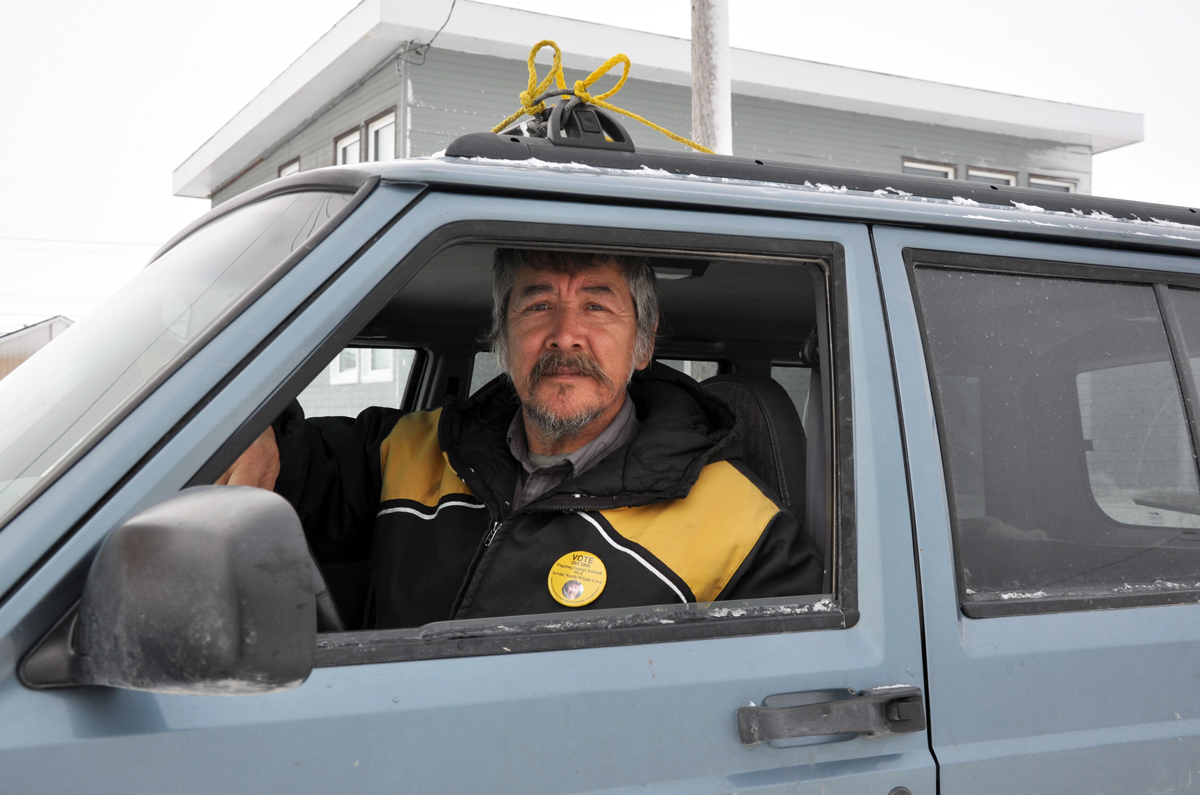
George Kuksuk says it’s time that Arviat got a utilidor system. (PHOTO BY SARAH ROGERS)

David Kritterdlik, the only candidate from Whale Cove, calls his campaign “David and Goliath 2013.” (HANDOUT PHOTO)
ARVIAT — Arviat North-Whale Cove is home to one of the most crowdest races in this year’s territorial election, with five candidates vying to represent the new constituency..
Two candidates did not respond to requests for interviews: Elizabeth Copland, who has served as chair of the Nutrition North Canada advisory board and more recently, the Nunavut Impact Review Board, and retired mechanic Amauyak Netser.
Here’s a look at the three other candidates.
Joseph Ivitaaruq Kaviok
Kaviok worries about the future of his children, because there are few jobs to be had in Arviat, even for youth who have a good education.
“We’re the third largest community and there’s a lack of work here,” said Kaviok, 56, who has served as Arviat’s fire chief on and off since the 1970s.
And that’s pushing people onto social assistance, which many rely on to feed their families, he said.

“The education is there, even the graduation rates are there, but as parents, we wonder: where are the jobs?” said Kaviok, a father of 10.
Part of the solution to that might be encouraging more decentralization, to bring Government of Nunavut jobs to the Kivalliq.
Youth in the region also need access to mental health workers, Kaviok said, since communities cannot always rely on elders and church leaders to provide support.
Youth make up a large and growing percentage of a region that already struggles with suicide, he said, and many aren’t getting the help they need.
Infrastructure needs also sit at the top Kaviok’s priorities; Arviat has only one fire truck to service its roughly 400 houses, while the community’s airport can’t land anything larger than turbo-prop planes.

Kaviok calls the four other candidates “good and capable competitors” but says of his candidacy: “If I’m going to keep quiet, no one will ever hear what I have to say.”
David Kritterdlik
Kritterdlik says he’s tired of Nunavut’s smallest communities always having to fight for what they need.
“They never have anyone running for MLA,” said the general contractor and airline agent. “I want to see what kind of good I can bring for my community if I’m elected.”
The majority of Whale Cove’s needs are the same as that of any community in Nunavut, Kritterdlik said, including housing shortages and a lack of education and employment.
And those issues should continue to dominate discussion in the legislative assembly, he said.
“I don’t think anyone has the solution to unemployment,” Kritterdlik said, “but we have to help young people get the right training. If local organizations can get access to funding, they can also help by hiring our young people and giving them experience.”
Kritterdlik, 62, says the region’s mining industry promises to continue the creation of jobs for Kivalliqmiut.
But until then, Nunavut has to look at other ways to bring prosperity to the region.
While plans to build a road connecting the territory to Manitoba remain at a standstill, Kritterdlik says Nunavut should look at a rail link between Churchill and Arviat.
“Although we have access to Manitoba by land, we don’t have any on-ground transportation,” he said. “I think it would be cheaper and would benefit all the Kivalliq.”
Kritterdlik knows he has a tough fight Oct. 28, as the only candidate from Whale Cove, population 407, compared with his four competitors, who are based in Arviat.
Kritterdlik calls his campaign “David and Goliath 2013.”
“We’ll just have to wait and see what happens,” he said.
George Kuksuk
Kuksuk, 59, has served as Arviat’s mayor and later as a hamlet councillor. He has also chaired different corporations, including Sakku Investment Corp. — an arm of the Kivalliq Inuit Association — where he helped negotiate a partnership agreement between Sakku and First Air.
He resigned his role as chair of the Keewatin Business Development Corp. to run for MLA, promising constituents that he’ll “speak up.”
In a community the size of Arviat, population 2,300, Kuksuk says it’s time the hamlet used a utilidor system for water and sewage services.
Trucking water to houses has become a challenge, he said, while a utilidor system, over time, would save money for the Government of Nunavut.
To help families in crisis, Kuksuk would like to see a safe house or shelter built to serve the community or the region.
Right now, the RCMP and social services are forced to temporarily house such families in local hotels or with other families.
“Every community has social issues and Arviat and Whale Cove are no different,” said Kuksuk. “We should have a proper facility for those kinds of incidents.”
Kuksuk, who used to run a transport and shipping company, also sees room for the government to help small business launch or expand.
He wants more small businesses to be eligible for loans.
And a local issue has Kuksuk thinking about how to improve search and rescue efforts throughout the region – this after a young Arviat man has been missing two weeks since he left the community to hunt caribou.
Kuksuk wants the Kivalliq region to get its own search and rescue base, a facility that would store equipment, an aircraft and act as a dispatch centre for searches in the region.
That would save valuable time, he said, rather than have search aircraft flying in from southern and eastern Canada.
And that’s only one example of the infrastructure Nunavut is lacking, Kuksuk said.
(0) Comments