


Bevington attacks Aglukkaq over Inuit dental care
Closure of national dental therapist school in 2011 still rankles
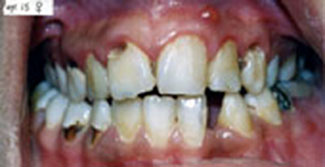
This photo from 2006 shows the teeth of a teenager who did not receive good dental advice or care. (FILE PHOTO)
Western Arctic MP Dennis Bevington of the New Democratic Party, in a May 1 question in the House of Commons, accused Leona Aglukkaq, the national health minister, of hurting her own constituents when the Conservative government pulled funding in 2011 from the National School of Dental Therapy, causing it to close.
In his question, Bevington referred to an action plan on Inuit oral health that Inuit Tapiriit Kanatami released last month.
ITK’s proposed plan said the quality of Inuit dental health should be improved until it meets the World Health Organization’s standard of 50 per cent of school children entering school without a cavity.
The ITK report also noted that many dental therapist positions in Nunavut are not filled.
ITK’s work was made in response to a Health Canada study released in 2011 that found one in five Inuit over the age of 40 have no teeth.
“ITK wants to see more oral disease prevention, more health promotion and more treatment rather than just pulling diseased teeth,” Bevington said May 1.

“Considering this, why did the minister of health end funding for the country’s only National School of Dental Therapy, forcing it to close when the people most in need are her own constituents?” he said.
Aglukkaq responded by pointing to her government’s Pathways to Health Equity Program for Aboriginal Peoples, announced in June 2012.
Under that program, the federal government is to spend $25 million over 10 years on aboriginal health research.
“Our government is the single largest investor in health research in this country. We invested in Pathways to Health and one of the priority areas identified in the program was oral health,” Aglukkaq said in her reply to Bevington’s question.
She also said the federal government prefers to let provinces and territories make their own decisions about health care priorities and that Ottawa continues to raise their funding each year.
“We continue to increase transfers to the provinces and the territories because they know best where to prioritize delivery and that member from the Western Arctic continues to vote against it,” Aglukkaq said.

Bevington continued to push the issue May 2, putting out a press release that accused Aglukkaq of not directly answering his question.
“Rather than committing to action, Aglukkaq instead tried to blur the issue by saying a $2.5-million-a-year research study program was the answer,” Bevington’s press release said.
He also accused her of having “completely washed her hands of any responsibility for Aboriginal health care.”
“Until it closed, the school trained dental therapists for remote and Aboriginal communities. Northerners need more dental professionals not fewer and this minister has taken actions which make matters worse,” Bevington said.
The National School of Dental Therapy operated out of the First Nations University of Canada in Saskatchewan, whose funding was cut in February 2010 after allegations of financial mismanagement.
Prior to that time, in 2009, Health Canada had announced that funding for the dental therapist school would end as of June 30, 2011.
Mary Simon, then the president of ITK, said in a blog post written in March 2011 that the closure of the dental therapists school “is very disturbing.”
“The reduction in services to remote Inuit communities will only add to the existing problem of limited dental services. It will increase the risk of our children and youth experiencing lifetime oral health issues,” Simon wrote.
She also said Inuit ultimately need full-time dental therapists in every Inuit community.
(0) Comments