


Nunavut’s Chidliak diamond project set to prove its worth
Peregrine Diamonds outlines mining potential to council
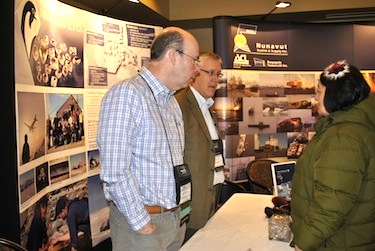
Brooke Clements, left, and Tom Peregoodoff of Peregrine Diamonds Ltd. speak April 10 to Nunavut Tunngavik Inc. president Cathy Towntongie at the Nunavut Mining Symposium trade show at the Frobisher Inn. (PHOTO BY JANE GEORGE)
The prospect of a diamond mine just 120 kilometres northeast of Iqaluit looks more realistic now that Peregrine Diamonds Ltd. has hauled rock samples into Iqaluit from the Chidliak project site on April 9.
Project leaders gave Iqaluit City Council an update that evening on the diamond mine that might one day be operational — if bulk tests for diamond quality are confirmed.
“We’re now at the bulk-sample stage. It’s where you find the economic potential of a mine,” Brooke Clements, president of Peregrine Diamonds, reported to councillors at the regular meeting.
The Vancouver-based diamond exploration company runs the 858,000-hectare Chidliak project, which includes 61 kimberlite deposits.
Such formations typically contain diamonds, and Peregrine has identified seven that could have grades high enough to make them worth mining. Six of these formations are within an eight-kilometre radius, said Clements.
“Having your best kimberlites so close together would make mining and processing more efficient, if we get to that point,” Clements told councillors.
One deposit in particular has a grade of 2.84 carats of diamonds per tonne of kimberlite rock.
“It we confirm that grade, it would make it one of the richest kimberlites in the world,” Clements said.
To verify the grade, the company is collecting a 200-tonne bulk sample from a trench. They expect to extract about 500 carats of diamonds from this, he said.
The diamonds will be evaluated to determine how much they are worth per carat, the measurement standard used to weigh diamonds.
Peregrine is transporting the samples to Iqaluit, to be shipped from there to research facilities in the south via sealift.
The company expects to have results on these by the end of the year.

Peregrine formed a partnership with De Beers Canada Ltd. in September 2012 to help finance the project and share developmental risks.
According to their agreement, De Beers holds an option to enter into a joint venture with Peregrine that would give De Beers majority ownership of the Chidliak property.
“De Beers is the world’s oldest and most experienced diamond company,” said Clements. “We think they are the ideal partner to help.”
Clements and Tom Peregoodoff, executive vice-president of Peregrine, outlined the benefits that an eventual mine could offer to Iqaluit, including employment opportunities and funding for sports and cultural events.
The project has employed 69 residents of Iqaluit and Pangnirtung since 2008, said Clements, adding that Peregrine spent some $4.3 million in wages and local services in both communities in 2011.
In terms of what the city could do to improve employment prospects, Clements highlighted the need for a well-educated workforce.
“When you think about a potential mine down the road and the need for workers, really the most important thing you can do is just do everything you can to support K-to-12 education,” he said. “That’s what makes a good worker, is a solid fundamental education.”
Councillors’ questions on the project focused on employment possibilities at the site, and the effects mining operations would have on the environment.
Clements and Peregoodoff could not elaborate on employment or training for mining work until plans for a mine are realized.
In answer to questions on environmental effects, Peregoodoff pointed out that all mining developments require a “closure plan” before they are permitted to open.
“Before we are actually allowed to commence development of project, we’re required to tell regulators and all stakeholders how we intend to close once we finish extracting the resource,” he said. “In general it involves returning the land to as close to its original status as possible.”
(0) Comments