


For Nunavut, Tory throne speech recites oft-heard messages
ITK welcomes commitments to resource development, northern sovereignty
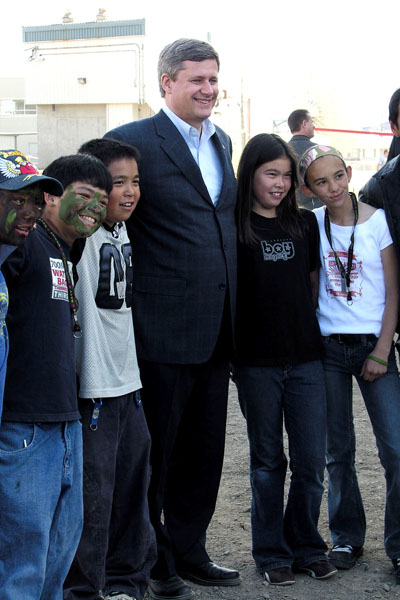
Prime Minister Stephen Harper poses with children behind Nakasuk School in Iqaluit during his first visit to the Arctic in August 2006. Many of the messages contained in his government’s Oct. 16 throne speech date back to his early Arctic tours. (FILE PHOTO)
The Conservative government’s throne speech Oct. 16 repeats many old promises, but contains few new commitments for Nunavut and the rest of the Canadian Arctic.
It took Governor General David Johnston more than an hour to read the speech inside the Senate chamber on behalf of Prime Minister Stephen Harper’s government, the first act in a new session of Parliament following prorogation earlier this year.
Most of its Arctic- and Nunavut-related material will be familiar to most Northerners, but it does not mention Canada’s chairmanship of the Arctic Council, which began earlier this year.
The speech also does not contain the phrase “climate change,” but it does say the government will work with provinces to reduce greenhouse gas emissions from the oil and gas sectors and do more on improving air quality.
On relations with Quebec, the speech affirmed the Tory government’s tendency to respect areas of exclusive provincial jurisdiction, saying “Our government will continue to respect the division of jurisdiction at the heart of the constitution adopted at Confederation.”
For Nunavik, this means it’s highly unlikely that Ottawa will spend the large amounts of money on social housing that the Makivik Corp. has long demanded.
Near the end of the speech, the Conservative government heaped praise on itself for its past activities in the Arctic.
These include:
• the opening this year of the Armed Forces training centre in Resolute Bay, which occupies part of an addition to the Polar Continental Shelf Project;
• expanding the Canadian Rangers, “our eyes and ears in the North;”
• the creation of the Canadian Northern Economic Development Agency, announced in 2009 and launched in 2010;
• mapping the Arctic seabed;
• investing in “health care, education and affordable housing for northerners,” a reference to previously announced social housing, adult education and health research contributions to territorial governments;
• a “historic” devolution agreement with the Northwest Territories.
The speech also said the federal government has made “great strides” in negotiating such an agreement with Nunavut.
However, when Nunavut Premier Eva Aariak met Harper in Rankin Inlet this past August, she said she’s “getting more and more concerned about the fact that the start of devolution negotiations is taking longer than expected.”
At the same time, the speech portrayed the Harper government as protector of the Arctic.

“But the eyes of the world increasingly look enviously to our North. Our Government will not rest,” the speech said.
For the future, the government said it will:
• complete the Dempster Highway to the Arctic Ocean;
• finish the Canadian High Arctic Research Station in Cambridge Bay by 2017, in time for the 150th anniversary of Confederation;
• complete what it calls “Canada’s first deep water Arctic port” at Nanisivik by the time its fleet of new Arctic patrol ships arrives;
• “recognize that the future prosperity of the North requires responsible development of its abundant natural resources,” and train northerners for jobs in the new resource economy;
• continue to defend the seal hunt;
• work with “an expanded team of partners” to search for the remains of Sir John Franklin’s ill-fated Arctic expedition;
• complete work on a protected area at Bathurst Island in Nunavut;
On relations with Aboriginal peoples, the government said it “will continue our dialogue on the treaty relationship and comprehensive land claims” and “continue to work in partnership with Aboriginal peoples to create healthy, prosperous, self-sufficient communities.”
And on resource development, the government promised to:
• enshrine the polluter-pays principle into law;
• create higher safety standards for companies operating in the offshore and increased the amount of liability insurance they must carry.
In reaction, the Inuit Tapiriit Kanatami said it welcomed the throne speech’s commitments to resource development and northern sovereignty.
“I was very pleased to note themes of partnership and developing healthy, prosperous, self-sufficient communities that are very much in line with discussions by Inuit leaders this summer with Prime Minister Harper and senior cabinet ministers,” ITK president Terry Audla said in the statement.
But Audla said he noticed only “brief mentions” of housing and the expansion of broadband internet, and looks forward to seeing those issues dealt with in the 2014 federal budget.
(0) Comments