


Hundreds receive child and family services from Nunavut: report
Report says 63 children and youth, 129 adults receive services outside the territory
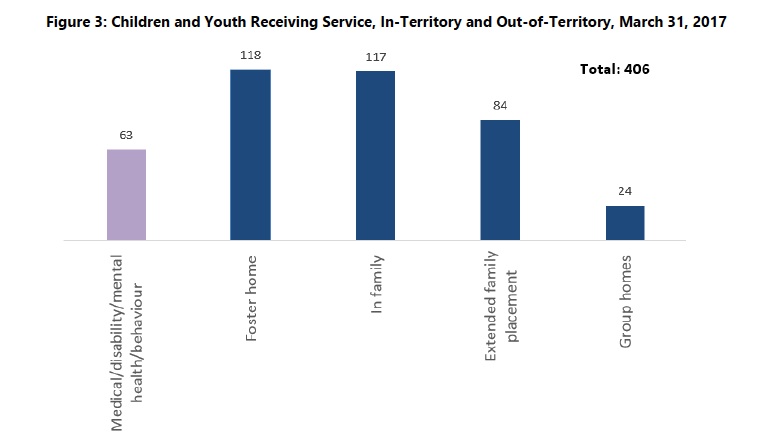
This graph from the child and family service director shows where Nunavut children and youth who receive services from the child and family services department live.
Hundreds of Nunavut children, youth and adults are living away from their homes and families, many for their own safety.
Concern over children who don’t live at home in his community of Arctic Bay prompted Quttiktuq MLA Isaac Shooyook to say in the Nunavut Legislative Assembly Sept. 14 that “if a child is fostered by another person other than the parents, it will result in a lack of proper foundation and a negative impact for the rest of the child’s life.”
Shooyook delivered this member statement on the same day that the annual report from the Director of Child and Family Services was tabled in the legislature.
And this report, which you can access online here , shows how many Nunavut children, youth and adults do live away from their homes and families.
In all, 406 children and youth are receiving services from the department—242 boys and 164 girls.
Of these, 363 live in Nunavut, the majority in foster homes, the Child and Family Services’ director’s report for 2016-17 reveals.
Of the children and youth receiving services, 90 are in permanent custody.
“Under the Child and Family Services Act, the Department of Family Services is mandated to seek Permanent Custody Orders for children and youth who need significant protection,” the report said.
The 63 children and youth, who receive services out-of-territory, are there for a variety of reasons, including “severe behavioural or mental health challenges, and/or medical issues,” the report said.
To ensure “adequate oversight over out-of-territory facilities and clients’ care,” the department said it has created two client liaison officer positions in Ottawa and Edmonton.
“These Client Liaison Officers will be Nunavut Inuit, which will create culturally appropriate relationships and connections for Nunavummiut residing out-of-territory.
“The Department recognizes the importance of working to repatriate children and youth who are receiving services out-of-territory, where possible,” the report said

As for adults, about 250 are also receiving services from the department, 129 of them outside Nunavut.
That’s because Nunavut does not have the “capacity or infrastructure” to meet the needs of Nunavummiut who require specialized care, ongoing medical intervention, treatment of mental health, or dementia services, so the department said it must rely on out-of-territory residential care facilities.
The annual report also offered up some figures on the use of family violence shelters, which saw 455 clients this past year, 224 women and 231 children.
Although there was a drop in admissions to the shelters, from 593 women and children in 2015-16 to 455 in 2016-17, the department said this does not necessarily mean a decrease in occupancy in the shelters.
“Rather, women and children may be staying longer in the shelters, which would result in fewer admissions,” the report said.

The report also included the number of adoptions in Nunavut 2016-2017; there were 185 in total—155 custom adoptions, 27 private and three through the department, with consultation from Inuit organizations.
(0) Comments