


Inuit circumpolar org plays big role, with little cash
Norway, not Canada, will underwrite Inuit participation at 2015 Paris climate change meeting

Duane Smith, the president of ICC-Canada, speaks to the members of the ICC board Sept. 15 at the organization’s AGM in Cambridge Bay. (PHOTO BY JANE GEORGE)
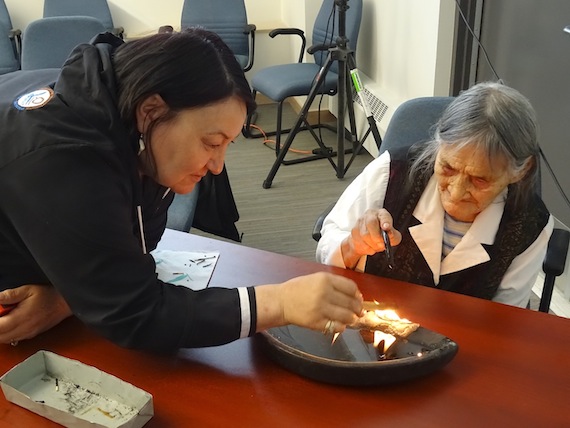
In Cambridge Bay, Cathy Towtongie, the president of Nunavut Tunngavik Inc., and 85-year-old elder Mary Kaniak, light the qulliq at the start of the Inuit Circumpolar Council-Canada annual general meeting on Sept. 15. (PHOTO BY JANE GEORGE)
CAMBRIDGE BAY — The Arctic expertise of the Inuit Circumpolar Council, which currently represents Inuit internationally, is more and more in demand at high-level conferences.
But it’s not because of the current Conservative government that ICC-Canada is able to represent Inuit from Canada internationally.
That was clear from what ICC-Canada president Duane Smith had to say Sept. 15 during the organization’s annual general meeting in Cambridge Bay.
In his president’s report to the board, Smith told them that “his goal is to ensure your voice is heard.”

But it’s not easy because the financial statements of the organization project a shortfall of $138,000 for this fiscal year.
ICC-Canada, which is now chairing the international organization until 2018, received about half of its $2.7-million 2015 budget from projects handed out by Aboriginal Affairs and Northern Development Canada and from the Department of Foreign Affairs.
The rest was cobbled together from smaller projects and contributions from the Inuit birthright organizations — the Inuvialuit Regional Corp., Nunavut Tunngavik Inc., Makivik Corp. and the Nunatsiavut government, which sit on the ICC board.
ICC-Canada has submitted requests for core funding to the federal government, but gets no response, Smith said.
So it’s Norway, surprisingly, which will fund ICC’s participation at the upcoming United Nations climate change meetings in Paris this coming December, which world leaders like President Barack Obama hope will produce a plan to curb climate change.
At the Paris meeting, ICC will join with Saami from Norway, Sweden, Finland and Russia, as part of an Arctic indigenous delegation, led by ICC’s international president, Okalik Eegeesiak.

Information handed out at the AGM said that “currently there is no support from Canada for Inuit to prepare or engage in climate issues of the COP21 meeting nor will Canadian Inuit be invited to be on the Canadian delegation, although the three territories will be invited to send a delegate.”
That’s different than what ICC experienced in the past when Inuit were heavily involved and present at the 2009 global climate change meeting in Copenhagen.
Smith, who said Inuit are no longer asked to join the Canadian official delegation, called this a “disturbing trend.”
The money from Norway will help ICC develop plans and side events at the gathering, Smith said.
Among the goals of the ICC and Saami delegation in Paris: to advocate for help for Inuit to adapt to climate change, perhaps with the creation of a special adaptation fund.

ICC also plans to help organize or host summits on wildlife management, the economy and education during its chairmanship.
The education summit sparked interest from some ICC board members, such as the IRC president, Nellie Cournoyea who called for more investment in education.
“We need to see what’s working. The sooner you do it, the sooner it will pay off,” said Vernon Amos, also from the IRC.
(0) Comments