


Kusugak delays Nunavut power rate hike by two years
QEC will move now towards implementing higher territorial power rates on April 1, 2014
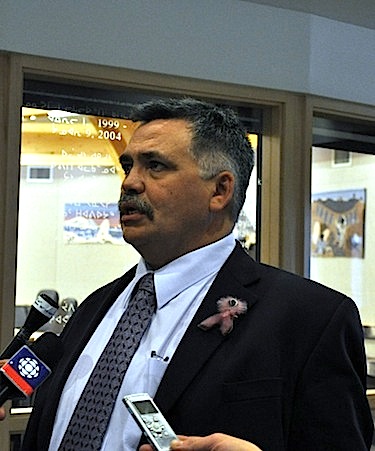
The hike in power rates will be delayed until 2014, Lorne Kusugak, Nunavut’s minister of community government and services, said Feb. 21 in the Nunavut legislature. (FILE PHOTO).
If you’re paying electrical bills in some Nunavut communities, you can take a deep breath: the Qulliq Energy Corp.’s new, “rebalanced” rate scale for electricity will be delayed by two years and scaled in slowly, Lorne Kusugak, Nunavut’s minister of community and government services, said Feb. 21 during the opening session of the Nunavut legislature.
Delaying the move towards territorial-wide rates gives customers time to adjust to the rate increase implemented in April 2011, when power rates rose by about 19 per cent across the territory, Kusugak said.
“It also provides the Government of Nunavut an opportunity to review its electrical subsidy programs to ensure they provide maximum benefit to Nunavummiut,” Kusugak said.
Phase II of Qulliq Energy Corp.’s latest general rate application would, over about 10 years, gradually move the territory towards territorial-wide rates.
This means customers in some communities, such as Iqaluit, would pay more, while customers in some other communities would pay less. But the total amount of revenue paid by power customers would not increase.
Before the Utility Rates Review Council’s recent public hearings in six Nunavut communities, the new rate scheme was to have come into effect April 1, 2012.

The QEC will now move towards implementing the new territorial power rates on April 1, 2014, Kusugak said.
The new rates will be phased in over a number of years beginning on that date, he said.
And limits will be placed on the maximum increase or decrease that domestic and commercial customers will face during the transition period.
The maximum increase will stand at five per cent, and a limit of a four-per cent decrease will apply to domestic and commercial rate classes” in any community at any given time,” he said.
Under Phase II, non-commercial power rates in Rankin Inlet, Baker Lake, Iqaluit, Pangnirtung, Cape Dorset and Igloolik are to rise by up to five per cent.
And, with the exception of Baker Lake, commercial power rates paid by private businesses are also to rise by up to five per cent.
At the same time, commercial and non-commercial customers in all other Nunavut communities may see a decrease in their rates of up to four per cent.
This represents the second phase of a rate-change process that started Oct. 4, 2010, when the power corporation requested across-the-board rate hikes of about 19 per cent.
The GN eventually granted most of that rate increase, in April of 2011, but not until after hearing numerous complaints from business, consumers and municipal governments.
During public hearings held during Phase I of the rate process, QEC officials floated the idea of “rate rebalancing,” under which communities would be grouped into rate zones.
The purpose of such a plan would be to even out power rates paid by relatively low-cost communities like Iqaluit and high-cost small communities.

Right now, each community in Nunavut pays its own tailor-made set of power rates, based on the cost of providing service in the community.
In 2004, the QEC floated the idea of a common set of power rates for all Nunavut communities, but that one-rate proposal was shot down after meeting widespread opposition, especially from Iqaluit.
(0) Comments