


Legendary geologist Raymond Thorsteinsson hailed as “last living Arctic explorer”
“No matter where he was, he would heat up his Primus stove and make tea”
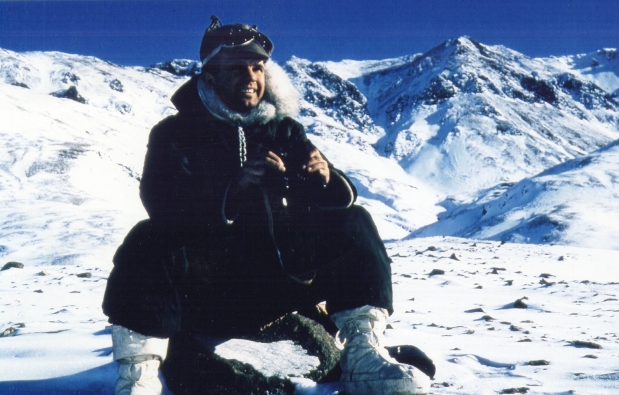
Raymond Thorsteinsson, geologist and Arctic explorer who recently passed away in Calgary at the age of 91. It was taken sometime during the 1950s, during one of his scientific expeditions to the Arctic. (HANDOUT PHOTO/POSTMEDIA NEWS)
AMANDA STEPHENSON
Postmedia News
CALGARY — Raymond Thorsteinsson’s life could have come straight out of an adventure novel.
The renowned Calgary geologist, who passed away April 23 at the age of 91, first made a name for himself in the Canadian Arctic in the 1950s and 1960s.
Braving polar bears, ever-shifting ice floes and the fury of the elements, Thorsteinsson explored and mapped more than 500,000 square kilometres of frozen archipelago — and in between, he still managed to squeeze in an important daily ritual.
“He was a gentleman, and he always made time for tea,” says daughter-in-law Mary Thorsteinsson. “No matter where he was, he would heat up his Primus stove and make tea, and always have a little piece of chocolate.”
Thorsteinsson, who served his entire professional career with the Geological Survey of Canada, received numerous honours for his work, including the Founder’s Medal from the Royal Geographical Society of London. He was named a member of the Order of Canada in 1983 and an officer of the order in 1989.

Benoit Beauchamp, a professor of geoscience at the University of Calgary and past executive director of the Arctic Institute of North America, says Thorsteinsson ranks among the top three geologists Canada has ever known.
He says Thorsteinsson’s geological work in an area of the Arctic called the Sverdrup Basin led directly to the development of the Canadian oil and gas industry in the North.
“He was the ultimate pioneer,” Beauchamp says. “He discovered, literally, one of Canada’s most promising basins when it comes to oil and gas.”
Beauchamp, who has plenty of Arctic field work under his own belt, says the conditions Thorsteinsson worked under in those days were incredibly rugged.
He travelled by canoe or dogsled, with the assistance of Inuit guides, and ate tinned rations supplemented by whatever food could be gleaned from the land.
He would often stay in the North for six months at a time, braving cold, snow, fog and wind.

“We don’t do that anymore. When I go, I stay five or six weeks and then I want to come home,” Beauchamp says.
“These early guys were a different breed than we are. They were incredibly tough characters — not just physically tough, but psychologically tough.”
Daughter Anna Dagnall — who was a small child at the time of Thorsteinsson’s early field work — says her father carried a rifle with him on all his explorations, since the danger from polar bears was so great. He was known as an excellent shot and Dagnall says she always felt confident in his abilities.
“My mother and brother and I always felt at ease, because we knew he could handle himself,” she says.
By all accounts, Thorsteinsson had an adventurous spirit — perhaps inherited from a Viking ancestor. Thorsteinsson was immensely proud of his Icelandic heritage, and was a founding member of the Leif Eiriksson Icelandic Club of Calgary.
But he also had a reputation as a quiet, modest man who, in spite of his fame in scientific circles, was always willing to mentor younger geologists.
“I first met Ray when I started my master’s degree in 1968,” says Ashton Embry, who works with the Geological Survey of Canada.
“I remember that he took the time to talk to me, when I was just a little student who didn’t really mean much and he was already a big deal. He impressed me right from the start.”
Thorsteinsson’s thirst for knowledge kept him working right up until the end of his life.
Though he officially “retired” in 1992 after 39 field seasons in the Arctic, he continued to make regular trips to his office right up until the time of his death. His final project was a study of a collection of extinct, fossilized fish.
Beauchamp says it was a privilege to work alongside a man he always thought of as “the last living Arctic explorer.”
“Every so often he would call me and ask me to come see something in his office — some rocks he had collected, or his fossil fish,” Beauchamp recalls.
“For me, it would be like walking in as a privileged individual into a temple — just to be in the office of such a great scientist.”
A celebration of Thorsteinsson’s life is planned for Monday.
(0) Comments