


Metalworking tool suggests evidence of medieval Europeans on Baffin
“There should be a new narrative about the history of Arctic Canada”
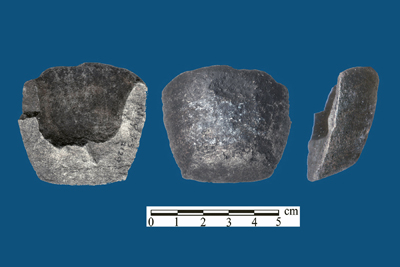
This once-intact crucible found in the South Baffin region is believed to have been used by Europeans for high-temperature metalworking. (IMAGE COURTESY OF P. SUTHERLAND)

Fieldwork at Immiliagaajuk outside of Kimmirut has revealed evidence of a Viking or Medieval Norse presence dating back to 1000 A.D., researchers say. (PHOTO COURTESY OF P. SUTHERLAND)
A 50-year-old discovery on Baffin Island is now considered further proof of European presence in the Canadian Arctic as early as 1,000 A.D. according to a recent paper published in the journal Geoarchaeology, which focuses on a soapstone pot or bowl discovered in the 1960s at a site near Kimmirut.
Researchers have now identified this pot as a crucible, likely used by Vikings or medieval Norse to do metalworking during the years around 1,000 A.D.
That may be the earliest evidence for high-temperature metalworking in North America north of Mexico, said the paper’s lead author, archaeologist Pat Sutherland.
Sutherland, who has done fieldwork around South Baffin since 2000, said she first saw the object at its home in the Canadian Museum of History in 2001.

“It seemed to be something associated with metalworking from that time period,” she said. “When we found traces of metal [at the Baffin site] later on, we went back to the crucible and found traces of bronze in it.”
The crucible is about five centimetres high, but broken in half, Sutherland said. It would have likely been used to melt small pieces of metal and poured into moulds to make small objects, like jewellery.
But she notes that indigenous people in northern North America did not practice high-temperature metalworking. The Dorset people, who inhabited Baffin Island at the time, would have heated copper to help bend the metal, but smelting was only a European practice at the time.
Traces of a whetstone, used to sharpen knives, and tally sticks found at the site support that, Sutherland said.
The site refers to an area just east of Kimmirut called Cape Tanfield, or Immiliagaajuk, which means a place of many ponds — a popular place for local Inuit to build cabins or go boating.
The area wouldn’t have been a permanent settlement for the Norse, but rather a camp or trading station, where the group would have traded for pieces of walrus ivory and skins.

“It shows that the Arctic wasn’t this marginalized or isolated place, but a place that had a lot of valuable resources,” Sutherland said. “And I think Inuit are excited to know that the Arctic might have been a nexus at the time.”
Kimmirummiut were heavily involved in the fieldwork and research process, Sutherland said, from sharing traditional knowledge about the region to helping with logistics for visiting archaeology students.
She hopes this and future discoveries in the area could bring benefits to the community.
“There’s potential for economic development here, and even for a national heritage status,” Sutherland said.
But even more so: “There should be a new narrative about the history or Arctic Canada,” she added.

South Baffin is not the only site that has revealed evidence of the Arctic as a trading place between European and Dorset peoples; Sutherland’s previous research has linked the remnants of yarn and wood found near Pond Inlet to a Norse presence there.
Sutherland, based in Ottawa, plans to return to Nunavut next summer to continue her research.
But she faces a few challenges: the biggest one being unable to access many of the research materials, including the crucible and soil samples from the Kimmirut site, which are kept at the Canadian Museum of History.
That’s because Sutherland was dismissed from her post at the museum in 2012. The museum told CBC last month that Sutherland was terminated for harassment following an 18-month investigation done by an independent third party that was initiated by the CMH’s former CEO and president, Victor Rabinovitch.
Sutherland said she “categorically [denies] the museum’s allegations.”
Under Article 33 of the Nunavut land claims agreement, archeological objects found in the Nunavut settlement area are owned jointly by government and by the Nunavut Heritage Trust.
Right now, the CMH holds many such artefacts in trust, pending the construction of a museum in Nunavut that’s is capable of holding them.
(0) Comments