


Montreal police re-open investigation into Inuit woman’s death
Aug. 28 death of Siasi Tullaugak, of Puvirnituq, first deemed a suicide
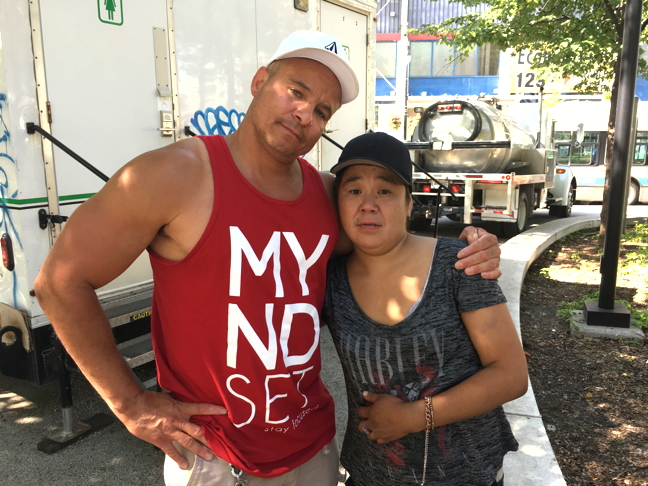
John Tessier, an addictions counsellor with Montreal’s Open Door day shelter, comforts Anna Tullaugak, sister of Siasi Tullaugak, in Cabot Square. Siasi, 27 and from Puvirnituq, was found dead Aug. 28 in what police originally deemed a suicide. Police are now investigating possible foul play. (PHOTO BY COURTNEY EDGAR)
SPECIAL TO NUNATSIAQ NEWS
MONTREAL—Montreal police have re-opened their investigation into the death of Siasi Tullaugak, a 27-year-old woman from Puvirnituq who was found hung from the lower balcony of a building she had no connection to, in the city’s downtown core, in the early hours of Aug. 28.
The balcony is six-feet off the ground, adjacent to an alley and at a residence to which Tullaugak had no known connection.
Despite the concerns of friends, family members and front-line workers who said she was not suicidal and that the circumstances of her death suggested foul play, the police originally deemed the death a suicide. But two weeks later, on Sept. 13, police re-opened the case.
“We have received new information that has permitted us to open an investigation. We can not, however, provide more details while the investigation is still in progress,” said a Sept. 13 email from Montreal police to Nunatsiaq News.
Her death came just two days before the death of another young Inuk woman, Sharon Barron, which police also concluded was suicide. Together, the deaths of the two woman have sparked a conversation in Montreal about how local police treat Indigenous women and related criminal investigations.

Two Montreal detectives visited Montreal’s Open Door shelter Sept. 13 for the first time since Tullaugak’s death—which had occurred 17 days prior—to ask questions about the case. The Open Door is known to police and frequented by homeless Inuit in the city.
Investigating officers then went to Cabot Square Sept. 14, another gathering spot for Inuit struggling with addictions and poverty.
Last week, on Sept. 8, the Native Women’s Shelter and Iskweu Project, which provide social services for Indigenous women in Montreal, held a vigil for both Tullaugak and Barron in Cabot Square, just a block from the Open Door day centre.
The director of the Open Door, David Chapman, said Tullaugak had spent most of her days there since returning to Montreal in April.
He said she had struggled with addiction and was involved in the sex trade, under the thumb of a pimp, and that she often found herself in dangerous situations.
John Tessier, an addictions counsellor who would see Tullaugak nearly every day and knew her well, said he also does not believe she was suicidal and he suspects foul play in her death. His co-worker Frank Paris said that he believes the same thing.

“She was a soldier, you know,” Paris said. “Even though she was living on the streets, she didn’t seem beat up about it.”
Anna Tullaugak, Siasi’s sister, says she can’t believe that Siasi would take her own life. She says she last saw her sister around 10 p.m. the night before her death.
According to Anna’s account, they were walking along Ste. Catherine St. with Oba Femi Tussaint when the sisters were separated because Anna was stopped by police for crossing the street at a red light.
Sources who did not wish to be named said Tussaint and Tullaugak had been fighting loudly that night around that time.
When asked about it, Tussaint told Nunatsiaq News that he last saw Siasi get into a silver car with a man he did not recognize just two hours before her death. He also said he doesn’t think Siasi was suicidal.

Siasi was happy, Anna said.Despite her struggles, Siasi was nurturing and took on the role of caring for other women in the streets whenever she could, as well as their children.
The sisters would tell each other, “Don’t leave me and I won’t leave you,” Anna said. They would see each other nearly every day.
“We grew up together, four years apart, with an adopted mother. She always said, ‘sisters stick together.’”
Chapman said about six weeks ago, the Tullaugak sisters had been asking him and other workers at the Open Door to help fly them back home to Puvirnituq.
But though he tried, Chapman was unable to secure money from organizations that help return women to the North when they are in desperate situations. There were persistent delays and, he said, eventually Siasi just stopped asking.
“She had said to her sister Anna, the day of her death, that someone was trying to kill her and she was afraid to say who,” Chapman said.
“There are a lot of people out there who are capable of doing pretty terrible things and it is not immediately observable.”
(0) Comments