


Nunavut education needs more Inuit influence, local control: NTI
“The current level of inclusive education services in Nunavut is grossly inadequate”
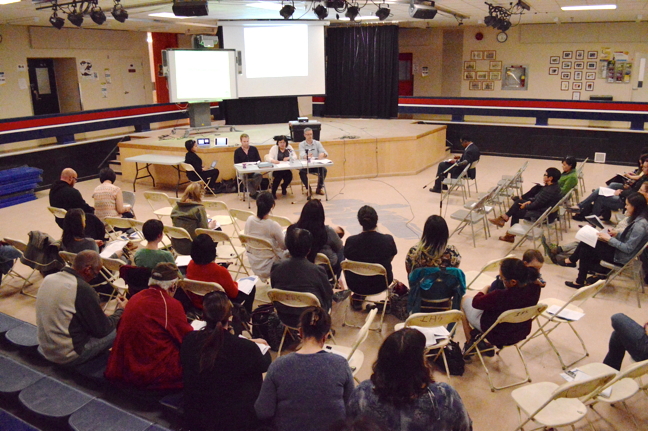
Iqaluit residents gather at Inuksuk High School June 20 for a consultation on a new Education Act. Nunavut Tunngavik Inc., opposes some of the proposed changes saying they take control away from local district education authorities. The land claim body also says the GN is not putting enough emphasis on Inuktut-language instruction and hiring. (FILE PHOTO)
Nunavut Tunngavik Inc. describes the state of the territory’s education system as “a national embarrassment” in a series of submissions to the Government of Nunavut which are critical of both the current Education Act and proposed reforms set for implementation in 2017.
“The current level of inclusive education services in Nunavut is grossly inadequate,” NTI’s submission continues.
The Inuit organization says Nunavummiut can’t receive an adequate education in a system woefully unprepared to accommodate Inuit culture, the special needs of students and the regional identity of communities.
Recommendations submitted by NTI call on the GN to provide additional funding to correct educational shortfalls in the Inuktitut curriculum, additional support to District Education Authorities, or DEAs, along with increased bilingual teacher staffing and special needs support.
NTI wants to halt proposed reforms limiting the role of the DEAs, which currently oversee inclusive education and implementation of individual student support plans, or ISSPs.
Under the proposed Education Act reforms, the GN would shift more responsibility onto educators and administrators, rather than to DEAs, which would be retooled to focus primarily on advocacy, policy governance and local programming.

That would move accountability away from local control, NTI alleges, and would exacerbate reforms the organization has opposed since the divisional boards of education were abolished in 2000 and the new Education Act came into effect in 2008, further limiting DEA authority.
The report also recommends that the Identification of students with special needs include input from a specialist.
Under the current Education Act, students with special needs are identified on the basis of teacher opinion, with a response to the student’s need drafted by a school team.
NTI recommends that local DEAs retain their responsibilities for special needs students and the implementation of individual student support plans, or ISSPs, that the proposed Education Act reforms would grant instead to school administration.
“The proposed Education Act would assign this very significant responsibility to principals alone and remove it entirely from local DEAs,” the report said.
“DEA members are more easily held accountable for decision made in relation to inclusive education.”

NTI says the GN is in no position to implement its reforms without having reliable data on students—particularly with special needs—and should implement an electronic data management system sooner than the three-year timeframe Nunavut’s Department of Education has imposed.
The GN’s current “Tumit Model of Student Support” says 85 per cent of student needs are “successfully met,” but NTI says that number is inaccurate and based on “incorrect assumptions.”
NTI says it believes that number is closer to 40 per cent, according to the report, with 35 to 45 per cent of students requiring some support to meet the curriculum and another 10 to 20 per cent of students requiring “many supports.”
“These percentages [in the Tumit model] do not reflect the reality in Nunavut,” the report says.
NTI says the GN contributes to this inequality by failing to meet commitments made in the 2008 Education Act and continuing to hire more unilingual English teachers—more than 110 since 2008, the report states.

“By not devoting funds and programming to adequately prepare Inukut-speaking educators, the government appears to be abandoning its commitment to strengthening Inuktut as a language of education, government and society,” the report says.
The report proposes that the GN hire more language specialists to bridge the divide between English-speaking teachers and Inuktitut-speaking students until “adequate numbers of certificate, diploma and degree certified bilingual educators can be trained.”
There are currently 76 language specialists employed in Nunavut, according to the report. NTI wants the GN work towards having one language specialist in each class in the territory.
That figure comes to approximately 692 language specialists, according to the report.
“One workable approach may be to establish, for example, 10-person Language Specialist teams for each of Nunavut’s 43 schools, with DEAs actively recruiting and recommending the Language Specialist from local communities,” the report suggests as an alternative.
NTI did not provide an estimate for how much either proposal would cost.
NTI’s submission to the GN on education reform is the newest installment in a hotly contested public debate over the Education Act.
Comments made at Iqaluit’s most recent public consultation on the Education Act, held Sept. 2, drew the ire of a Nunatsiaq News reader.
You can read that commentary here.
(0) Comments