

Nunavut filmmaker captures ancient method of caching walrus
“There are old ruins there and lots of walrus bones all over the island”
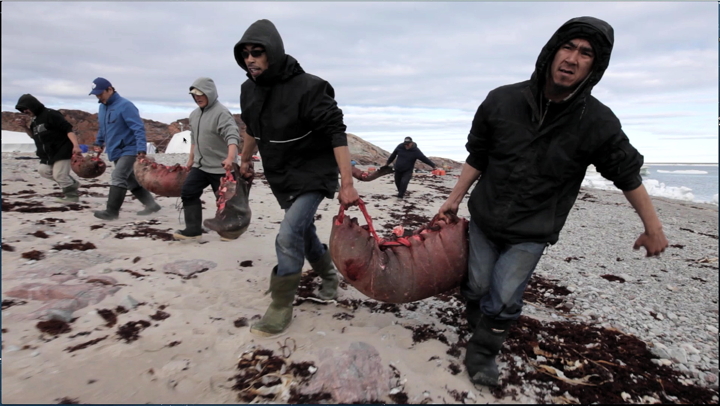
Crews help transport walrus meat wrapped in skins during a recent Kinguliit Productions film shoot on Qiasut, a traditional walrus-hunting island about 40 miles from Igloolik. (PHOTO BY JONATHAN FRANTZ)
When you take a film crew and bunch of local helpers and visitors in four boats on a two-hour trip to a small island outside of Igloolik to make a short documentary on walrus hunting, it’s really convenient when a walrus happens to swim by your camp.
Kinguliit Productions filmmaker Zach Kunuk and cameraman Jonathan Frantz felt rather fortunate when that happened during filming in the middle of August on an island known locally as Qaiqsut.
“That first day, in the evening, a walrus came by, swimming by the shore,” said Kunuk, on the phone from Igloolik. “Earlier that day we saw a bearded seal swimming by and we decided we need fresh meat so they started hunting it. We thought it was a bearded seal, but it was a walrus.”
Kunuk, who has made numerous feature and documentary films including the 2001 award-winning Atanarjuat, said it was a bit late in the season to be hunting for walrus, so the crew was a little concerned at first, wondering whether they would find one.
But they needn’t have worried. They managed quickly to grab the camera and film hunters harvesting the walrus and bringing it to land to carve it up.
The finished film will feature an elder, Peter Awa, harvesting, skinning, butchering and caching the walrus while explaining the process to a young man.
It’s meant to be an instructional video, Kunuk said, so that traditional hunting practices can be recorded and preserved for future generations.
The tiny island, about 40 miles from Igloolik, has been frequented by Inuit for centuries, Kunuk said, and contains ancient foot paths and artifacts.
“It was a place where Piugattuk’s clan always did their walrus hunt. There are old ruins there and lots of walrus bones all over the island,” said Kunuk.
“It’s a fabulous place. In 1822 when Parry’s wooden ship came here, he went to that little island. They describe what they saw as deer paths, but it was just Inuit in the area who made those paths so they wouldn’t destroy their kamiks.”
The idea was to go there and film a successful hunt, with an elder explaining how to find and properly harvest a walrus without allowing it to sink in the waters.
Then he could show how to carve it up without wasting any of the meat — “there’s a special way, really only one way” — then wrap it in skins to form logs and bury it in the ground for aging. That’s called igunaq.

Kunuk, says it’s important to record these kinds of traditional activities before the elders pass away and take their skills, and language, with them.
“We’ve gone to school. We’ve learned English and social studies. We learned about Africa and animals we’ll never hunt like elephants, tigers and monkeys. We forgot about our own backyard,” he said.
“We’re going to be the elders and our grandchildren will look up to us and say, ‘how do you cut this up?’ and we have to know.”
The ease of the hunt early on turned out to be the only fortunate part of the trip.
Kunuk said the weather turned bad — cold, rain, fog, wind, and sleet — and for the rest of the week, they were mostly holed up in their tents playing cards for bullets and long games of the political strategy game Risk, sometimes making up the rules as they went.

“We took a lot of time lapse shots of the ice going by, but lucky for us, we did get the walrus that we were supposed to get. We wanted to go out more and butcher them on the ice floe like they always did but we didn’t get the chance,” Kunuk said.
“After a week, running out of sugar and cigarettes, we decided to finish the project. Right now we’re at the editing stage.”
They also had to contend with a number of polar bears who, despite the large group of humans, kept hanging around the camp. At one point, there were two bears, he said, hopping from one ice pan to another.
Kunuk said it’s an area where polar bear hunting is prohibited right now so they couldn’t harvest a bear unless it directly threatened them. They did fire a warning shot once, to scare them away.
The half-hour educational film was paid for through a $60,000 grant procured by Nunavut Tunngavik Inc. through the Department of Fisheries and Oceans. Kunuk is hoping to make a bunch of DVDs and have NTI and DFO distribute them to the communities. He will also upload it to his IsumaTV website for public streaming.
Kunuk is currently working on a script for his next full-length Inuktitut action film which goes by the working title “The Searchers.”
Set around the turn of the 20th century, a group of men go on a hunting trip of sorts, to find women to bring home to their camp for wives. When they spy a small camp with a woman, a daughter and an elderly couple, they pounce, taking the girls and killing the elders.
When the husband arrives back at the camp from a hunting trip with his son, and discovers the elders dead and his wife and daughter missing, he and the boy embark on their own hunt, to find the perpetrators.
“There’s a lot of running,” says Kunuk. He says he wants to pick the actors soon so they can be in shape in time for filming, tentatively scheduled for early in 2015.

The shoreline on Qiasut where the film crew camped in mid-August. (PHOTO BY JONATHAN FRANTZ)
(0) Comments