


Nunavut performer combines two cultures on debut release
“Growing up I didn’t really identify as anything”

Kathleen Ivaluarjuk Merritt poses for a picture posted to Facebook on May 29. The Rankin Inlet musician draws on both her Inuit and Irish heritage for her debut album, called, “Ivaluarjuk: Ice, Lines and Sealskin.” (FACEBOOK PHOTO)
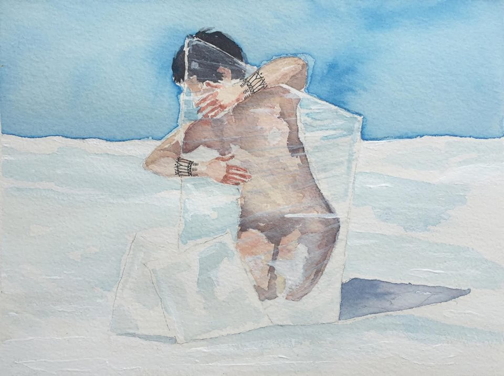
Kathleen Ivaluarjuk Merritt will release her debut album, with this cover art, at the Yellowknife Folk on the Rocks festival July 17. (ART BY KYLE SHEURMANN)
Growing up in Rankin Inlet with mixed Inuit and Irish ancestry, musician Kathleen Ivaluarjuk Merritt found herself belonging to two cultures without wanting to belong to either.
That’s because at times Merritt didn’t feel Inuk enough, and at other times she didn’t feel her Cape Breton heritage made her Irish enough.
“Growing up I didn’t really identify as anything,” said Merritt, who is currently fundraising online to launch her debut album.
“When you’re a young child, and you’re told you are something, that you have to be something, you just don’t want to be. I was also very rebellious.”
Caught between two cultures and rebelling against both, Merritt found herself in a cultureless space — something she says other Nunavummiut know about.
“It’s a very real challenge that a lot of young Inuit face today, who have both cultures embedded in them.”
But now the 27-year-old musician says she’s overcome emotional challenges to embrace both heritages and draw on both cultures for her debut album: “Ivaluarjuk: Ice, Lines and Sealskin.”
“There’ll always be people who make you feel one way or another, but it’s really up to you to know who you are, to feel confident enough in what you do, to really believe in yourself,” Merritt said.
That confidence can be heard in a pre-released song from her imminent album debut — a beautiful track called “Love Song,” which features throat singing, spoken word, landscape sounds and melodic guitar strumming that conjures images of a Cape Breton seascape.
Merritt collaborated with a dozen Nunavut musicians, including the Jerry Cans, for her album, which is set to launch at Yellowknife’s Folk on the Rocks festival July 17.

Merritt started a $2,500 online fundraising campaign about a month ago to help cover the $30,000 she said it costs to make an album almost entirely in Nunavut.
To date, she’s raised about 70 per cent of that through the online Indiegogo fundraiser, which ends July 12.
But the album has been a long time coming, mirroring her journey towards accepting first her Inuit identity and then her Irish one.
One of her earliest memories growing up in Rankin Inlet is of a young girl at the playground making fun of her for not being Inuk enough, Merritt said.
“I even had people close to me say, ‘you’re half Inuk, you’re half Qallunaat.’ I felt I was always being identified as that by others. So for a long time, especially through high school, I never wanted to identify as an Inuk.”

That changed when Merritt attended the Nunavut Sivuniksavut program in Ottawa, where she learned about Inuit history, language and culture.
“I started really embracing the Inuk in me, and really appreciating things like patience, things that we have naturally growing up in this environment,” Merritt said.
Travelling to different parts of the world after completing the NS program made Merritt more appreciative of her Nunavut roots too, the musician said.
Appreciating her Irish heritage took a bit longer, though.
Growing up, Merritt spent summers with family in Cape Breton, but it wasn’t the same thing as seeing cousins from her mother’s home community of Coral Harbour, for example.
“I have like a hundred cousins in Coral Harbour, and I’d see them year round,” Merritt said, laughing.
There was an eight-year stretch where Merrit said she didn’t visit her Cape Breton family at all.
“And then when I did, I got in shit from my aunt,” she laughed. “Now we’re in contact more often.”
And now Merritt embraces and identifies with both parts of herself.
“I’m learning as much as I can about both cultures now, and want to represent both equally,” Merritt said, but added that she feels closer to her Inuit roots, having grown up in Nunavut.
Despite all this internal exploration, Merritt said these days, she simply identifies as a human being.
“Often times I’ll hear from cab drivers, or other people, ‘Oh, your accent — you don’t sound Inuk. So what are you?’ I’ve gotten that question so many times: what are you?”
And how does Merritt answer that question?
“You know what, I’m a human being. That’s how I identify now.”
“For me it’s not about focusing on people who point things out. It’s about focusing on yourself and being able to be confident in how you identify,” Merritt said.
After the album launch in Yellowknife July 17, Merritt said she hopes to perform in a few Nunavut communities, including her hometown of Rankin Inlet and in Iqaluit.
You can donate to Merritt’s online fundraising campaign here.
And you can listen to the pre-released track from that album here.
(0) Comments