


Nunavut water testing program still awaiting official status
Iqaluit river monitoring accreditation process expensive, complex
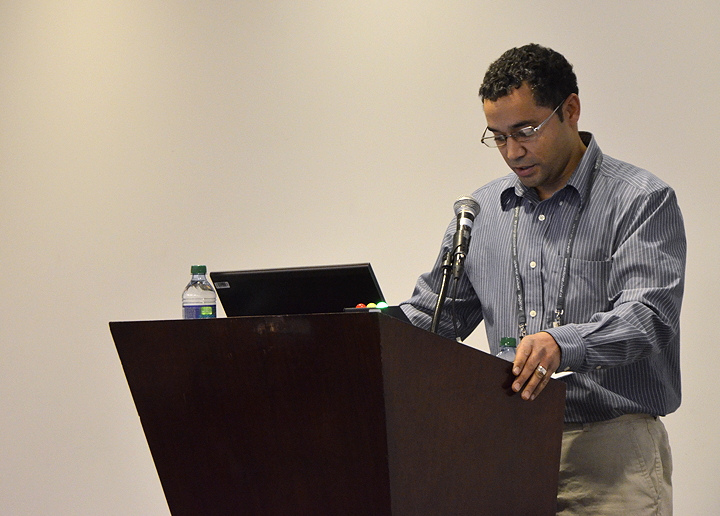
Jamal Shirley, research design and policy development manager at the Nunavut Research Institute in Iqaluit, gives a presentation on NRI’s water monitoring program at ArcticNet’s annual conference in Ottawa, Dec. 11. (PHOTO BY DAVID MURPHY)
Special to Nunatsiaq News
OTTAWA — Three years ago Jamal Shirley told Nunatsiaq News he wanted national accreditation for a water testing process to monitor the Apex River in Iqaluit — an important recreational area where Iqalummiut also collect untreated drinking water.
Shirley, the research design and policy development manager of the Nunavut Research Institute, still hasn’t got that accreditation.
“Has it really been that long?” Shirley said with a scratch of his head and a light chuckle.
That’s nobody’s fault though: the accreditation is expensive and hard to achieve in the North.
The water testing project, launched in 2009, monitors water quality in Apex river for microscopic bacteria that can make people sick.
National accreditation for the program would mean NRI could officially test the water for health purposes — to see if the water is safe to drink.
Testing already occurs in every Nunavut municipality for treated tap water, but not for untreated water from natural sources such as rivers or lakes.
“The main limitation is we don’t have a full-time lab technician,” Shirley said Dec. 11 after his presentation on the water monitoring program at the Arctic Change conference in Ottawa.
To head in that direction would cost about $40,000 for accreditation. As well, the NRI would have to foot the bill for experts to fly into Iqaluit for three consecutive years and scrutinize the testing procedure.
Another sticking point — shipping hazardous sample bacteria to Iqaluit, which has proved difficult in the past. These kinds of samples contain concentrated toxic E. coli bacteria which are used to compare against local water samples.
But Shirley doesn’t blame anyone for the lack of resources.
“Oh jeez, where do you start? You could really point to a lack of resources in almost any critical public policy area in Nunavut. There’s no one source of blame,” he said.
Shirley is determined ‘though; he’s hoping to get accreditation within the next couple of years. Testing natural, untreated waters for health purposes, he added, would be a big plus for all Nunavut communities.
“Throughout the Arctic, from Labrador to Alaska, people use raw water for drinking. And it’s often widely preferred over treated tap water,” Shirley said
“People have a lot of confidence and connection in their traditional water sources. This [testing] is one way to ensure that those water sources remain clean and safe,” he said.
And it’s more important than ever today to test water sources on the land.

“Because, I see a lot of people walking dogs and sometimes you see dog crap right next to the water where people are collecting drinking water,” Shirley said.
“Communities are growing. There’s more and more activity in the watershed that also supplies this drinking water to communities. There [are] more dogs around. More possibility for waste inputs,” he said.
Not to mention a rapidly changing climate, he added.
But fear not, Iqalungmiut: despite containing trace levels of E. coli, Shirley said Apex River is safe.
“There’s no cause for concern as far as I’m concerned, from my perspective.”
Right now Shirley and his students test the river for relationships between water quality and other aspects of the physical environment including how climate change is affecting the water.
For example, if the temperature in Iqaluit changes and snow melts more quickly, the water might contain more microbes which could make it unsafe to drink.
Shirley uses the water testing program to teach students so they can learn what’s required to test water for health purposes and also to test tap water.
The same water monitoring program is used in Pond Inlet and Pond Inlet officials plan to teach Arviat how to do it as well, Shirley said.
(0) Comments