


Nunavut and Nunavik’s newsmakers of 2016: the stars
Our list of those who shone in 2016

Aggu MLA and Education Minister Paul Quassa has handled the controversial Nunavut education department for more than three years with dignity and grace. (FILE PHOTO)

A scene from a public hearing that the Nunavut Impact Review Board held earlier this year in Cambridge Bay. Unlike many Nunavut institutions, the NIRB demonstrated a rare degree of competence in 2016. (FILE PHOTO)
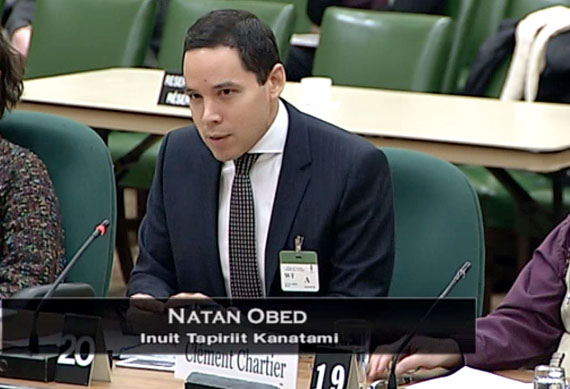
Natan Obed, president of Inuit Tapiriit Kanatami since the fall of 2015, ranks as one of the major stars of 2016. (SCREEN CAPTURE)
For some of us, the year 2016 was filled with rewarding moments. For others it was just a so-so year and for some it was a year of heartbreak.
But amidst all that, there were people and institutions who shone—giving us hope for the future.
Here’s our list of last year’s stars.
1. ITK President Natan Obed
Chosen in the fall of 2015 to serve as president of Inuit Tapiriit Kanatami, Natan Obed represents a new style of educated Inuit leadership.
Unlike so many of the propped-up tokens of the 1980s and 1990s, he’s an articulate communicator who doesn’t need to rely on pre-scripted lines fed to him by non-Inuit handlers. Since his arrival in Ottawa, he’s gained much respect within federal government circles where his Inuit-specific message has finally gained a receptive audience.
2. Education Minister Paul Quassa
If there were an award for “most-improved Nunavut leader,” Aggu MLA and Nunavut Education Minister Paul Quassa would win hands down.
He’s the political head of one of Nunavut’s toughest government departments and has presided over the thankless task of reviewing the Education Act and responding to the sometimes impossible expectations of stakeholders.
Through it all, he’s handled the job with grace and dignity and earlier this year, he made a tough evidence-based decision on the Nunavut university issue.
Earlier in his political career, personal problems kept him from realizing his full potential. But since his election in 2013, Quassa has blossomed. Let’s give him the applause he deserves.
3. Nunavut Impact Review Board
You’ve likely read thousands of words in our news outlet about Nunavut institutions that can’t or won’t perform their public service functions at an acceptable level.
The NIRB isn’t one of them. And this year, it once again demonstrated its competence, saying yes to mining projects in which the benefits outweigh containable risks and saying no to dubious projects that may be too costly to the environment.

Examples of the former include the NIRB’s positive recommendations on TMAC’s Doris North Project and Agnico-Eagle’s Vault Pit expansion. Examples of the latter include the NIRB’s rejection of Dunnedin’s Kahuna diamond project and Sabina’s Back River gold project.
This is one organization that strives to get the balance right, in line with Nunavut’s oft-stated commitment to sustainable development.
4. Nunavut’s first responders
This includes Nunavut’s emergency measures organization, the RCMP, firefighters and search and rescue committees in every community, emergency measures technicians and nurses.
Emergencies of many kinds are on the increase: lengthy searches for missing persons and overdue travellers on land and sea, fires, dangerous armed standoffs and shooting sprees.
Across Nunavut, these are usually handled by first responders who work impossibly long hours and who, in many cases, are volunteers who selflessly give their time. These unsung heroes rank among the best of 2016.
5. Hamlet of Clyde River
At a time when the official guardians of Inuit rights from NTI were snoring at the back of the room with their eyes closed and their mouths hanging wide open, the Hamlet of Clyde River set into motion a process that could expand the legal rights of Inuit across all four Inuit regions and beyond, to Aboriginal rights in Canada.
You may or may not agree with their positions on offshore seismic testing and oil and gas development, and the Supreme Court of Canada’s decision on their issue is still pending. But Clyde River dared to tread where NTI and others were too fearful and lazy to hazard even a single step.
For our list of 2016’s duds of the year, follow this link here.
(0) Comments