


Quebec moves to increase taxes paid by mining companies
“The government’s ambition is to make Quebec one of the most prosperous places in the world”
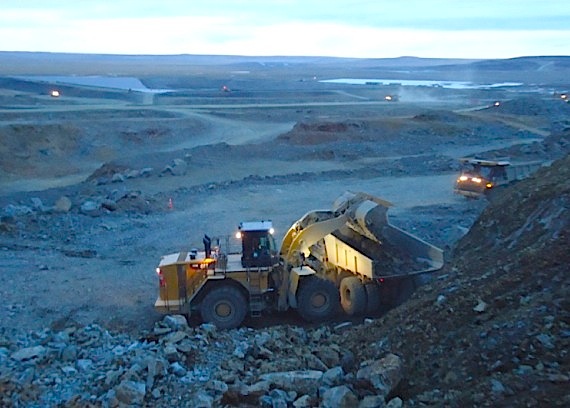
Trucks move ore from an open pit at the site of Canadian Royalties’ Nunavik Nickel mine. (PHOTO COURTESY OF CANADIAN ROYALTIES)
Quebec’s Parti Québécois government has decided to move ahead with a plan to increase the amount of tax paid by mining companies.
The new rate hikes, which come into effect in 2014, will see mines paying the higher of two taxes, a royalty on production or tax on profit.
Nicolas Marceau, Quebec’s finance minister, and Martine Ouellet, Quebec’s natural resources minister, unveiled the province’s new mining tax regime May 6.
“The government’s ambition is to make Quebec one of the most prosperous places in the world by relying as a priority on private investment. Such prosperity must benefit all Quebecers,” said Marceau in a Quebec government news release.
Marceau said the increases will bring Quebec $50 million more in 2015.
The new fixed tax or royalty stands at one per cent for mines producing less than $80-million worth of ore and at four per cent for those that produce more than $80 million.

The new graduated tax on profits starts at 16 per cent on mines with a profit margin of 35 per cent or less. This will rise to as much as 22.9 per cent on mines with a profit margin of more than 50 per cent.
That’s less than the tax increases proposed and promoted by now-premier Pauline Marois when she campaigned for election last year.
But the slump in metal prices led to the change in the new government’s plans, Marceau said.
Many in Quebec were “justifiably dissatisfied with the Liberal regime” because some mining companies operated over a long period without paying a penny in taxes, Marceau said.
And when mines earned large profits due to market changes, the share of tax paid did not budge, he said.
From now until 2020, Quebec expects revenues to see an increase between $73 and $200 million per year.

“We estimate that over 12 years, total additional revenues collected for the benefit of Quebecers will range between $770 million and $1.8 billion,” Marceau said.
Mine companies, such as Hopes Advance iron mine project near Aupaluk and the Lac Otelnuk iron mine project south of Kuujjuaq, can also expect to give Makivik Corp. and the communities closest to the mines a share of their profits through impact benefits agreements.
Quebec also wants to increase the number of ore processing jobs in the province by giving various tax breaks to mining companies, such as a 10-year tax holiday for large investment projects.
“We believe that with this basket of measures, more Quebec ore will be processed here, both in terms of non-traditional metals, like lithium and rare earths, and traditional ore like iron and nickel,” Marceau said.
To ensure no mines site are abandoned without first undergoing remediation, mining companies will have to pay 100 per cent of the cost of cleaning up mine sites before starting operations.

Quebec also plans to make mining companies’ activities more transparent in its Mining Act. The act’s new provisions on information disclosure will enable Quebecers to know how much each mine operator pays in taxes on how much tonnage.
Reaction to the changes ahead for mining companies received criticism from the Liberal party’s finance critic Raymond Bachand.
Bachand said the hikes would give Quebec more money but come “at the worst possible time” for the mining industry.
The Quebec mining association didn’t have much good to say about the new regime, either. Its president and director general Josée Méthot said her organization’s members are “unhappy this decision was imposed on us.”
(0) Comments