


Rankin’s population down? Mayor isn’t convinced
“Everyone believes we have been growing steadily like everywhere else”
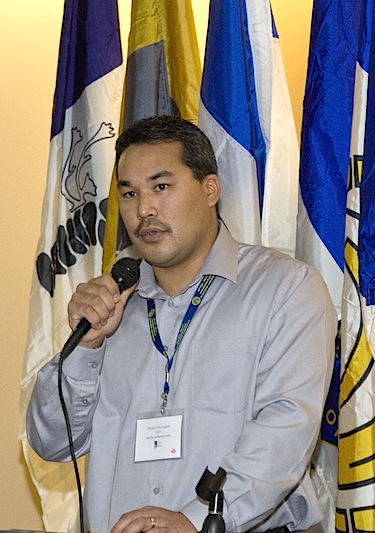
“We’re experiencing a boom here in Rankin,” Rankin Inlet Mayor Pujjuut Kusugak told delegates at the 2011 Kivalliq Trade Show last November. (FILE PHOTO)
Rankin Inlet Mayor Pujjuut Kusugak isn’t worried about new census statistics that suggest his community’s population is on the decrease.
Rankin’s population, which made it the territory’s second largest populated community in 2006 with 2,358 residents, dropped by four per cent (or about 100 residents) to 2,266, according to Statistics Canada’s 2011 census data released last week.
That means neighbouring Arviat, which grew by 12 per cent to reach 2,318 residents in 2011, surpasses Rankin as the territory’s second-largest community.
But Kusugak isn’t convinced that’s the case.
“I believe when I hear Arviat’s population is up, but I have a hard time believing Rankin’s population is down,” he said. “Everyone believes we have been growing steadily like everywhere else.”
For the last few years, Arviat has noted the highest birth rate in the territory – and likely among the highest in the country. More than 60 per cent of its population is under the age of 16.

“I can honestly say many babies are born to Rankin families,” Kusugak said. “We also have many people that seem to be moving here rather than moving out. It is hard to believe the numbers for Rankin are accurate.”
Kusugak wonders if new residents to the community weren’t being counted properly in the preliminary census data, which still needs to be finalized.
But even if the numbers hold true, Kusugak said he’s not concerned.
“There are many who are succeeding in Rankin and it may still boom with its population, depending on the mining developments in our region,” he said. “We have many new homes that were built and filled. This is not news, but we really do need more.”
The 2011 census shows that Rankin has 708 homes or private dwellings – and 626 of them are occupied by “usual residents.”
The 2011 census data, released Feb. 8, revealed that Nunavut’s population continues to grow faster than the national average. Both the territory and its capital city, Iqaluit, grew by eight per cent since 2006.

And all but six Nunavut municipalities grew in population over the past five years.
Several communities marked significant growth since the last census, including Repulse Bay (up 26 per cent) Gjoa Haven (up 20 per cent) and Arctic Bay ( up 19 per cent.)
But Nunavut’s smallest community got even smaller; Grise Fiord lost four per cent of its population since 2006 and sits at 130.
Both Hall Beach and Igloolik also lost residents over the last five years, shrinking by 17 and six per cent respectively.
Nunavut’s overall growth is tied to the territory’s high fertility levels, a trend that statisticians noticed in most provinces and territories this census period.
Nunavut women bear an average of 3.2 children each, compared to the average Canadian woman who bears 1.6 children each.
Nunavut’s birth rate is up slightly from 2.8 children in 2006.
(0) Comments