

Remains of extinct Arctic predator shed new light on prehistoric Canada
This one’s a fish with “piercing teeth”

Here’s how the fossil of the Laccognathus embryi fossil looks today. (PHOTO BY TED DAESCHLER/ANSP)
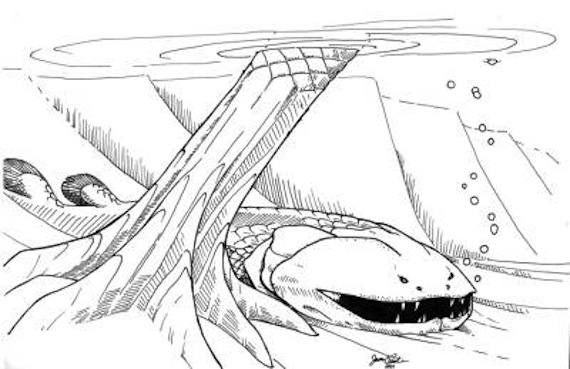
This is an artists rendering of Laccognathus embryi fossile fish in its habitat 415 to 360 million years ago when Nunavut’s High Arctic enjoyed sub-tropical temperatures. (PHOTO BY JASON POOLE/ANSP)
RANDY BOSWELL
Postmedia News
Ellesmere Island, the same fossil treasure trove in Nunavut that produced the remains of the famous “walking fish” Tiktaalik in 2004, has yielded another new species — an extinct aquatic predator named for an Alberta geologist — that sheds fresh light on the nasty underwater world of prehistoric Canada.
Found encased in rock on southern Ellesmere by a team of U.S. scientists, the previously unknown type of bottom-dwelling fish was nearly two metres long and had big, “piercing teeth” used to devour prey — possibly even Tiktaalik itself, the evolutionary superstar that lived in the same swampy, freshwater environment as the newly discovered species about 375 million years ago.
With limb-like fins, Tiktaalik has been hailed as a crucial “missing link” species representing the moment in evolution when animals began moving out of the water and onto dry land.
The new species, Laccognathus embryi, belonged to a group of more primitive “lobe-limbed” fish that are vaguely similar to present-day lungfish and even, in some ways, to modern alligators, co-discoverer Ted Daeschler, a paleontologist with the Philadelphia-based Academy of Natural Sciences, told Postmedia News on Monday.

The fossilized beast’s formal name pays tribute to Geological Survey of Canada scientist Ashton Embry, whose research on Ellesmere Island’s rock layers “paved the way” for the fossil discovery, the U.S. research team said.
Daeschler noted that several fossilized examples of the extinct fish have been unearthed at the same site near Ellesmere’s Byrd Fiord where Tiktaalik was found. University of Chicago scientist Neil Shubin — who led the Tiktaalik discovery and later wrote a controversial book, Your Inner Fish, about the implications of that find for understanding human evolution — is also co-author of the paper in the latest issue of the Journal of Vertebrate Paleontology that details the Laccognathus find.
“I wouldn’t want to be wading or swimming in waters where this animal lurked,” said Daeschler, curator of vertebrate zoology at the Pennsylvania academy, in a summary of the study. “Clearly these Late Devonian ecosystems were vicious places, and Laccognathus filled the niche of a large, bottom-dwelling, sit-and-wait predator with a powerful bite.”
The individual fish found fossilized on Ellesmere Island probably died — along with the Tiktaalik specimen — when a flooding river spilled its banks and left hundreds of fish stranded in mud that later solidified into rock, Daeschler said in an interview.
At the time, the Earth’s continents were beginning to assemble into a single, large land mass known as Pangea, with much of present-day Canada just north of the equator and characterized by a warm, humid climate.
(0) Comments