

Report: Quebec best province, Nunavut best territory to be an animal abuser
Nunavut ranks at bottom of list of Canadian animal protection laws
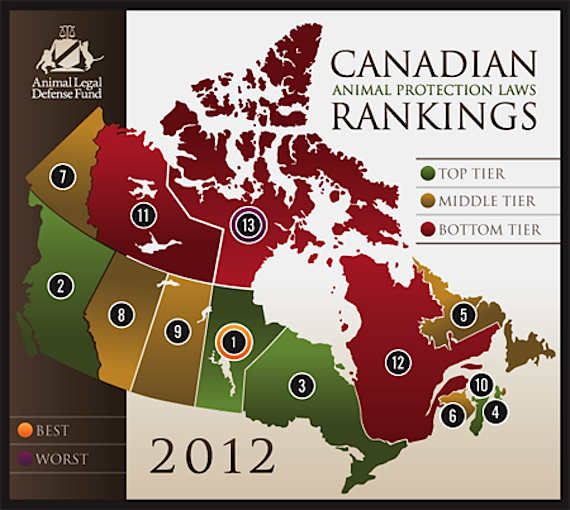
This map from the Animal Legal Defense Fund shows that Nunavut comes in last place with respect to its animal protection laws.
Quebec, Nunavut, the Northwest Territories, and Saskatchewan are the best provinces and territories in Canada to be an animal abuser, according to a report released earlier this week by the Animal Legal Defense Fund.
Based on an analysis of the animal protection laws of each jurisdiction, the report ranks provinces and territories where laws protecting animals have real teeth, and calls out those like Quebec and Nunavut — the worst in Canada this year for animal protection laws — where animal abusers get off easy.
The fund’s sixth annual report ranks every province and territory on the relative strength and general comprehensiveness of its animal protection laws.
Manitoba, British Columbia, and Ontario take top honors in 2013, a news release on the report said.
Quebec did improve to its animal protection law since the 2012 report, it noted.
Improvements included adding restrictions on future ownership of animals upon conviction and enacting stiffer penalties, with animal abusers now facing a fine of up to $25,000 for a first offence and up to $75,000 for repeat offenders.

However, Quebec still held its position as the province with the weakest animal protection legislation joined by Nunavut — the territory that needs the most improvement in its animal legislation.
“Our annual reports aim to gather support for the movement to strengthen and enforce animal protection laws throughout the Canadian provinces.” says the organization’s executive director Stephen Wells.
The full report is available here.
Among Nunavut’s strengths, which were noted by the report:
• some prohibitions apply to owners and non-owners alike;
• no breed-specific legislation;
• penalties may include incarceration;
• officers may retain dog until costs are paid, disposition of dog if costs not paid within certain time;
• possible seizure of mistreated animals;
• pre- and post-judgment forfeiture of dog when in critical distress (for euthanasia purposes); and,
• principal protections applicable to wider range of species, not just dog.s

But what Nunavut needs to enact in its animal protection laws comprises a much longer list, including:
• definitions/standards of basic care;
• broader range of protections;
• prohibitions related to animal fighting;
• recognition of psychological harm;
• increased penalties for repeat offenders;
• mandatory seizure of mistreated animals;
• mandatory reporting of suspected animal cruelty by veterinarians/select non-animal-related agencies;
• immunity for anyone who reports animal in distress/assists in the enforcement of animal protection legislation; and,
• duty of peace officers to assist in the enforcement of animal protection legislation.
(0) Comments