

Sentences for male abusers too lenient, some Inuit women say
“A lot of victims and families believe the sentences are too short”
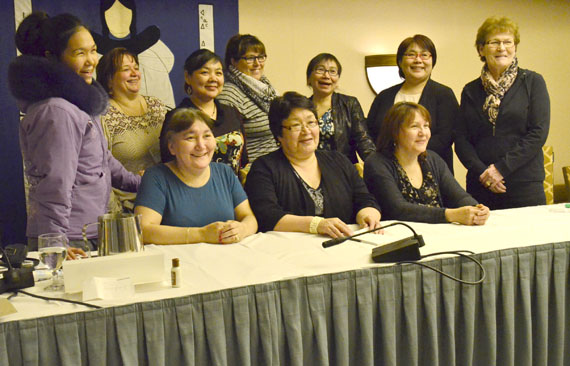
The board of Pauktuutit Inuit Women of Canada poses Feb. 12 for a group photo at the end of their four-day pre-inquiry MMIW consultation meeting in Ottawa last week. Pauktuutit will team up with Inuit Tapiriit Kanatami and Tungasuvvingat Inuit to ensure the federal government’s upcoming inquiry on missing and murdered Indigenous women takes Inuit-specific issues into account. (PHOTO BY JIM BELL)
OTTAWA — An old complaint surfaced last week at a meeting of the Pauktuutit national Inuit women’s organization in Ottawa: that northern courts are too lenient on offenders convicted of violent crimes against Inuit women.
“A lot of victims and families believe the sentences are too short,” one participant said.
The issue arose during Pauktuutit’s pre-inquiry consultation meeting, held over four days at an Ottawa hotel, on missing and murdered Indigenous women.
Participants included 30 people flown to Ottawa from small communities across the Arctic, Pauktuutit board members, staff from Inuit Tapiriit Kanatami and Tungasuvvingat Inuit, representatives of the Saturviit Inuit Women’s Association of Nunavik and the AnânauKatiget Tumingit Labrador Inuit Women’s Association, as well as observers from the Government of Nunavut, the federal government and Makivik Corp.
The free-flowing discussion did not follow a rigid agenda and participants were free to share their views and experiences on any topic at any time.
During conversations on the justice system, some participants said many Inuit women do not feel protected by the courts.
And some questioned the effect of the Supreme Court of Canada’s Gladue decision, which requires that judges take an Aboriginal offender’s special circumstances into account when calculating sentences.
“The get less time because they are Inuit. People are still concerned about the sentences being lenient,” said Annie Buchan of Cambridge Bay, a former Pauktuutit board member.
This echoes complaints that Pauktuutit made in the early 1990s, when the organization called for an inquiry into sentencing practices in the Northwest Territories, alleging Inuit women victimized by violent crime were denied the right to personal security.
Qajaq Robinson, a lawyer with Borden Ladner Gervais, explained that the Gladue decision, which dates to 1999, is a response to the grossly disproportionate number of Aboriginal people serving time Canadian prisons.
And it means that in crafting sentences, judges must look at the backgrounds of Aboriginal offenders.
“The courts have to look at how the history of colonialism leads to turmoil in the communities,” Robinson said.

And one participant said there are already too many men held at territorial correctional centres.
“Sometimes men plead guilty even when they are not guilty,” she said.
Other complained about the lengthy periods of time — sometimes two to three years — between the laying of a charge and the resolution of the charge in court.
This means that by the time a trial starts, the victim and perpetrator may have already reconciled.
“By the time they have gone through the process of healing and forgiving, they have to go to court,” she said.

Robinson said these delays are not unique to the North, and that courts across the country are overwhelmed with criminal cases.
“That’s a phenomenon that you see across the North and even in Ontario at the courthouse on Elgin and Laurier,” Robinson said.
Other participants complained that female crime victims in small Inuit communities don’t get enough information about the progress of cases in which they’re complainants and don’t get enough information from the National Parole Board.
Throughout their discussions, participants — many of whom are family members of murdered and missing Inuit women and girls — made harrowing disclosures of homicides and sexual assaults committed primarily by community and family members.
This means that for Pauktuutit, an Inuit-specific approach to the issue of missing and murdered Indigenous women means emphasizing the lack of healing and violence prevention measures in small communities.
(0) Comments