


Small steps: Iqaluit shelter society welcomes help for the homeless
“These men are at risk just by virtue of being alive right now and we should care. We should act”

The shelter’s kitchen and common area where, most nights, men use the couches and chairs for sleeping.
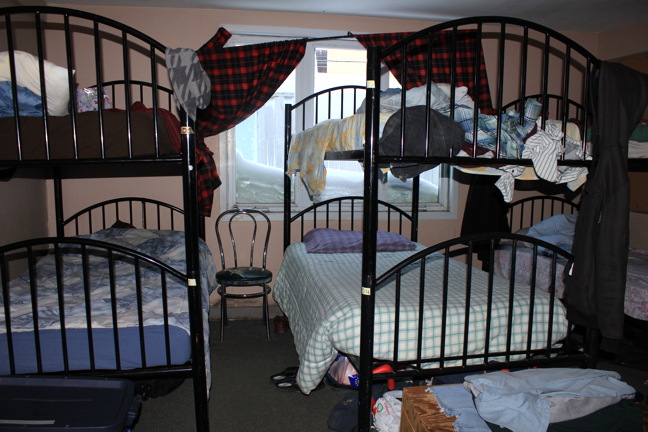
One of three rooms at the men’s shelter, this one containing eight bunk beds.
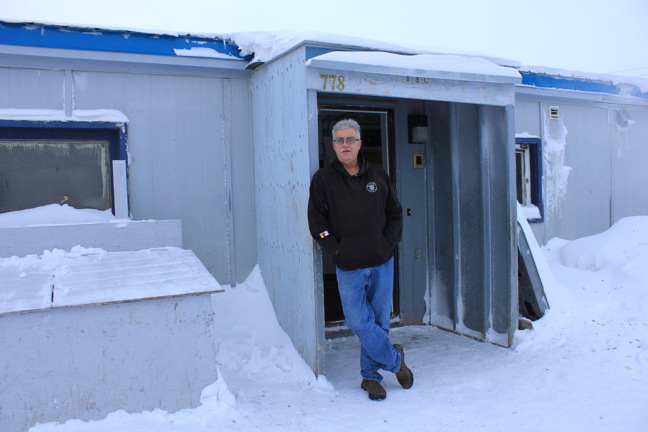
Doug Cox stands in front of the Iqaluit men’s shelter on Fred Coman Drive for which the shelter’s non-profit society pays about $100,000 in rent annually. (PHOTOS BY LISA GREGOIRE)
A promise from Iqaluit councillors to take the issue of homelessness more seriously is giving renewed hope to the society that runs the city’s men’s shelter.
But more than anything, the shelter needs local citizens to take the issue seriously too by offering their skills and time to help sustain the organization.
Janet Brewster, who sits on the Uquutaq Society’s dwindling board of directors, said she is grateful to those who take people into their homes when they have nowhere to stay, and to municipal councillors for offering help.
“These men are at risk just by virtue of being alive right now and we should care. We should act,” said Brewster, on the verge of tears, Jan. 13.
“For a lot of people, it’s a concept that’s out there—some people get lost, some people get hurt, it happens. But this is happening to real people, and they matter.”
In the wake of the recent death of Jake Angurasuk, a man suspected of having undiagnosed mental illness and who had called the shelter home for several years, the City of Iqaluit has promised to make addressing homelessness a priority for 2017.
They are doing so after a plea from Coun. Joanasie Akumalik during a Jan. 10 city council meeting where he said addressing homelessness should be within the city’s mandate. Fellow councillors agreed.
But local cynics might question the city’s priorities, and the depth of its commitment to social problems, by pointing to the city’s $40.5 million investment in a new aquatic centre set to open Jan. 26.
Brewster said perhaps people who frequent the shelter can get passes to the new pool so they too can enjoy the new facilities.

Mayor Madeleine Redfern told Nunatsiaq News Jan. 12 that she looks forward to working with Uquutaq and other agencies in town who serve the homeless population, such as the soup kitchen and Tukisigiarvik Society, to identify gaps in capacity and resources to fill them.
She said the city could also help to procure federal dollars under Ottawa’s homelessness and housing strategies.
Doug Cox, who’s managed the men’s shelter under the Uquutaq Society since the Salvation Army pulled up stakes in 2009, said Jan. 13 he’s pleased that people want to help his clients, some of whom have nothing but the clothes on their backs and garbage bags of meagre belongings.
But what he’d really like to see is a new building.
The Iqaluit men’s shelter, 778 Fred Coman Dr., has 22 bunk beds in three crowded rooms but most nights, more than 30 men stay there, with extras sprawling on couches and chairs in the common room.

The building is neat and tidy for the most part and has a regular supply of food for breakfast and dinner thanks to generous local donations. But it’s crowded and run down and musty smelling.
Nonetheless, the society pays just under $100,000 a year in rent to True North Properties Group which owns the building. That’s about one fifth of the shelter’s half-million annual budget.
Their funding comes from three main sources: the Government of Nunavut’s department of Family Services, Nunavut Income Assistance and the federal Homelessness Partnership Strategy, which is funnelled through the City of Iqaluit.
Cox, mired in the facility’s day-to-day demands, has seen the topic of homelessness come and go from people’s radar, so you can forgive him for being skeptical when reporters come knocking. He reins in his expectations.
Cox had been trying to get a mental health worker to visit the shelter and perhaps meet with Angurasuk in the weeks prior to his death because Angurasuk needed support but was wary of government offices. Cox wishes now he’d begun that process earlier.
When the coroner needed someone to identify Angurasuk’s body, they called Cox. Angurasuk was on his side in a fetal position, Cox said. One minute Cox was donning his Santa suit for pre-Christmas parties Dec. 18. The next he was in mourning. It hit him hard.
It hit Brewster hard ,too, as has the disappearance of other Iqaluit men in recent years. It’s why she’s fighting to diversify the services offered by the Uquutaq Society—mental health services, training and transitional housing for starters. But they don’t have the capacity to do that right now though, she said.
With seemingly little interest from MLAs, it’s up to local people to lead, Brewster said. Iqalungmiut are multi-skilled and generous, she said. She’s confident people will step up.
And the timing couldn’t be better for a call-out.
The Uquutaq Society is holding its annual general meeting Jan. 28, from 1 p.m. to 3 p.m., at the Iqaluit Soup Kitchen.
“We would appreciate interest from community members. It doesn’t have to be on the board. If people are interested in contributing their skill sets, whether it’s writing or planning or facilitating, that would be really helpful,” Brewster said.
“These people are important to our community. They’re good and decent human beings who are at a time in their life where they need our help and we should be doing everything we can to help them.”
(0) Comments