

Team Nunavut hockey player finds strength in father’s last words
“I’m not going to let it get me down, so I’m just going to work hard”
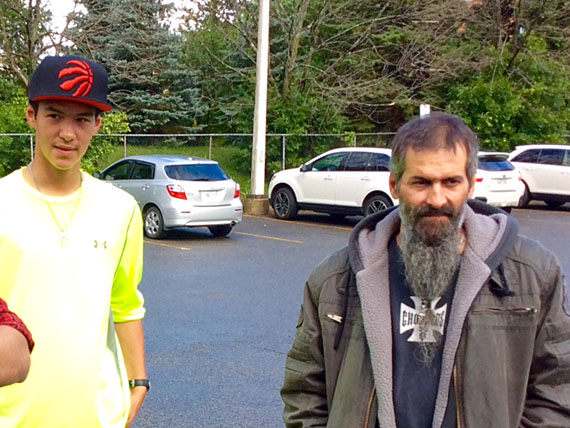
Camille Lavallée, a 14-year-old player on Team Nunavut’s bantam hockey team, with his late father, Claude Lavallée. (PHOTO COURTESY OF CAMILLE LAVALLEE)
The day when 14-year-old Camille Lavallée left Arctic Bay to join Team Nunavut’s hockey training camp in Iqaluit should have been one of the proudest days of his young life.
Instead, he learned his father had just passed away in Ottawa.
Hidden within the grief was a parting gift from his father: a challenge to keep going, no matter what.
“He must go on, he shouldn’t stop himself just because he lost his father,” Lavallée’s father, Claude, said from his hospital bed to daughter Roxanne Kigutaq.
In the week that passed, Lavallée found comfort in the sport of hockey.
“It was pretty hard trying to leave [for training camp]. I’m not going to let it get me down, so I’m just going to work hard,” Lavallée told Nunatsiaq News from his home in Arctic Bay.
Using an improvisational style developed from playing small-town hockey, Lavallee has grown into a multi-dimensional asset for Team Nunavut who is capable at both ends of the rink.
His natural talents as a hockey player, and “never say quit” attitude, rallied Nunavut’s bantam boys hockey team during the training camp.
For assistant coach Conor Fudge, Lavallée’s performance has been nothing short of spectacular.
“He’s always just that presence that the kids look too. When things go wrong, which they tend to do, you always need that steady presence. I think his maturity and his ability to stay focused, kids really feed of that,” he said.
Fudge lost his own father shortly before the Arctic Winter Games two years ago.
He said he would have understood if the distraction turned out to be too much for the teenager.

“He had to leave from Arctic Bay on his own, having that in the back of his mind. Its incredible what he had to have gone through that week.”
But Lavallée never asked for special treatment from the coaches or anyone else on the team.
Fudge and the rest of the coaching staff were amazed at how Lavallée adapted so quickly to their structured style of play , which is all but absent in the “shinny” style of hockey he’s used to in Arctic Bay.
With a population of 863, Arctic Bay hockey players usually stick to a loose five-on-five style of the game.
And no full-time coaches are available to teach the young players, who often shift between positions during a game.

Usually, said Lavallée, there isn’t even a goalie.
Talented players from remote communities often struggle when placed in a structured team environment, Fudge admitted.
“We’re asking a lot of all the players, especially Camille, and just the way he handled that, he never questioned anything. He bought into team play, he bought into our whole dynamic without even questioning it.”
Coaches first slotted Lavallée as a forward, but they quickly realized his instinctual ability better served the team on defense.
Again, Lavallee wouldn’t be deterred. He took the change in stride.
“It was fun,” admitted Lavallée, a Montreal Canadiens fan.
His favorite player is on-ice troublemaker and forward Brendan Gallagher.
Lavallee attended his father’s memorial service March 2, a day before he was scheduled to leave for Iqaluit.
“Our father was always busy,” said Roxanne, Lavallée’s sister.
Work at the mine kept Claude Lavallée from seeing much of his son’s on-ice performance.
But he knew the sport had a strong hold on Camille.
“He knew Camille was a good hockey player and he was proud of him. And we’re all proud of him,” she continued.
As the Arctic Winter Games ramps up in Iqaluit, Lavallée says his focus is on the team.
“I’m happy. I want my team to win,” he said.
“I’m trying to stay positive.”
Team Nunavut, as well as the other bantam boys hockey teams, will hit the ice at Iqaluit’s two rinks March 7.
The 2016 Arctic Winter Games hockey tournament will continue until March 11.
(0) Comments