


Western Nunavut project paves way for local fishery
Multi-million-dollar Genome Canada-funded project meshing traditional and genetic knowledge

Gjoa Haven harvesters, in early September 2017, show off the inReach satellite devices they will use to upload harvesting data from the land during a two-year harvester study Carleton University’s Stephan Schott is leading in the Kitikmeot community. (PHOTO BY STEPHAN SCHOTT)
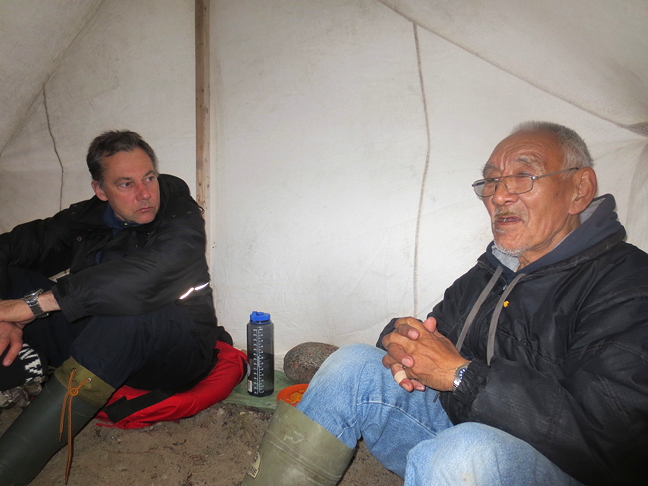
Carleton University professor Stephan Schott, left, and Simon Okpakok, interpreter and research collaborator, camping on the land with Okpakok’s family and others, in September 2016. (PHOTO COURTESY STEPHAN SCHOTT)
There are five different kinds of whitefish and cisco—two related species—which swim in the fresh waters near Gjoa Haven. But local elders seem to be familiar with only four of them.
It’s possible, says Stephen Schott, that the fifth species is a newcomer that has recently migrated into Arctic waters.
But that’s just a theory, and part of a host of information Schott and his team from Kingston Ont.’s Queen’s University are learning during a four-year fisheries project funded through Genome Canada.
The project, set to be completed in 2019, is using both traditional and western scientific knowledge to determine whether a commercial fishery is possible, and sustainable, in Gjoa Haven.

“We’re looking at [species] that are the most marketable and in demand,” Schott said Sept. 1, over the phone from Gjoa Haven during a recent visit to the western Nunavut community.
“Also, we need to know exactly, through genetic and traditional knowledge, how they are related. We don’t want to overharvest one type of fish. We need to know if they are mating and inter-mingling.”
With two summer field seasons under their belts, Schott says the project is progressing well. Based on numerous community meetings and consultations, it’s safe to say local people do want the jobs and plentiful country food that a local fishery could supply.
The project team has been looking at Cambridge Bay’s Kitikmeot Foods as an example; the company, which produces Arctic char and muskox, has been operating there since 1993.
But members of the project team need to figure out which species are abundant enough in the area to support a commercial fishery, what kinds of species are most desirable to eat, how to get the product to the community freezers and processing plant, and who the buyers would be.
Schott, a social scientist in a crew of biologists from Queen’s—where the Genome Canada investment is located—is responsible for ensuring traditional knowledge is sewn throughout this investigation and he says it’s been a real learning journey for all involved.

At a week-long traditional knowledge workshop in February 2016, local elders and hunters participated in a mapping exercise to show where people usually find various species including cod, shrimp, whitefish, lake trout and Arctic char and what they know about fish stocks and migration patterns.
Scientists on the team then used that information to conduct species sampling in summer 2016. They also did sampling through ice in December last year.
The biologists then extracted DNA and RNA from the samples to examine the species at a molecular level and to determine exactly what they are.
That’s the connection with Genome Canada, a federally-funded, not-for-profit organization that promotes genomics—the science of deciphering and understanding an organism’s genetic information, or DNA.
Genome Canada, which invests in projects that develop and use genomic-based technologies for economic and social benefit, is giving Schott’s team $5.6 million over four years to do its work.
Schott’s colleagues are hiring local guides to help them gather fish samples but also teaching them how to do the research, Schott said. But the learning goes both ways.
Schott’s team held a workshop this past May, when they showed photos of fish samples to elders, who identified what kind of fish they were and told them the Inuktitut names.
Researchers hope to compare that traditional knowledge with the genetic testing.
“So far we see a lot of overlap of the traditional identification and the DNA and morphological identification,” Schott said, from Gjoa Haven. “It seems to coincide quite a bit.”
When asked if he was surprised, Schott said no.
“I trust traditional knowledge,” he said. “I think it just means there’s a lot of experience in seeing these types of fish, and knowing how to differentiate these fish,” he said.
And thanks to relationships built up between northern hunters and southern academics, Schott has managed to secure more money from Polar Knowledge, the Government of Nunavut and in-kind donations from the Gjoa Haven HTA, to fund a separate, two-year harvesting study in Gjoa Haven.
In that side project, Schott wants to answer a number of questions including how harvesting meets the basic food needs of the community, who eats country food, when and what they eat, and how much it costs to get that food.
Participating harvesters are also using inReach satellite communicators to upload information about their trips on the land, such as what kinds of animals they saw, which ones they harvested and other observations, such as travel hazards.
That information gets uploaded to a Carleton University database in Ottawa and is then linked to an interactive atlas accessible to other community members.
Schott said that while the project is supposed to wrap in 2019, there is a possibility to extend it further, if there is still money left and work to be done.
(0) Comments