


Northern premiers stress adaptation to climate change
“Many changes are happening, so adaptation is one of our common positions.”
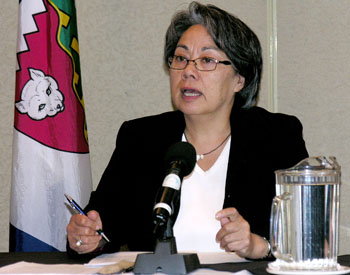
Eva Aariak, the Nunavut premier, played host to the premiers of Yukon and the Northwest Territories at their 2009 annual gathering, held Sept. 4-5 in Iqaluit. (PHOTO BY JIM BELL)
Canada’s three northern territories will need plenty of help in the future to cope with the effects of climate change, the three northern premiers said this past weekend in Iqaluit.
To that end, they’re focusing their policy work on adaptation to climate change, through a pan-territorial strategy they hope to unveil by the end of next year.
“When climate change became such an area of debate internationally, the one thing that was lacking in that discussion, not only at the national level, but also at the international level, was the issue of adaptation,” Dennis Fentie, the Yukon premier, told reporters in Iqaluit last week.
The premiers says in their communiqué that their proposed pan-territorial adaptation strategy would bring northern territorial governments together with aboriginal organizations, researchers and the federal government.
Fentie reeled off a long list of environmental hazards that are already attributable to climate change, such as invasive species, the melting of Arctic ice, receding glaciers, flooding, and melting permafrost.
“Many changes are happening, so adaptation is one of our common positions. We’ve been successful in injecting that into the national and international debate,” Fentie said.
At the same time, premiers had much less to say about what methods they favour for reducing the greenhouse gas emissions that cause global warming.
In a Sept. 5 communiqué, they did say they support “effective measures to reduce greenhouse gas emissions” and that they “discussed measures” aimed at doing that, but without providing any other details.
In 2008, the three northern premiers, which then included ex-Nunavut premier Paul Okalik, all rejected the idea of a national carbon tax.
But for now, they all say they’re happy about being included in the delegation that will represent Canada at the COP15 climate change talks in Copenhagen this December.
And they all say they want discuss climate change, and other issues, in a meeting they hope to arrange with Canadian aboriginal leaders who sit permanently with the Arctic Council.
“I’m very much looking forward to meeting with the aboriginal permanent participants of the Arctic Council,” Eva Aariak, the Nunavut premier, told reporters.

Floyd Roland, the Northwest Territories premier, warned that governments must find ways of coping with climate change that don’t do damage to the vulnerable economies of the three territories.
“When we’re trying to talk about developing our economies, the discussions and policies being formed can impact on just how we can move ahead with some of those economic development initiatives. When you look at the land we live in, accessiblity is difficult and the cost of doing business is difficult,” Roland said.
Related articles:
• Report: Arctic feedback loops will worsen climate change
• COP15 United Nations climate change conference, Dec. 7 – Dec. 18, 2009
(0) Comments