


Amundsen departs Iqaluit for research voyage
Icebreaker to sail 10 days through NW passage en route to Kugluktuk
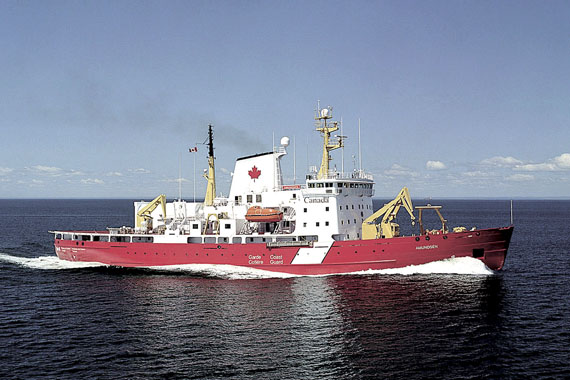
The Canadian Coast Guard icebreaker Amundsen was to have sailed out of Iqaluit Aug. 2 with more than 100 scientists, students and crew members for a 10-day research voyage through the Northwest Passage to Kugluktuk. (FILE PHOTO)
A voyage on a Canadian Coast Guard icebreaker like the Amundsen is a voyage like no other.
Hard hats and steel-toed boots are required for passengers on the 31-year-old vessel, named after the Norwegian explorer Roald Amundsen.
The Amundsen, decorated with the distinctive red and white hull of a Canadian Coast Guard icebreaker, sailed out of Iqaluit Aug. 2 for a 10-day research voyage up the coast of Baffin Island, through the Northwest Passage and on to Kugluktuk — its only scheduled port of call, with an arrival slated for Aug. 12.
And along for the ride on this 98-metre icebreaker — specially outfitted in 2002 with laboratories and other scientific equipment — are more than 80 researchers, students and crew.
But before any of these non-official passengers or “supernumerary personnel” can even step on board, they must apply and receive a federal security clearance.
And then they had to sign other forms, attesting to their medical fitness, as well a waiver that says they acknowledge the risks taken by stepping aboard.
This waiver underlines the fact that, even though climate change has made travelling through the Northwest Passage easier than it was in 1903 when Amundsen first attempted his transit, this trip through the High Arctic still carries with possible danger.
This is what passengers accept in the waiver annexed to the “familiarization” manual:
• Coast Guard ships are “dynamic platforms with violent movements” in every direction and even “livelier in heavy sea conditions” than other ships;
• Passengers must have a good sense of balance and be extremely aware of where they put their feet and hands and personal effects… “failure to do so can result in broken bones, lacerations, abrasions, burns, or, if the person is thrown overboard, drowning;”
• Anyone who suffers should start taking motion sickness medicine way before they get on board… “failure to control seasickness could result in dehydration, confusion, or the loss of situational awareness that could be a contributing factor in falls and inappropriate response to stimuli;”
• There is a possibility that drinking water may be rationed or become contaminated… water not used for drinking may contain “a level of salt or tank minerals, which can irritate the skin;”

• There is always the possibility of mechanical or system failures, causing “sudden electrical blackouts or temperature vagaries in the supply of domestic water… these situations also present a risk to individuals of disorientation… burns, scalds, and falls or knocks;”
• In the case of search and rescue, it is possible that passengers may be required to assist in caring for survivors, possibly exposing them to “unpleasant sights, smells, and sounds, which might include exposure to bodily fluids from victims. There is a risk of exposure to disease;”
• In the event of medical emergencies or injuries at sea, things can get touchy… “it is possible that the time taken to evacuate the patient may be measured in days. The condition of the patient may be adversely affected by this time factor;” and
• Evacuation by helicopter can carry risks and chills: “where the patient is winched upwards to the helicopter in a stretcher or horse collar is a terrifying experience, especially when combined with rough sea conditions, darkness, and an already heightened apprehension of mortality on the part of the patient.”
Once on board passengers are drilled to “stop and think” so they can walk on the decks without getting their heads bashed cable wires. During a safety exercise everyone learns how to put on yellow survival suits— just in case they hear seven short blasts followed by one long blast, which means it’s time to abandon ship.
The Amundsen left Quebec City on July 1 and sailed towards Hudson Bay, entering Hudson Strait around July 7.
From then until August 2, the Amundsen conducted sampling and mapping in the Hudson Strait, Foxe Basin and Hudson Bay where it looked at the seawater, seabed sediments and microscopic underwater life.
Research on board the Amundsen falls under ArcticNet, a group based at Quebec City’s Laval university, which brings together climate change researchers with Inuit organizations, northern communities, federal and provincial agencies and the private sector on climate change-related issues.
The Amundsen’s made two research voyages in 2007 and 2008 that brought the vessel into contact with thousands of Inuit living in Nunavut, Labrador and the Northwest Territories, when health workers conducted the Qanuippitali health survey.
In 2004, the Amundsen was used for the Qanuippitaa health survey in Nunavik, whose results were released in 2008.
Follow the stories of Nunatsiaq News reporter Jane George, who will be aboard the Amundsen from August 2 to 12 on www.nunatsiaqonline.ca.
(0) Comments